
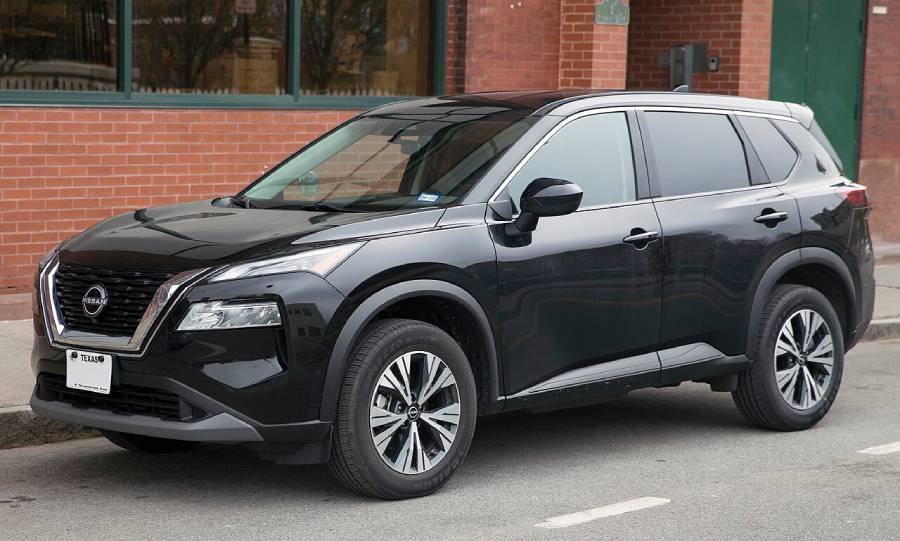
The Nissan Rogue is a two-row compact SUV designed to balance exterior size with passenger and cargo space. Its overall dimensions determine more than how large the vehicle looks: length and width affect parking and garage fit, wheelbase influences the space available between the axles, and interior measurements determine how much room front- and rear-seat passengers have.
Nissan Rogue dimensions include five key exterior measurements—length, width, height, wheelbase, and ground clearance—along with cabin measurements such as headroom, legroom, shoulder room, and hip room. Cargo capacity adds another practical dimension by showing how much storage space is available behind the second row and how that space increases when the rear seats are folded.
The exact measurements depend on the Nissan Rogue model year and, for certain specifications, the trim or vehicle configuration. This guide covers the Rogue’s exterior dimensions, interior passenger measurements, seating capacity, and cargo space before explaining how its size relates to garage fit and other compact SUVs. Each specification is identified by model year where necessary so measurements from different Rogue generations are not treated as interchangeable.
What Are the Nissan Rogue Dimensions?
The 2026.5 Nissan Rogue is 183 inches long, 72.4 inches wide, and 66.5 inches tall, with 8.2 inches of ground clearance. These measurements apply across the S, SV, and SL trims listed by Nissan, giving the Rogue a consistent basic exterior footprint regardless of which of these trim levels you choose.
| Measurement | 2026.5 Nissan Rogue |
|---|---|
| Overall length | 183 in |
| Overall width | 72.4 in |
| Overall height | 66.5 in |
| Ground clearance | 8.2 in |
| Turning diameter | 35.4 ft |
At 183 inches long, the Rogue measures 15.25 feet from front to rear. Its 72.4-inch body width equals just over 6 feet, while its 66.5-inch height equals approximately 5.54 feet. These three measurements establish the vehicle’s basic footprint and are the most relevant exterior dimensions when checking parking or garage space.
Ground clearance measures 8.2 inches, creating space between the lowest part of the vehicle and the road surface. Nissan also lists a 35.4-foot turning diameter. Although turning diameter is not a body dimension, it provides additional context for the amount of space the Rogue requires when making a turn or maneuvering in confined areas.
What Are the Nissan Rogue Exterior Dimensions?
The Nissan Rogue exterior measures 183 inches in length, 72.4 inches in body width, and 66.5 inches in height. These dimensions describe the space occupied by the vehicle’s body and help determine whether the Rogue can fit into a garage, parking space, or other restricted area.
The 183-inch overall length makes the Rogue approximately 15 feet 3 inches long. Vehicle length is particularly relevant when measuring garage depth because the available space must accommodate the entire vehicle plus clearance in front and behind it. The same measurement affects parallel parking because the parking space needs to be longer than the vehicle itself to provide room for entry and exit.
The Rogue has an exterior body width of 72.4 inches, or approximately 6 feet. Nissan identifies this figure as exterior body width, so it should not automatically be treated as the vehicle’s total width with the side mirrors extended. Garage openings and other narrow spaces should therefore be checked against the full mirror-to-mirror width when that measurement is available rather than relying only on body width.
The 66.5-inch exterior height equals approximately 5 feet 6.5 inches. Height matters when entering garages and other structures with restricted overhead clearance. Roof-mounted accessories can increase the effective height beyond the standard vehicle specification, so those accessories need to be measured separately when clearance is limited.
The Rogue also provides 8.2 inches of ground clearance. Ground clearance measures the vertical distance between the road surface and the vehicle’s lowest specified point. This measurement helps indicate how much clearance the vehicle has when passing over raised driveways, uneven surfaces, and similar obstacles.
Taken together, the Rogue’s length, width, height, and ground clearance provide a more useful picture of exterior size than any single measurement. Length and width define most of its parking footprint, height determines overhead clearance, and ground clearance describes the space underneath the vehicle.
What Are the Nissan Rogue Interior Dimensions?
The Nissan Rogue provides 41.5 inches of front legroom and 38.5 inches of rear legroom, giving both rows dedicated passenger space within its two-row cabin. Interior dimensions also include headroom, shoulder room, and hip room, although some measurements can vary with equipment such as a panoramic moonroof.
| Interior Measurement | Front Row | Second Row |
|---|---|---|
| Legroom | 41.5 in | 38.5 in |
| Seating rows | 1st row | 2nd row |
| Seating capacity | Up to 5 passengers total |
Legroom measures the longitudinal space available for occupants’ legs. The 2026.5 Rogue provides 41.5 inches of front legroom and 38.5 inches of rear legroom according to Nissan’s current specifications. The 3-inch difference gives the front row more leg space while retaining substantial room for passengers in the second row.
Headroom measures the vertical space available between the seat and roof. This measurement is particularly relevant for taller occupants because additional equipment can change the available vertical cabin space. A panoramic moonroof, for example, requires components within the roof structure and can affect both headroom and total passenger volume. For this reason, headroom should be compared using the same Rogue trim and roof configuration rather than treating one figure as universal across every version.
Shoulder room measures cabin width around the occupants’ upper bodies, while hip room measures usable width closer to the seat cushion. These measurements answer a different question from legroom: legroom indicates front-to-back space, whereas shoulder and hip room help describe how much lateral space passengers have when sitting beside one another.
Cabin volume also changes according to configuration. Nissan lists 105.4 cubic feet of interior passenger volume without a moonroof for applicable 2026 Rogue configurations, compared with 100.4 cubic feet with a moonroof on applicable trims. The difference is 5 cubic feet, demonstrating why equipment needs to be considered when comparing Rogue interior-space specifications.
How Many Passengers Can the Nissan Rogue Seat?
The Nissan Rogue seats up to five people across two rows. The layout consists of two front seating positions and a second-row bench that accommodates up to three passengers, making the standard Rogue a five-passenger compact SUV rather than a three-row vehicle.
Passenger capacity alone does not indicate how much space each occupant receives. The Rogue’s 41.5 inches of front legroom and 38.5 inches of rear legroom provide a more useful measurement of front-to-back passenger space. The rear figure is especially relevant when evaluating the vehicle for families or adults who regularly use the second row.
The second row uses a 60/40 split-folding design, allowing passenger seating and cargo space to be adjusted independently. One portion of the rear seat can be folded for longer cargo while the remaining portion stays available for passengers, or both sections can be folded when maximum cargo room is required.
The five-passenger capacity therefore works together with the Rogue’s interior dimensions rather than functioning as a standalone specification. Seating capacity establishes how many occupants the vehicle is designed to carry, while legroom, passenger volume, and seat configuration describe how the available cabin space is distributed between those occupants and their cargo.
How Much Cargo Space Does the Nissan Rogue Have?
The 2026.5 Nissan Rogue provides up to 36.5 cubic feet of cargo space behind the second row and up to 74.1 cubic feet with the rear seats folded. The exact capacity depends on the interior configuration, including whether the vehicle has a moonroof.
| Cargo Configuration | Cargo Capacity |
|---|---|
| Rear seats upright, without moonroof | 36.5 cu ft |
| Rear seats upright, with moonroof | 36.3 cu ft |
| Rear seats folded | Up to 74.1 cu ft |
With the second-row seats upright, Rogue models without a moonroof provide a maximum of 36.5 cubic feet of cargo capacity. Applicable configurations with a moonroof provide 36.3 cubic feet, a difference of 0.2 cubic feet. This configuration retains all five seating positions while keeping the rear cargo area available for groceries, luggage, sports equipment, and other everyday items.
Folding the second row increases maximum cargo capacity to 74.1 cubic feet. The expanded configuration provides approximately twice the cargo volume available behind the upright rear seats, making it more suitable for larger items that require both the standard cargo compartment and the space normally occupied by second-row passengers.
The Rogue’s 60/40 split-folding rear seat also allows the passenger and cargo areas to be configured separately. Drivers can fold one section for longer items while retaining part of the second row for a passenger. Folding both sections prioritizes cargo capacity instead.
An available Divide-N-Hide cargo system provides another way to organize the rear storage area. Nissan states that the system supports six cargo configurations, allowing the cargo floor to be arranged for different storage requirements. This feature changes how the available space can be organized rather than increasing the vehicle’s exterior dimensions.
What Are the Nissan Rogue Cargo Area Dimensions?
Nissan publishes cargo volume for the 2026.5 Rogue, but its current consumer specifications do not provide a complete set of cargo-area length, width, and height measurements. Cargo volume and cargo dimensions should therefore be treated as separate specifications.
Cargo volume is measured in cubic feet and describes the total amount of storage volume available. Cargo dimensions describe physical distances such as the length of the load floor, width between specific points, or vertical height of the cargo opening. A vehicle with 36.5 cubic feet of cargo volume cannot be assumed to have specific cargo-area dimensions based on that volume alone because wheel wells, seatbacks, interior trim, and the shape of the roof affect the usable space.
For the 2026.5 Rogue, the manufacturer-supported figures are up to 36.5 cubic feet behind the second row and up to 74.1 cubic feet with the second row folded. Buyers who need to transport an item with fixed dimensions, such as a bicycle, furniture box, pet crate, or large suitcase, should measure the actual cargo opening and usable load-floor dimensions of the specific vehicle rather than converting cargo volume into estimated linear measurements.
This distinction is important when evaluating practical cargo space. Cubic-foot capacity is useful for comparing overall storage volume between SUVs, while cargo length, width, and height determine whether a specific object can physically pass through the opening and fit inside the vehicle.
Will a Nissan Rogue Fit in a Standard Garage?
A Nissan Rogue can fit in many residential garages, but the garage must provide more space than the vehicle’s 183-inch length, 72.4-inch body width, and 66.5-inch height. The exterior dimensions establish the minimum physical footprint; additional clearance is required to open the doors, walk around the vehicle, and close the garage door safely.
The Rogue measures 15 feet 3 inches long, so garage depth is the first measurement to check. A garage must accommodate the vehicle itself plus clearance at the front and rear. Using a garage’s total interior depth without accounting for shelving, tools, storage cabinets, or other objects can overstate the amount of usable parking space.
Width requires similar consideration. The Rogue’s 72.4-inch specification represents exterior body width, not necessarily the maximum distance between the outer edges of the side mirrors. A garage opening that is only slightly wider than 72.4 inches would therefore be insufficient for practical use. Measure the narrowest point of the garage entrance and compare it with the vehicle’s full width, including mirrors, before determining whether the Rogue will fit.
Vehicle height presents less of a constraint in many garages, but it still needs to be checked. The standard Rogue stands 66.5 inches, or approximately 5 feet 6.5 inches, tall. Roof racks, crossbars, cargo boxes, and other roof-mounted accessories can increase the actual clearance requirement beyond the factory body-height specification.
The safest approach is to compare the specific garage with the specific Rogue rather than relying on the label “standard garage.” Measure the garage opening width, usable interior depth, and lowest overhead obstruction. These three measurements determine whether the Rogue physically fits, while additional side clearance determines whether occupants can comfortably enter and exit after parking.
Is the Nissan Rogue Bigger Than Other Compact SUVs?
The Nissan Rogue is similar in overall size to major compact SUVs such as the Toyota RAV4 and Honda CR-V, but each model distributes its exterior and interior space differently. The Rogue is longer than a standard 2026 Toyota RAV4 but shorter than the Honda CR-V dimensions used for comparison.
| SUV | Length | Width | Height | Wheelbase |
|---|---|---|---|---|
| Nissan Rogue | 183.0 in | 72.4 in | 66.5 in | 106.5 in |
| Toyota RAV4 | 181.0 in | 73.0 in | 66.7 in* | 105.9 in |
| Honda CR-V | 184.8 in | 73.5 in | 66.2 in | 106.3 in |
*RAV4 dimensions can vary by grade and configuration.
At 183 inches long, the Rogue is 2 inches longer than the 181-inch standard 2026 RAV4 configuration. The Rogue is also 0.6 inch narrower based on the published body-width figures. The RAV4 has a 105.9-inch wheelbase compared with the Rogue’s 106.5 inches, giving the Rogue an additional 0.6 inch between the front and rear axles.
The Honda CR-V is slightly larger in exterior footprint based on the comparison specifications. At approximately 184.8 inches long and 73.5 inches wide, it is about 1.8 inches longer and 1.1 inches wider than the Rogue. These differences are measurable but small enough that all three vehicles remain closely grouped in overall compact-SUV size.
Exterior size does not determine cargo capacity by itself. Body shape, seat position, wheel wells, roofline, and interior packaging affect how much usable space fits within an SUV’s exterior footprint. For this reason, length or width should not be used alone to conclude that one compact SUV provides more passenger or cargo room than another.
The comparison instead shows where the Rogue sits within the segment: it occupies a footprint between the RAV4 and CR-V in overall length while remaining slightly narrower than both comparison vehicles. Buyers concerned about garage fit should compare exterior measurements, while buyers prioritizing passenger or luggage space should compare interior and cargo specifications separately.
Read more: Nissan Rogue Gas Type: Fuel Requirement Explained
Do Nissan Rogue Dimensions Change by Model Year?
Nissan Rogue dimensions change between model years when Nissan introduces a new generation or substantially revises the vehicle, so dimensions from an older Rogue should not automatically be applied to a current model. The 2026.5 Rogue covered in this guide measures 183 inches long, 72.4 inches wide, and 66.5 inches tall.
The difference becomes clear when comparing the current Rogue with an older generation. The 2020 Nissan Rogue measured 184.5 inches long and 72.4 inches wide, with a height of 68.0 inches for front-wheel-drive models and 68.5 inches for all-wheel-drive models. Its wheelbase measured 106.5 inches. The current 2026.5 Rogue is therefore 1.5 inches shorter than the 2020 model based on Nissan’s published overall-length specifications.
Changes are not limited to exterior measurements. A redesigned vehicle can redistribute space between the passenger compartment and cargo area even when its exterior footprint changes only slightly. Interior legroom, passenger volume, cargo capacity, and seating configuration should therefore be checked for the specific model year rather than inferred from exterior length or width.
Trim and equipment can also affect individual specifications within the same model year. For example, current Rogue cargo volume varies between some configurations even though Nissan lists the same 183-inch length, 72.4-inch width, and 66.5-inch height across the regular 2026.5 Rogue trims. Equipment differences can consequently matter even when the basic exterior footprint remains unchanged.
The Rogue Plug-in Hybrid should also be treated as a separate vehicle configuration when comparing dimensions. Nissan lists the 2026 Rogue Plug-in Hybrid at 185.4 inches long, 75.3 inches wide, and 68.5 inches tall, which differs substantially from the regular 2026.5 Rogue dimensions used throughout this guide.
For accurate measurements, first identify the Rogue’s model year and powertrain, then check the applicable trim and equipment. This prevents specifications from different Rogue generations or configurations from being combined into a single set of dimensions.
What Should You Measure Before Buying a Nissan Rogue?
Measure four areas before buying a Nissan Rogue for a space-sensitive use case: garage width, garage depth, overhead clearance, and the dimensions of large cargo items you expect to carry. Comparing these measurements with the vehicle specifications provides a more reliable fit assessment than relying on SUV size classifications alone.
Start with the garage opening and usable interior width. The 2026.5 Rogue has a published body width of 72.4 inches, but body width should not be treated as the complete space required for parking. Side mirrors and the clearance required to open the doors increase the practical width requirement. Measure the narrowest point of the garage entrance as well as the usable space around the parked vehicle.
Next, measure usable garage depth and compare it with the Rogue’s 183-inch, or 15-foot-3-inch, overall length. Exclude space occupied by shelves, cabinets, bicycles, tools, water heaters, or other permanent storage. Additional clearance at the front and rear makes it easier to walk around the vehicle and close the garage door without contact.
Check overhead clearance against the Rogue’s 66.5-inch body height. The lowest obstruction matters more than the garage’s maximum ceiling height. Garage-door components, lighting fixtures, roof racks, crossbars, and cargo boxes can reduce the available clearance or increase the vehicle’s effective height.
Finally, measure large items that need to enter the cargo area. The Rogue provides up to 36.5 cubic feet of cargo volume behind the second row and up to 74.1 cubic feet with the rear seats folded, but cubic-foot capacity does not confirm that an object with fixed length, width, and height will fit. Measure items such as pet crates, bicycles, large boxes, or mobility equipment and compare them with the actual cargo opening and usable load area of the specific Rogue.
These measurements connect the Rogue’s published dimensions with real-world use. Exterior dimensions determine whether the vehicle fits the available parking space, while actual cargo-area measurements determine whether specific objects fit inside it.