
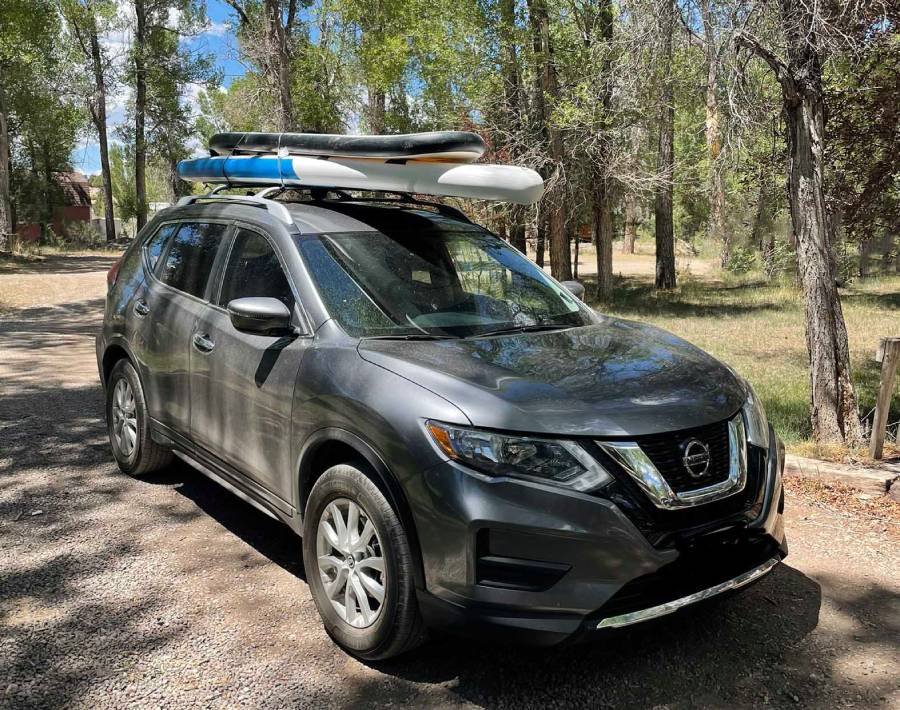
The Nissan Rogue roof rack weight limit depends on the model year, roof configuration, and the roof rack or crossbar system installed on the vehicle. The safest usable limit is not automatically the highest weight rating printed on a rack or cargo carrier. Drivers need to check the applicable Nissan specification and the limits of each load-bearing component before placing cargo on the roof.
Roof capacity also differs from cargo capacity. The complete roof-loading system can include the vehicle roof, factory roof rails, crossbars, mounting hardware, and a carrier such as a cargo box, bike rack, or kayak carrier. Each component can have its own rating, and the lowest applicable limit can restrict how much weight the complete system should carry. Accessory weight may also reduce the capacity available for the cargo itself.
This guide explains the Nissan Rogue roof rack weight limit by model year and shows how roof rails, crossbars, dynamic and static loads, and aftermarket racks affect usable capacity. It also explains how to calculate roof loads for luggage, kayaks, bicycles, cargo boxes, and rooftop tents without confusing accessory ratings with the vehicle’s actual roof-loading limits.
What Is the Nissan Rogue Roof Rack Weight Limit?
The Nissan Rogue roof rack weight limit must be determined from the specification for the exact model year and the roof rack system installed on the vehicle. A single maximum weight should not be applied to every Nissan Rogue because the Rogue has been produced across multiple generations with different roof configurations, factory accessories, and crossbar systems. The vehicle-specific Nissan documentation should therefore establish the starting limit before cargo is loaded.
The roof rack’s advertised capacity is also not necessarily the amount of cargo that can be placed on top of the Rogue. A complete roof-carrying setup can involve the vehicle roof, longitudinal roof rails, crossbars, mounting hardware, and a cargo carrier. For example, adding a cargo box creates another component with its own weight and load rating. The usable cargo capacity must account for the applicable limits of the components supporting that box rather than relying only on the cargo box’s advertised capacity.
The lowest applicable weight rating in the roof-carrying system should be treated as the limiting factor. For example, installing aftermarket crossbars rated for more weight than the Nissan-approved roof load does not automatically increase the amount of weight the vehicle can safely carry. Conversely, crossbars with a lower rating can reduce the usable capacity even when the vehicle itself permits a higher roof load.
Drivers should also distinguish the roof rack weight limit from the Nissan Rogue’s overall payload capacity. Payload concerns the weight carried by the vehicle, including relevant occupants and cargo, while the roof rack limit specifically constrains the load supported by the roof-carrying system. Roof cargo contributes weight to the vehicle, so staying below the rack limit does not remove the need to remain within other applicable vehicle weight limits.
The exact number should therefore be verified for the specific Nissan Rogue before loading the roof. The next section compares the relevant limits by model year instead of assuming that one specification applies to every Rogue produced since 2008.
What Is the Nissan Rogue Roof Rack Weight Limit by Model Year?
The Nissan Rogue roof rack weight limit should be checked by model year because Nissan’s roof equipment and applicable specifications can differ between generations and configurations. The Rogue has been sold since the 2008 model year, so a specification associated with a newer Rogue should not automatically be applied to a 2008–2013 or 2014–2020 vehicle.
For a model-year comparison to be reliable, each figure needs to be matched to Nissan documentation for that specific vehicle and roof system. The materials provided for this article do not contain Nissan’s official model-year roof-load specifications, so inserting numerical limits here would require unsupported assumptions. The final model-year table should be populated only after the relevant Nissan owner’s manuals, accessory instructions, or other official technical documentation have been verified.
| Nissan Rogue model year | Roof rack weight limit | Roof configuration | Verification |
|---|---|---|---|
| 2021–present | Verify by model year | Factory or compatible roof system | Nissan documentation |
| 2014–2020 | Verify by model year | Factory or compatible roof system | Nissan documentation |
| 2008–2013 | Verify by model year | Factory or compatible roof system | Nissan documentation |
The 2021–present Nissan Rogue belongs to a different vehicle generation from the 2014–2020 Rogue, while 2008–2013 models belong to the first generation covered by this guide. Generation grouping is useful for organizing the specifications, but it should not replace model-year verification. A change in crossbars, roof rails, mounting hardware, trim availability, or accessory instructions can affect which limit applies.
Roof configuration matters within the same model year as well. A Rogue equipped with factory roof rails is not automatically carrying cargo directly on those rails. Crossbars or another approved mounting system may be required, and that equipment introduces additional specifications that need to be considered. An aftermarket rack can introduce a different rating again.
For this reason, the correct model-year figure should answer more than “How much can the roof rack hold?” It should identify which Nissan Rogue, which roof configuration, and which rack system the number describes. This prevents a crossbar rating, accessory rating, or specification from another model year from being presented incorrectly as the universal Nissan Rogue roof rack weight limit.
Are the Nissan Rogue Roof, Roof Rails, and Crossbars Rated for the Same Weight?
The Nissan Rogue roof, roof rails, and crossbars should not be assumed to have the same weight rating. These components perform different functions within the roof-carrying system, and the applicable load limit depends on how the cargo is mounted. A weight rating for one component does not automatically establish the capacity of every other component connected to it.
The vehicle roof provides the structural base for the system. Roof rails run longitudinally along the vehicle and provide mounting points for compatible equipment, while crossbars span the width of the roof and create the platform used by cargo boxes, bike racks, kayak carriers, and similar accessories. A Nissan Rogue equipped with roof rails therefore does not necessarily have a complete cargo-carrying setup until compatible crossbars or another approved carrier system is installed.
The lowest applicable rating in the load path determines how much the complete setup can carry. The relevant load path can be represented as Nissan Rogue roof → roof rails or mounting points → crossbars → carrier → cargo. If one component has a lower permitted load than the others, adding components with higher ratings does not remove that restriction.
For example, assume a hypothetical roof system permits 165 lb while a set of crossbars is rated for 150 lb. The 165-lb figure cannot be used as the crossbar system’s carrying capacity because the crossbars introduce a lower 150-lb constraint. If a cargo carrier installed on those crossbars has an even lower rating, that carrier creates another restriction. These figures are examples of the calculation method rather than specifications for the Nissan Rogue.
This distinction is particularly important with aftermarket equipment. A manufacturer may advertise a high load capacity for its crossbars or rack, but that number describes the product under specified installation and operating conditions. It does not automatically override the vehicle manufacturer’s roof-load restrictions. Drivers should compare the applicable Nissan specification with every installed component’s rating and follow the lowest relevant limit.
How Do You Calculate the Safe Roof Rack Load on a Nissan Rogue?
Calculate the usable Nissan Rogue roof cargo capacity by identifying the applicable load limit and subtracting the weight of equipment that counts toward that limit. The calculation must include relevant components between the roof and the cargo rather than treating the weight of the luggage, kayak, or bicycle as the only load.
A practical calculation can be expressed as:
Available cargo capacity = applicable roof/rack load limit − applicable carrying-equipment weight
Carrying equipment can include crossbars, a cargo box, roof basket, kayak carrier, or bicycle carrier, depending on how the manufacturer defines its load rating. This distinction matters because an accessory consumes part of the available capacity when its own weight is included in the load applied to the rated system.
For example, consider a hypothetical setup with an applicable 150-lb limit. If the cargo box and other equipment counted against that limit weigh 40 lb combined, no more than 110 lb remains under that particular limit for cargo. Loading 150 lb of luggage into the box would create 190 lb of total load in this example, exceeding the 150-lb limit by 40 lb. These numbers demonstrate the calculation and are not Nissan Rogue specifications.
The same method applies to recreational equipment. A kayak setup requires the combined applicable weight of the kayak and its carrier to be considered. A bicycle setup requires the carrier plus the bicycles. A cargo-box setup requires the box plus the luggage inside it. The capacity printed on the cargo accessory should not be confused with the amount the Nissan Rogue is permitted to support.
Multiple weight restrictions can also apply simultaneously. Suppose a hypothetical vehicle limit is 165 lb, its installed crossbars are rated for 150 lb, and its cargo box is rated to carry 165 lb of contents. The 165-lb cargo-box rating does not permit 165 lb of luggage because the 150-lb crossbar rating is already lower. The weight of the box itself may further reduce the amount available for luggage, depending on how the applicable ratings are defined.
Drivers should therefore calculate roof cargo only after identifying four pieces of information: the Nissan Rogue’s applicable roof specification, the crossbar or rack rating, the carrier rating, and the weight of the installed equipment and cargo. This method prevents a high accessory rating from being mistaken for the safe carrying capacity of the complete roof system.
What Is the Difference Between Dynamic and Static Roof Load on a Nissan Rogue?
Dynamic roof load is the load carried while the Nissan Rogue is moving, while static roof load refers to the load supported while the vehicle is stationary. The two conditions are different because cargo on a moving vehicle is subjected to forces that do not exist at the same level when the vehicle is parked.
Dynamic loading changes during acceleration, braking, cornering, and travel over uneven roads. Roof-mounted cargo also raises the vehicle’s center of gravity. As the Rogue changes direction or speed, the roof rack, crossbars, mounting points, and cargo restraints must manage forces created by both the cargo’s mass and vehicle movement. This is why a roof-load specification intended for driving should not automatically be treated as a static-load specification.
Static loading becomes particularly relevant when considering equipment such as a rooftop tent. Once the vehicle is parked, the roof system may need to support the tent and its occupants rather than only the tent’s transport weight. However, a higher static roof capacity should not be assumed unless Nissan and the manufacturers of the installed rack components provide specifications that support it. Multiplying a dynamic rating by an arbitrary factor does not establish a safe static capacity.
For example, a rooftop tent may be light enough to fall below a rack’s dynamic rating while being transported. When two adults enter the tent after the vehicle is parked, the total stationary load becomes substantially higher. Whether that configuration is acceptable depends on the vehicle, mounting system, crossbars, and tent requirements. The dynamic rating alone cannot answer that question.
Nissan Rogue owners should therefore identify what type of load a published rating describes before using it. A specification for cargo carried while driving answers a different question from the amount a stationary roof system can support. This distinction becomes essential when evaluating rooftop tents but is less complicated for conventional cargo such as luggage, bicycles, and kayaks that is removed rather than occupied while the vehicle is parked.
How Much Kayak, Bike, or Cargo Weight Can a Nissan Rogue Carry on the Roof?
The amount of kayak, bicycle, or luggage weight a Nissan Rogue can carry depends on the remaining capacity after the applicable rack and carrier weights are considered. There is no universal number of kayaks, bikes, or pounds of luggage that applies to every Rogue because equipment weight and component ratings vary between setups.
The correct approach is to calculate the complete load for the intended cargo. A kayak setup can include a kayak carrier and the kayak itself. A bicycle setup can include one or more bike carriers plus the bicycles. A cargo-box setup includes the box and the items placed inside it. Each complete load must remain within every applicable restriction established for the vehicle and carrying system.
Can You Carry a Kayak on a Nissan Rogue Roof Rack?
A Nissan Rogue can carry a kayak when the vehicle’s approved roof system is compatible with a kayak carrier and the complete load remains within the applicable weight limits. The calculation should account for the kayak and the equipment used to mount it rather than checking the kayak’s weight alone.
For example, a hypothetical 45-lb kayak installed with a 15-lb carrier creates 60 lb of combined load before other applicable roof equipment is considered. Adding a second identical kayak and carrier would add another 60 lb. Whether one or two kayaks are acceptable depends on the specific Rogue’s applicable limit, crossbar rating, carrier specifications, available mounting space, and installation requirements.
Weight is therefore only one constraint. The kayak carrier must also fit the installed crossbars, and the cargo must be positioned and secured according to the equipment manufacturer’s instructions. A lightweight kayak does not make an incompatible mounting system safe.
How Many Bikes Can a Nissan Rogue Roof Rack Carry?
The number of bikes a Nissan Rogue can carry on its roof is determined by their combined weight, the bike carriers, the rack system, and the available mounting space. Counting bicycles without calculating their weight can produce an inaccurate answer because bicycle weights differ substantially between models.
For example, two hypothetical 30-lb bicycles weigh 60 lb. If two roof-mounted bicycle carriers add 15 lb each, the bicycles and carriers create 90 lb of combined load. Two heavier bicycles using heavier carriers could produce a substantially larger load even though the number of bicycles remains the same.
The carrier manufacturer may also specify how many bicycles can be mounted and the maximum bicycle weight supported by each carrier. Nissan Rogue owners must therefore satisfy both vehicle-related restrictions and accessory-specific restrictions. Staying below one rating does not permit the user to exceed another.
How Much Luggage Can You Put in a Nissan Rogue Roof Cargo Box?
The luggage capacity of a Nissan Rogue roof cargo box is limited by the lowest applicable rating after the weight of the cargo box and other relevant equipment is considered. The maximum load advertised for the cargo box itself should not be treated automatically as the Rogue’s available roof-cargo capacity.
For example, assume a hypothetical applicable system limit of 150 lb and a cargo box that contributes 40 lb toward that load. The remaining capacity under that particular limit would be 110 lb before any additional applicable equipment is considered. Even if the cargo box manufacturer states that the box can hold more than 110 lb of contents, the higher box rating would not override the lower system constraint.
Luggage should also be distributed according to the vehicle and rack manufacturer’s instructions rather than concentrated at one point. Dense items can add substantial roof weight despite occupying little space. A full cargo box is therefore not necessarily an overloaded cargo box, while a partially filled box can still exceed a weight restriction if it contains sufficiently heavy items.
For kayaks, bicycles, and luggage, the same principle applies: calculate weight from the complete carrying setup and compare it with every applicable limit before driving. This provides a more reliable answer than estimating capacity from cargo size, accessory volume, or the number of items alone.
Can You Put a Rooftop Tent on a Nissan Rogue?
A rooftop tent should only be installed on a Nissan Rogue when the vehicle, roof rack, crossbars, mounting system, and tent are explicitly compatible with the complete setup. Staying below a published roof rack weight limit does not by itself confirm that a rooftop tent is suitable for the vehicle.
A rooftop tent creates two different loading conditions. During travel, the roof system supports the tent while the Rogue accelerates, brakes, turns, and travels over uneven surfaces. This is the dynamic load. After the vehicle is parked and occupants enter the tent, the roof system supports the tent, mounting hardware, and occupants as a static load. The second condition can place substantially more total weight on the system than transporting the tent alone.
For example, consider a hypothetical 120-lb rooftop tent. Its transport weight might appear acceptable when compared with a roof rack rating above 120 lb. That comparison is incomplete because the weight of applicable mounting equipment must also be considered. When the vehicle is stationary, two 170-lb occupants would add another 340 lb to the setup. The resulting load condition cannot be evaluated safely from the tent’s 120-lb transport weight alone.
Do not calculate the Nissan Rogue’s static roof capacity by multiplying its dynamic roof-load rating. Ratios such as “the static capacity is three times the dynamic capacity” should not be treated as a Nissan specification unless they are explicitly supported by documentation for the vehicle and installed equipment. Roof design, mounting points, crossbars, load distribution, and rack construction all affect the complete system.
Rooftop tent compatibility should therefore be verified through documentation for the exact Nissan Rogue model year and every installed component. The tent manufacturer may also specify required crossbar spacing, minimum crossbar capacity, acceptable mounting dimensions, or vehicle restrictions. A setup that fails one of these requirements should not be considered compatible merely because its total transport weight is below another component’s rating.
The source materials supplied for this article do not contain Nissan documentation confirming rooftop tent compatibility or model-specific static roof capacities. For that reason, a universal claim that every Nissan Rogue can support a rooftop tent would not be supported by the available evidence.
Does an Aftermarket Roof Rack Change the Nissan Rogue Weight Limit?
Installing an aftermarket roof rack does not automatically increase the Nissan Rogue’s vehicle-specific roof weight limit. An aftermarket manufacturer can establish a load rating for its own rack, crossbars, feet, or mounting hardware, but that product rating does not replace a lower restriction imposed by the vehicle or another component in the carrying system.
The usable limit is determined by the applicable constraints across the complete load path. These can include the Nissan Rogue’s roof or mounting specification, the aftermarket rack, crossbars, mounting hardware, and the carrier attached above them. The component with the lowest applicable rating prevents a higher-rated component from increasing the capacity of the complete setup.
Consider a hypothetical example in which the vehicle permits a 150-lb load under the applicable conditions while an aftermarket rack is rated for 200 lb. Installing the 200-lb rack does not create a 200-lb vehicle roof capacity; the lower 150-lb vehicle restriction remains applicable. If the situation is reversed and the vehicle permits 150 lb while the installed rack is rated for only 120 lb, the 120-lb rack becomes the lower constraint. These figures illustrate the relationship between ratings and are not Nissan Rogue specifications.
Aftermarket equipment can also change how cargo is mounted without changing how much weight the vehicle itself is designed to support. Different systems use raised rails, fixed mounting points, door-frame attachment points, or other mounting methods. Compatibility therefore requires more than matching the rack’s width to the Rogue’s roof. The rack manufacturer should list the specific Nissan Rogue model year and configuration as compatible with the mounting system.
Accessory ratings require the same distinction. A cargo basket rated for 150 lb, for example, does not establish a 150-lb Nissan Rogue roof capacity. A bike rack capable of supporting several bicycles does not establish that the vehicle and crossbars can support the combined weight. Each product specification describes its own constraint within the complete system.
Use the lowest applicable rating rather than the highest advertised rating when evaluating an aftermarket setup. Nissan documentation should establish the vehicle-specific restriction, while the aftermarket manufacturer’s documentation establishes the restrictions for the added equipment. Comparing both sets of specifications prevents a high rack rating from being incorrectly interpreted as an increase in the Nissan Rogue’s roof carrying capacity.
What Happens If You Exceed the Nissan Rogue Roof Rack Weight Limit?
Exceeding the applicable Nissan Rogue roof rack weight limit can affect vehicle handling, increase stress on the rack and mounting system, and make roof-mounted cargo less stable. The effects are not limited to the possibility of damaging a crossbar. Adding excessive weight high above the vehicle changes how that mass behaves during acceleration, braking, cornering, and sudden steering inputs.
One major effect is a higher center of gravity. Roof cargo places weight considerably higher than cargo stored on the cabin or cargo-area floor. As roof weight increases, the vehicle can experience greater weight transfer during turns. The driver may notice more body movement or different steering behavior, particularly during abrupt lane changes, highway exits, or other maneuvers that create lateral forces.
Excess roof weight also increases the forces acting on crossbars, mounting feet, roof rails, and cargo carriers. These forces become more significant when the vehicle is moving because the load is subjected to braking, acceleration, road vibration, bumps, and aerodynamic forces. A cargo system that appears stable while the Rogue is parked can therefore experience substantially different conditions at highway speed or on an uneven road.
Cargo stability creates another risk. A roof box, bicycle, kayak, or other item places force on both the carrier and its attachment points. Loading beyond an applicable component rating can increase stress on those connections. An overloaded or incorrectly secured system can shift, loosen, or damage components while the vehicle is moving.
Roof weight must also be considered separately from cargo volume. A roof carrier does not need to be physically full to exceed a weight limit. Compact, dense cargo can create more load than larger lightweight items. For example, filling part of a cargo box with dense equipment can produce a higher total weight than filling the entire box with lightweight clothing. Weight should therefore be measured or calculated rather than estimated from the amount of available space.
There are 3 categories of limits that should be checked before loading: vehicle-specific limits, rack or crossbar limits, and carrier-specific limits. For example, these can include a Nissan roof specification, an aftermarket crossbar rating, and a cargo-box maximum load. Staying within only one of these limits does not establish that the complete setup is within all applicable restrictions.
Read more: Nissan Rogue Gas Type: Fuel Requirement Explained
How Should You Load a Nissan Rogue Roof Rack Safely?
Load a Nissan Rogue roof rack safely by verifying the applicable limits, calculating the complete load, distributing the cargo correctly, securing every item, and rechecking the system before and during a trip. This process accounts for both weight and the way that weight is connected to the vehicle.
Verify the vehicle specification first. Identify the exact Nissan Rogue model year and roof configuration, then consult the applicable Nissan documentation. Do not substitute a specification from another Rogue generation or assume that a rating found for one roof configuration applies to another.
Verify every installed component next. Check the specifications for the crossbars, mounting hardware, cargo box, basket, bike rack, kayak carrier, or other equipment used in the setup. Aftermarket products should specifically support the relevant Nissan Rogue configuration and should be installed according to their manufacturer’s instructions.
Calculate the complete applicable load before adding cargo. Include the weight of equipment that counts toward the relevant load rating and then add the cargo. For a cargo-box setup, this can mean considering the box plus its contents. For a kayak setup, it can mean the carrier plus the kayak. For bicycles, it can mean the bike carriers plus the combined bicycle weight.
Distribute the cargo according to the vehicle and rack instructions. Staying below the total weight limit does not make every load arrangement appropriate. Concentrating substantial weight in one location can place different stresses on the rack and mounting system than distributing the same total weight as specified by the manufacturer.
Secure the cargo with the approved attachment method. A kayak, bicycle, cargo box, or roof basket must remain connected to the rack under driving forces rather than merely remaining stable while parked. Follow the carrier manufacturer’s requirements for mounting hardware, straps, locks, tie-down points, and other securing components applicable to the product.
Recheck the roof system after loading and during travel when required by the equipment manufacturer. Confirm that mounting hardware and cargo remain secure, especially after installation and before extended driving. Any movement, loosened hardware, unusual noise, or visible change in the rack should be investigated rather than ignored.
Safe roof loading therefore depends on more than keeping the cargo below a single number. The complete process is verify → calculate → distribute → secure → recheck. Following that sequence helps ensure that the Nissan Rogue, its rack system, and the cargo carrier remain within their respective operating requirements.
Where Can You Find the Roof Rack Weight Limit for Your Nissan Rogue?
Find the correct Nissan Rogue roof rack weight limit by checking documentation for the exact model year, roof configuration, and installed rack system. The most useful sources are the Nissan owner’s manual, Nissan accessory instructions, OEM roof rack or crossbar documentation, and the manufacturer’s specifications for any aftermarket equipment. A capacity associated with a different model year or component should not be substituted for the specification that applies to the vehicle being loaded.
Start with the owner’s manual for the exact Nissan Rogue model year. The manual establishes vehicle-specific operating requirements and can identify roof-loading restrictions, warnings, or instructions relevant to carrying cargo. Check the model year rather than relying on the Rogue generation alone because equipment and manufacturer instructions can change during a generation.
Check Nissan’s accessory documentation when factory crossbars or other OEM roof-carrying equipment is installed. A roof rail, crossbar, and cargo carrier perform different functions, so a specification associated with one component should not automatically be assigned to another. The accessory instructions can also specify installation requirements, mounting positions, and other restrictions that affect how the equipment should be used.
Check the rack manufacturer’s documentation when the Nissan Rogue uses aftermarket crossbars or a complete aftermarket roof rack. Confirm that the product is designed for the exact Rogue model year and roof configuration. Then identify its load rating and compare that rating with the applicable vehicle restriction. A higher aftermarket rack rating does not override a lower vehicle limit, while a lower rack rating can become the limiting factor.
Check the carrier specification separately for cargo boxes, bike racks, kayak carriers, baskets, and similar accessories. For example, a cargo box may have its own maximum cargo rating while the crossbars supporting it have another rating. Both limits remain relevant, and the usable load must satisfy the applicable restrictions throughout the complete system.
The verification process can therefore be summarized as model year → roof configuration → vehicle specification → crossbar or rack specification → carrier specification → total loaded weight. Following this order prevents specifications for different components from being mixed together and provides a more reliable way to determine how much cargo a specific Nissan Rogue roof setup can carry.
The source materials used to develop this article do not provide official Nissan roof-load figures for each Rogue model year. Exact numerical capacities should therefore be added only after the corresponding Nissan or equipment-manufacturer documentation has been verified. This is preferable to presenting an unsupported number as a universal Nissan Rogue roof rack weight limit.