
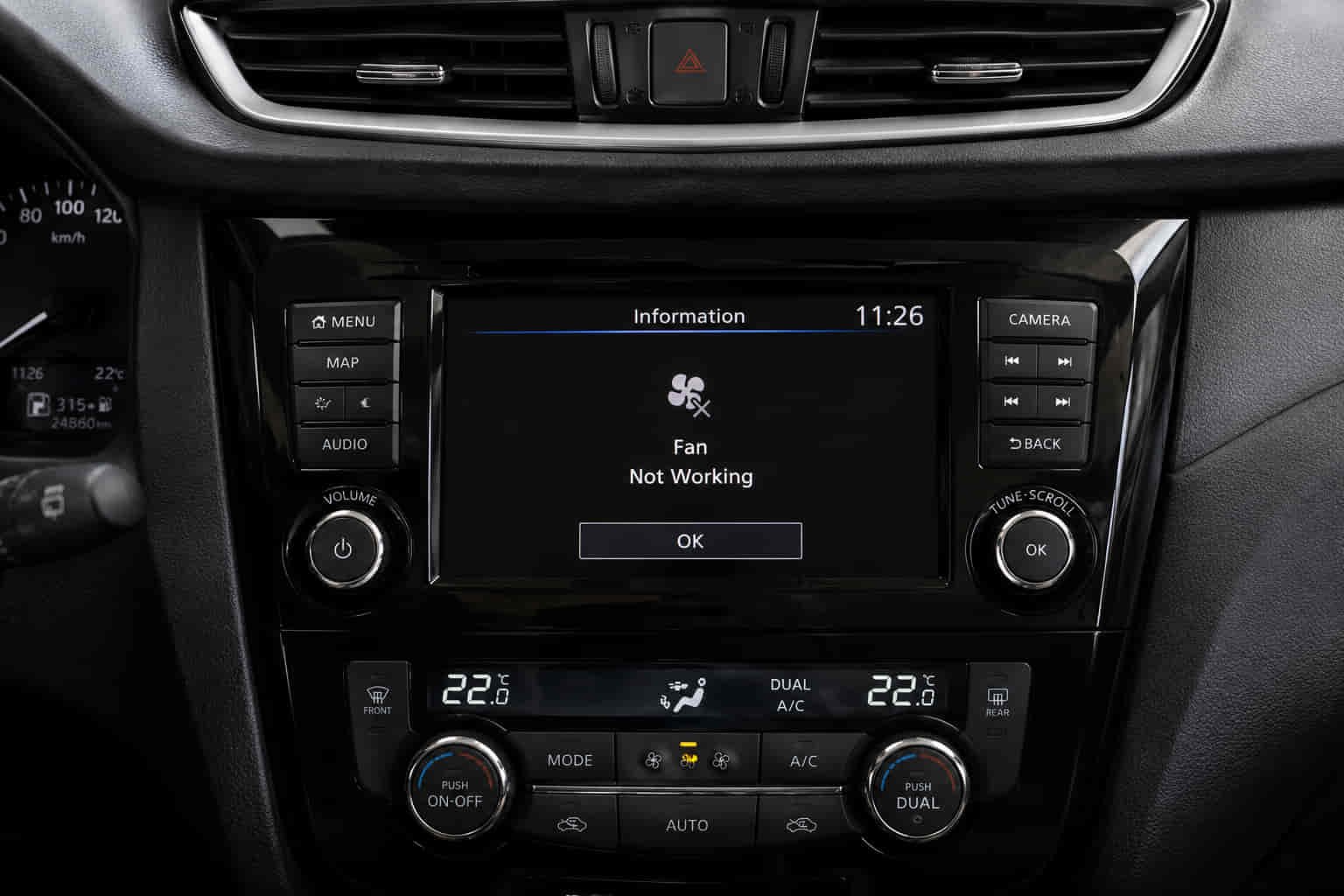
A Nissan Qashqai fan that is not working can lead to a wide range of problems, from poor air conditioning performance to serious engine overheating. Depending on which fan has failed, drivers may notice weak airflow from the vents, warm air coming from the climate control system, rising engine temperatures, or cooling fans that never activate when the engine reaches operating temperature.
The Nissan Qashqai uses two separate fan systems to maintain comfort and vehicle performance. The cooling fan helps regulate engine temperature by pulling air through the radiator, while the blower motor pushes air through the cabin ventilation and air conditioning system. Although these systems perform different functions, both rely on electrical components such as fuses, relays, control modules, sensors, and motors to operate correctly.
Because modern Nissan Qashqai models use electronically controlled cooling and HVAC systems, a failure in a single component can prevent an entire fan system from functioning. A blown fuse, faulty relay, failed fan motor, defective coolant temperature sensor, damaged wiring harness, or malfunctioning HVAC control module can all produce similar symptoms. This often makes diagnosis more difficult than simply replacing a fan.
Understanding whether the problem involves the engine cooling fan or the cabin blower fan is the first step toward identifying the root cause. Once the affected system has been identified, troubleshooting becomes significantly easier.
This guide explains the most common Nissan Qashqai fan not working problems, how each fault affects vehicle operation, and the most effective solutions for restoring proper cooling and airflow performance.
Why Is My Nissan Qashqai Fan Not Working?
A Nissan Qashqai fan may stop working when an electrical, mechanical, or sensor-related fault prevents the system from activating. The exact cause depends on whether the problem affects the engine cooling fan or the cabin blower fan, but both systems rely on a network of components that must communicate and operate correctly for normal airflow to occur.
The cooling fan is responsible for controlling engine temperature by drawing air through the radiator when vehicle speed alone cannot provide sufficient cooling. The blower fan performs a different function by circulating air through the heating, ventilation, and air conditioning system. Although these systems serve different purposes, they share a common dependence on fuses, relays, wiring circuits, control modules, and electric motors.
When a fault develops within any of these components, airflow can stop entirely or become severely reduced. Drivers may notice engine temperatures rising during traffic conditions, air conditioning performance deteriorating, weak airflow from cabin vents, or fans that never activate despite obvious operating demands. Because many faults produce similar symptoms, identifying the affected system is the first step toward an accurate diagnosis.
Modern Nissan Qashqai models use increasingly sophisticated electronic control systems to manage cooling and climate functions. As a result, problems that once involved simple mechanical components now often involve sensors, software logic, and communication networks. Understanding how these systems interact helps explain why a fan can stop working even when the motor itself remains functional.
Is the Cooling Fan Fuse Blown?
A blown cooling fan fuse is one of the simplest yet most common reasons a Nissan Qashqai cooling fan stops working. The fuse protects the fan circuit from electrical overload by interrupting power flow whenever excessive current is detected. Once the fuse opens, electricity can no longer reach the fan motor, preventing operation regardless of engine temperature.
The cooling fan motor requires a significant amount of electrical current, particularly during startup. If the motor begins drawing more power than normal due to wear, internal resistance, or mechanical binding, the fuse may fail to protect the circuit from damage. Electrical short circuits and wiring faults can produce the same result.
When the cooling fan fuse fails, the engine may continue operating normally under light conditions but begin overheating during slow-moving traffic, extended idling, or hot weather. This occurs because natural airflow through the radiator becomes insufficient without fan assistance. Drivers often notice the temperature gauge rising while the cooling fan remains completely silent.
A blown fuse should never be viewed as the root cause without further investigation. Fuses are designed to fail in response to another problem within the circuit. Simply replacing the fuse may restore operation temporarily, but the replacement fuse may fail again if the underlying issue remains unresolved.
Inspecting the fuse is often one of the first diagnostic procedures because it provides a quick indication of whether electrical power is reaching the fan system. If the fuse repeatedly fails after replacement, additional testing of the fan motor, wiring harness, and control components is usually required.
Is the Cooling Fan Relay Faulty?
A faulty cooling fan relay can prevent the Nissan Qashqai cooling fan from receiving power even when all other components are functioning correctly. The relay acts as an electrically controlled switch that allows the vehicle’s control systems to activate the fan without routing high current directly through sensitive electronic modules.
When engine temperature rises beyond a predetermined threshold, the Engine Control Module commands the relay to close. This action completes the electrical circuit and supplies battery power to the cooling fan motor. If the relay fails to operate correctly, the fan may never receive the power necessary to start.
Relay failures can occur for several reasons. Internal electrical contacts gradually wear over time due to repeated switching cycles. Heat generated within the engine compartment can accelerate deterioration, while moisture intrusion and corrosion may further reduce reliability. In some cases, the relay becomes stuck in either the open or closed position, creating intermittent or complete fan failure.
A defective relay often produces symptoms that closely resemble a failed fan motor. The cooling fan remains inactive despite rising engine temperatures, yet other components within the cooling system appear to function normally. Because relays do not contain moving parts visible from the outside, diagnosis usually requires electrical testing rather than visual inspection.
Intermittent relay failures can be particularly difficult to identify because the fan may operate normally during some driving conditions while failing during others. This inconsistency often leads drivers to suspect a temperature sensor or control module problem when the actual fault lies within the relay itself.
Testing the relay is a critical step whenever the cooling fan fails to activate. Confirming proper relay operation helps eliminate one of the most common electrical causes of cooling fan failure and prevents unnecessary replacement of more expensive components.
Has the Cooling Fan Motor Failed?
A failed cooling fan motor is one of the most common reasons a Nissan Qashqai cooling fan stops working completely. The motor is responsible for driving the fan blades that pull air through the radiator whenever additional cooling is required. If the motor can no longer operate, airflow through the radiator decreases significantly, increasing the risk of engine overheating.
The cooling fan motor experiences constant exposure to heat, vibration, moisture, and debris throughout its service life. Over time, internal bearings wear, electrical windings deteriorate, and brushes lose efficiency. As these components age, the motor may struggle to reach normal operating speed or stop functioning altogether.
Motor failure often develops gradually rather than occurring suddenly. Drivers may notice that the fan operates more slowly than normal, cycles inconsistently, or produces unusual noises before complete failure occurs. Grinding sounds, squealing noises, and vibration are common warning signs that internal components are wearing out.
When the motor fails completely, the cooling fan remains inactive even when engine temperature rises above normal operating levels. This condition is particularly noticeable during stop-and-go traffic because airflow through the radiator depends heavily on fan operation at lower vehicle speeds. The temperature gauge may climb rapidly while the fan remains silent.
Electrical testing is often necessary to confirm motor failure. If power and ground are reaching the fan assembly but the motor does not operate, the motor itself becomes the most likely source of the problem. Replacing a failed cooling fan motor typically restores proper airflow and prevents overheating-related issues from developing.
Is the Engine Coolant Temperature Sensor Malfunctioning?
A faulty engine coolant temperature sensor can prevent the Nissan Qashqai cooling fan from activating because the cooling system depends on accurate temperature information to determine when additional airflow is needed. If the sensor sends incorrect data, the Engine Control Module may never command the cooling fan to turn on.
The coolant temperature sensor continuously monitors engine temperature and transmits this information to the Engine Control Module. As engine temperature rises, the module uses sensor data to adjust fuel delivery, ignition timing, emissions controls, and cooling fan operation. Accurate temperature readings are essential for maintaining proper engine performance and cooling system efficiency.
When the sensor begins to fail, it may report temperatures that are significantly lower than actual engine conditions. The Engine Control Module interprets this information as an indication that cooling assistance is unnecessary, preventing the fan from activating even as engine temperatures continue rising. This situation can lead to overheating despite the cooling fan motor, relay, and fuse remaining fully functional.
In some cases, the sensor may provide erratic or inconsistent readings. Drivers may notice fluctuating temperature gauge behavior, unexpected cooling fan operation, poor fuel economy, hard starting conditions, or check engine lights. Because the sensor influences multiple engine management systems, symptoms often extend beyond fan performance alone.
Heat exposure, internal electrical deterioration, connector corrosion, and wiring damage are among the most common causes of coolant temperature sensor failure. Since the sensor operates continuously whenever the engine is running, long-term wear can eventually compromise accuracy.
Diagnosing a faulty coolant temperature sensor typically involves comparing live scan tool data with actual engine temperatures. Significant discrepancies often indicate a sensor problem. Replacing a defective sensor usually restores proper communication and allows the cooling fan system to operate as intended.
Is the Fan Control Module Defective?
A defective fan control module can prevent a Nissan Qashqai cooling fan from operating even when the fan motor, relay, fuse, and temperature sensor are functioning correctly. The fan control module acts as the system’s electronic manager, regulating fan speed and coordinating cooling fan operation based on engine demands.
Unlike older vehicles that relied on simple on-off fan control, many modern Nissan Qashqai models use variable-speed cooling systems. The fan control module receives commands from the Engine Control Module and adjusts fan operation according to coolant temperature, air conditioning requirements, engine load, and ambient conditions. This approach improves cooling efficiency while reducing unnecessary electrical consumption.
When the module develops a fault, communication between the Engine Control Module and cooling fan may be disrupted. The fan may fail to start, operate intermittently, run continuously, or function only at certain speeds. Because the module directly controls fan behavior, failures often create symptoms that resemble motor or sensor problems.
Heat is one of the primary contributors to fan control module failure. The module is typically installed within the engine compartment where it is exposed to high temperatures for extended periods. Repeated heating and cooling cycles can stress internal electronic components and eventually affect reliability. Moisture intrusion, corrosion, and electrical surges can accelerate deterioration.
Drivers experiencing fan control module issues often notice overheating during traffic conditions while cooling performance appears normal at highway speeds. This occurs because the fan is unable to respond appropriately to changing cooling demands. Air conditioning performance may also suffer because the cooling fan contributes to condenser airflow.
Confirming a fan control module failure generally requires advanced diagnostic testing. Technicians must verify that sensor inputs, electrical power, ground circuits, and fan motors are operating correctly before identifying the module as the source of the fault. Once replaced, proper cooling fan operation is usually restored across all operating conditions.
Is Low Coolant Preventing Fan Operation?
Low coolant can contribute to Nissan Qashqai cooling problems and may indirectly affect cooling fan operation. Although the cooling fan itself does not rely on coolant to function, the Engine Control Module depends on accurate temperature information generated by the cooling system. When coolant levels fall significantly, temperature readings may become unreliable, making cooling system behavior less predictable.
The cooling system is designed to circulate coolant through the engine, radiator, heater core, and associated passages. As coolant absorbs heat from the engine, it transfers that heat to the radiator where airflow removes excess thermal energy. The cooling fan assists this process when natural airflow is insufficient.
When coolant levels become too low, air pockets can form within the cooling system. These air pockets may prevent the coolant temperature sensor from accurately measuring engine temperature. As a result, the Engine Control Module may receive misleading information and fail to activate the cooling fan at the correct time. In other situations, the fan may operate continuously because the system detects abnormal temperature conditions.
Drivers experiencing low coolant conditions often notice additional symptoms before severe overheating occurs. The temperature gauge may fluctuate unexpectedly, cabin heater performance may become inconsistent, coolant warning lights may appear, and coolant reservoirs may require frequent refilling. These symptoms frequently indicate leaks or cooling system problems that require immediate attention.
Low coolant is rarely the sole cause of fan failure, but it can contribute to cooling system malfunctions and overheating complaints. Verifying coolant level and inspecting the system for leaks should always be part of the diagnostic process whenever a Nissan Qashqai experiences cooling fan or overheating issues.
Is a Wiring Problem Interrupting Fan Power?
Wiring damage can prevent a Nissan Qashqai fan from operating even when all major components remain functional. Both the cooling fan system and cabin blower system rely on electrical circuits to deliver power, transmit control signals, and maintain communication between modules and motors. A fault within these circuits can interrupt operation completely.
Modern Nissan Qashqai models contain extensive wiring networks that operate in challenging environments. Engine compartment wiring is exposed to heat, moisture, vibration, road debris, and chemical contamination. Over time, insulation can deteriorate, connectors can corrode, and electrical resistance can increase throughout the circuit.
A damaged wire may prevent electrical power from reaching the fan motor. Similarly, a poor ground connection can create voltage drops that reduce motor performance or stop operation entirely. Corrosion within connectors can also interfere with communication signals between sensors, relays, control modules, and fan assemblies.
One of the most difficult aspects of diagnosing wiring problems is their inconsistent nature. A partially damaged wire may function normally under certain conditions but fail when exposed to vibration, temperature changes, or movement. This often results in intermittent fan operation that appears random and difficult to reproduce.
Drivers frequently report situations where the fan works occasionally but fails at other times. These symptoms can easily be mistaken for relay, sensor, or control module failures. As a result, wiring inspections are often necessary after more common causes have been eliminated.
Comprehensive electrical testing is usually required to identify wiring-related faults. Verifying voltage supply, ground integrity, connector condition, and circuit continuity helps isolate the exact location of the problem and prevents unnecessary replacement of expensive components.
Is the Blower Motor Not Working?
A failed blower motor is the most common reason a Nissan Qashqai cabin fan stops working. Unlike the cooling fan that regulates engine temperature, the blower motor is responsible for pushing air through the vehicle’s heating, ventilation, and air conditioning system. When the blower motor fails, airflow from the dashboard vents may become weak or disappear completely.
The blower motor operates whenever the climate control system requests airflow. Whether the driver selects heating, air conditioning, windshield defrost, or simple ventilation, the blower motor generates the airflow necessary to distribute conditioned air throughout the cabin.
Over time, blower motor components experience wear due to constant operation. Bearings can deteriorate, brushes can wear out, and internal electrical circuits can become damaged. As these components age, motor efficiency declines and airflow performance gradually decreases.
Early signs of blower motor failure often include unusual noises such as squealing, grinding, clicking, or vibration coming from behind the dashboard. Airflow may become inconsistent, fan speed may fluctuate unexpectedly, or certain speed settings may stop functioning altogether. These symptoms often appear weeks or months before complete motor failure occurs.
When the blower motor fails completely, airflow from the vents stops regardless of fan speed settings. The air conditioning system and heater may still generate hot or cold air internally, but the air cannot be delivered into the cabin without a functioning blower motor.
Diagnosing blower motor failure typically involves verifying that electrical power reaches the motor while confirming that the motor itself cannot operate. Once failure is confirmed, replacing the blower motor restores normal cabin airflow and returns climate control performance to expected levels.
Has the Blower Motor Resistor Failed?
A failed blower motor resistor can cause a Nissan Qashqai cabin fan to stop working at specific speed settings or stop functioning altogether. The blower motor resistor controls fan speed by regulating the amount of electrical current delivered to the blower motor. If the resistor becomes damaged, airflow performance can be significantly affected even when the blower motor itself remains fully functional.
In manual climate control systems, the blower motor resistor is responsible for creating multiple fan speed levels. By reducing voltage supplied to the motor, the resistor allows the fan to operate at lower speeds. When higher fan settings are selected, resistance decreases and more power reaches the motor.
One of the most recognizable symptoms of a failing blower motor resistor is the loss of certain fan speeds. Many drivers discover that the fan only works on the highest setting while lower speeds stop functioning. This occurs because the highest speed often bypasses the resistor entirely and receives direct battery voltage.
Heat is the primary cause of resistor failure. Because the component continuously dissipates electrical energy, repeated heating and cooling cycles gradually weaken internal circuits. Restricted cabin air filters, excessive blower motor current draw, and poor ventilation around the resistor can accelerate deterioration.
As the resistor continues to degrade, airflow becomes increasingly unpredictable. Fan speeds may change unexpectedly, airflow may become inconsistent, and complete blower operation may eventually be lost. Because these symptoms closely resemble blower motor failures, proper diagnosis is essential before replacing components.
Testing the resistor typically involves verifying voltage output across different fan speed selections. If the resistor fails to deliver appropriate voltage while the blower motor remains functional, replacement usually restores normal operation across all fan settings.
Is the HVAC Control Module Causing the Problem?
A defective HVAC control module can prevent the Nissan Qashqai fan system from operating correctly because the module serves as the command center for climate control functions. It interprets driver inputs, processes temperature requests, and communicates with blower motors, actuators, and related electrical components.
Modern Nissan Qashqai climate control systems are significantly more advanced than traditional manual systems. The HVAC control module continuously monitors cabin temperature, outside temperature, airflow settings, and system demands to maintain occupant comfort. Every fan speed adjustment and airflow request passes through this module before being executed.
When the module develops a fault, communication with the blower motor system may be interrupted. The fan may fail to respond to speed adjustments, operate intermittently, become stuck at a single speed, or stop working entirely. In some cases, airflow settings appear normal on the control panel even though no physical response occurs within the HVAC system.
Electrical surges, internal circuit failures, moisture intrusion, software corruption, and connector problems are among the most common causes of HVAC control module issues. Because the module interacts with numerous climate control components simultaneously, failures often create multiple symptoms rather than affecting fan operation alone.
Drivers may notice inconsistent temperature regulation, incorrect airflow direction, unresponsive climate control buttons, intermittent blower operation, or display-related issues. The presence of several HVAC-related problems at the same time often indicates a control module fault rather than a simple motor or resistor failure.
Diagnosing HVAC control module issues usually requires advanced diagnostic equipment capable of monitoring module communication and command outputs. Once the fault is confirmed, repairs may involve software updates, electrical repairs, or complete module replacement depending on the severity of the problem.
How Can You Diagnose a Nissan Qashqai Fan Problem?
Diagnosing a Nissan Qashqai fan problem begins with determining whether the issue affects the engine cooling fan or the cabin blower fan. Although both systems use electric motors and supporting electrical components, they serve different functions and follow different diagnostic paths.
The first step is identifying the primary symptom. If the engine temperature rises above normal levels, overheating becomes the primary concern and attention should focus on the cooling fan system. If airflow from the dashboard vents is weak or nonexistent while engine temperature remains normal, the blower motor system becomes the more likely source of the problem.
Observing fan behavior provides valuable diagnostic information. A cooling fan that never activates despite increasing engine temperatures may indicate problems involving the fuse, relay, motor, temperature sensor, wiring, or fan control module. A blower fan that operates only at certain speeds often points toward a resistor issue, while complete airflow loss may suggest motor, electrical, or HVAC control module failure.
Electrical testing is often the most effective method for narrowing down the cause. Verifying power supply, ground integrity, fuse condition, relay operation, and component voltage helps determine whether the problem originates from a failed component or a communication issue elsewhere in the system.
Modern Nissan Qashqai models also store diagnostic trouble codes whenever electronic faults are detected. Accessing these codes through a scan tool can significantly reduce diagnostic time by identifying communication failures, sensor abnormalities, and module-related issues.
Accurate diagnosis is particularly important because many fan-related symptoms overlap. Replacing components without confirming the root cause often results in unnecessary expenses and continued system failures. A systematic approach that evaluates electrical supply, control signals, component operation, and stored fault codes provides the most reliable path to a permanent repair.
How Much Does It Cost to Fix a Nissan Qashqai Fan?
The cost of repairing a Nissan Qashqai fan problem depends on which component has failed and whether the issue affects the cooling fan system or the cabin blower system. Some repairs involve inexpensive electrical components, while others require motor replacement or advanced diagnostic procedures.
Fuse and relay replacements are generally among the least expensive repairs because the components are relatively simple and require minimal labor. When these parts are responsible for fan failure, repairs can often be completed quickly and economically.
Blower motor resistor replacement is also considered a moderate-cost repair. Because the resistor is a separate component from the blower motor, replacing it is usually less expensive than replacing the entire fan assembly. Many blower fan speed problems are resolved through resistor replacement alone.
Cooling fan motor and blower motor replacements typically involve higher costs due to component pricing and labor requirements. These motors are the primary moving components within their respective systems and eventually wear out through normal use. Replacing a failed motor generally restores full fan performance once supporting electrical systems are verified.
Fan control modules and HVAC control modules represent some of the more expensive repair possibilities. These components contain sophisticated electronics and may require programming or calibration after installation. Diagnostic costs may also increase when module communication issues are involved.
Accurate diagnosis remains the most important factor in controlling repair expenses. Identifying the exact source of the failure before replacing parts helps prevent unnecessary costs and improves the likelihood of a successful repair on the first attempt.
How Can You Prevent Nissan Qashqai Fan Failures?
Preventing Nissan Qashqai fan failures begins with maintaining both the cooling system and climate control system before problems develop. Most fan-related issues appear gradually and often provide warning signs long before complete failure occurs.
Regular cooling system maintenance helps protect cooling fan components from unnecessary stress. Maintaining proper coolant levels, repairing leaks promptly, and ensuring the radiator remains unobstructed improve overall cooling efficiency and reduce cooling fan workload.
Cabin air filter replacement is equally important for blower motor longevity. A clogged filter restricts airflow and forces the blower motor to work harder than intended. This additional strain increases operating temperatures and accelerates wear on both the motor and resistor.
Electrical system maintenance also plays a critical role. Corroded connectors, weak batteries, poor ground connections, and damaged wiring can create excessive resistance and reduce component lifespan. Periodic inspection of electrical connections helps identify developing issues before failures occur.
Drivers should pay attention to early warning signs such as unusual fan noises, intermittent airflow, inconsistent cooling performance, or fluctuating fan speeds. Addressing these symptoms early often prevents more expensive repairs later.
Preventive maintenance costs significantly less than replacing major fan system components. Consistent attention to cooling system health, HVAC performance, and electrical integrity helps maximize reliability and reduce the likelihood of unexpected fan failures.
Read more: Nissan Altima Gas Pedal Not Responding
When Should You Visit a Mechanic for a Nissan Qashqai Fan Problem?
A mechanic should be consulted whenever a Nissan Qashqai fan problem cannot be resolved through basic inspection and maintenance procedures. While some issues involve simple components such as fuses or relays, others require specialized diagnostic equipment and advanced electrical testing.
Immediate professional attention is recommended if the vehicle begins overheating. Engine overheating can quickly lead to cylinder head damage, gasket failure, and other costly repairs. Any cooling fan problem accompanied by rising engine temperatures should be treated as a priority.
Professional diagnosis is also advisable when electrical testing becomes necessary. Wiring faults, control module failures, communication issues, and intermittent electrical problems often require tools and expertise beyond basic troubleshooting methods.
Drivers experiencing repeated fuse failures, inconsistent fan operation, climate control malfunctions, or multiple warning lights should also seek professional assistance. These symptoms frequently indicate underlying electrical or module-related faults that require systematic diagnosis.
Ignoring persistent fan problems can allow minor issues to develop into larger mechanical or electrical failures. Early diagnosis helps maintain vehicle reliability, protects critical systems from damage, and often reduces overall repair costs by addressing faults before they become more severe.