The 2015 Nissan Rogue cabin air filter is located inside the passenger compartment, where it filters dust, pollen, dirt, and other airborne particles before air moves through the vehicle’s HVAC system and into the cabin. Replacing a dirty filter helps maintain unrestricted airflow through the vents and keeps contaminants from accumulating inside the heating and air-conditioning system.
Cabin air filter replacement is a routine maintenance job that most 2015 Nissan Rogue owners can complete without specialized automotive equipment. The process involves accessing the filter housing, removing the old filter, checking the airflow orientation, installing a compatible replacement, and confirming that the HVAC system operates normally afterward. Choosing the correct filter is important because fitment, filtration material, and features such as activated carbon can differ between replacement options.
Replacement timing depends on both the recommended service interval and the conditions in which the Rogue is driven. Dusty roads, heavy traffic, construction areas, and high-pollen environments can load the filter faster. This guide explains where the 2015 Nissan Rogue cabin air filter is located, when it needs replacement, how to replace it correctly, which filters fit, and how DIY replacement costs compare with professional service.
Where Is the Cabin Air Filter Located in a 2015 Nissan Rogue?
The cabin air filter is located on the passenger side of the 2015 Nissan Rogue, behind the lower dashboard area near the center console. The filter sits inside the HVAC housing rather than under the hood, so replacement requires access from inside the passenger compartment.
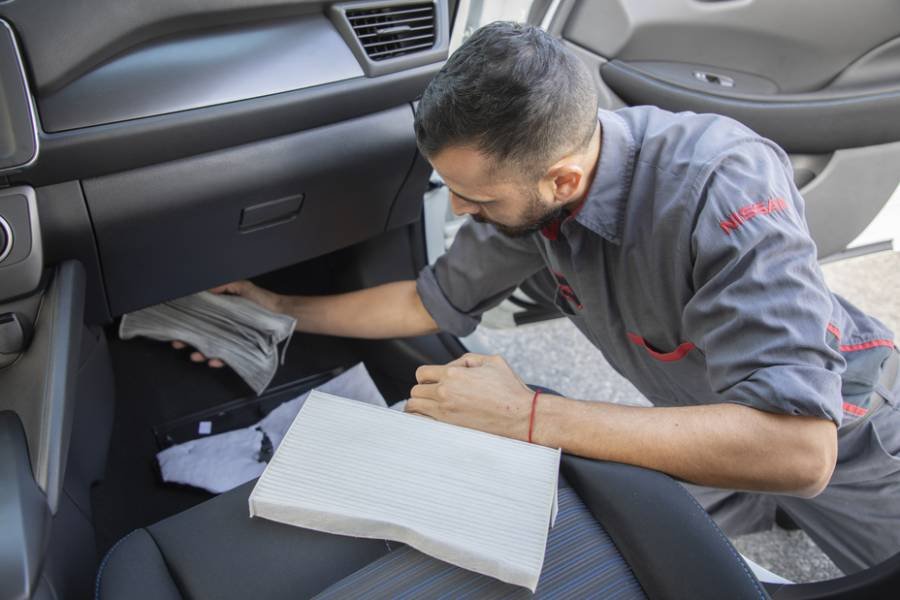
To reach the filter, move to the front passenger footwell and locate the HVAC housing toward the center of the vehicle. The cabin filter access cover is positioned on the side of this housing. Once the cover is removed, the filter can be pulled from its slot. The available working space is relatively narrow, so the old filter may need to be compressed slightly as it is removed.
The location matters because the 2015 Rogue does not use the same cabin-filter access arrangement found in every Nissan model. Owners should identify the HVAC housing and filter access cover before removing surrounding interior components. Removing unrelated dashboard or HVAC parts adds work without improving access to the filter.
The cabin air filter is part of the Rogue’s HVAC air path. Air entering the system passes through the filter media, where dust, pollen, and other particles are captured before the conditioned air reaches the passenger compartment. This placement is why a heavily contaminated filter can restrict the volume of air moving through the HVAC system and out of the dashboard vents.
How Often Should You Replace the Cabin Air Filter in a 2015 Nissan Rogue?
The 2015 Nissan Rogue cabin air filter should be inspected as part of routine vehicle maintenance and replaced according to Nissan’s applicable maintenance schedule or earlier when the filter becomes visibly contaminated or airflow declines. Mileage alone should not determine replacement because two filters used for the same distance can accumulate substantially different amounts of debris.
Driving environment directly affects how quickly the filter becomes contaminated. Dusty roads expose the filter to more suspended dirt, while dense urban traffic can increase exposure to road dust and airborne particles. Construction zones and high-pollen environments create similar conditions. A Rogue regularly driven in these environments can therefore require cabin filter inspection or replacement sooner than one driven primarily in cleaner conditions.
Filter condition provides another practical replacement indicator. A used filter with substantial dirt, leaves, dust, or other debris trapped between its pleats has less open filter area available for airflow. As contamination accumulates, resistance through the filter increases and the amount of air delivered through the vents can decline. Visible contamination combined with reduced HVAC airflow provides a stronger reason for replacement than mileage alone.
Replacement intervals should therefore be treated as scheduled maintenance guidance rather than a guarantee that the filter will remain clean until a specific mileage. Checking the filter periodically allows the owner to account for actual driving conditions. Replacing it when necessary maintains the intended filtration path without replacing a serviceable filter solely because a generic interval has been reached.
What Are the Signs That a 2015 Nissan Rogue Cabin Air Filter Needs Replacement?
A 2015 Nissan Rogue cabin air filter needs replacement when it is visibly contaminated or when restricted filtration is accompanied by noticeable HVAC airflow or cabin-air problems. The most useful indicators are reduced airflow from the vents, persistent unpleasant odors, increased dust inside the cabin, and visible dirt or debris trapped in the filter.
Reduced vent airflow occurs when accumulated contaminants block part of the filter media. The HVAC blower must move air through the filter before that air reaches the dashboard vents. As dust, pollen, leaves, and other debris fill the filter pleats, resistance to airflow increases. A driver may notice that the same fan-speed setting produces less airflow than it did with a clean filter.
A musty or unpleasant odor from the vents is another reason to inspect the filter. The filter continuously encounters outside air and can collect dust, organic debris, and other contaminants. Odor alone does not prove that the cabin filter is responsible because moisture or contamination elsewhere in the HVAC system can produce similar symptoms. Inspecting the filter helps separate filter contamination from other HVAC problems.
Visible contamination provides the most direct evidence. Remove the filter and examine the material between its pleats. A filter heavily loaded with dust, dirt, leaves, or other debris should be replaced rather than judged only by vehicle mileage. Comparing the dirty filter with a new replacement also makes contamination easier to identify.
A dirty cabin air filter should not be treated as the cause of every airflow problem. Weak airflow can also involve other parts of the HVAC system. Replace a visibly restricted filter first when its condition supports the diagnosis, but investigate the HVAC system further if airflow remains weak after a correctly installed new filter.
How Do You Replace the Cabin Air Filter in a 2015 Nissan Rogue?
To replace the cabin air filter in a 2015 Nissan Rogue, access the filter housing from the front passenger footwell, remove the filter access cover, pull out the old filter, install the compatible replacement in the correct orientation, reinstall the cover, and test the HVAC airflow. The job requires careful positioning because the filter opening is located in a confined area.
- Prepare the replacement filter. Confirm that the new cabin air filter is listed as compatible with the 2015 Nissan Rogue before removing the existing filter. Compare the replacement filter with the old filter during installation to verify its general shape and fit.
- Access the HVAC housing. Move to the front passenger footwell and locate the cabin air filter access area toward the center-console side of the lower dashboard. Create enough working space to reach the filter cover without unnecessarily removing unrelated dashboard components.
- Remove the filter access cover. Release the cover carefully and note how it attaches to the HVAC housing. Avoid forcing clips or tabs because the cover needs to seat correctly again after the replacement filter is installed.
- Pull out the old cabin air filter. Remove the filter through the access opening. The confined opening can require the filter to flex or compress during removal. Before discarding it, observe its installed orientation and inspect it for accumulated dust, leaves, and other debris.
- Check the replacement filter markings. Identify any directional marking printed on the new filter before installation. Follow the filter manufacturer’s orientation instructions rather than assuming that every arrow has the same meaning. An arrow labeled “AIR FLOW,” for example, describes airflow direction, while an “UP” marking describes filter orientation.
- Install the new filter. Guide the replacement filter into the housing without excessively crushing or folding the filter media. Make sure it sits fully inside the filter slot and follows the correct orientation indicated for that filter.
- Reinstall the access cover. Position the cover in its original location and confirm that its tabs or retaining points are secured. A cover that is not seated correctly can indicate that the filter has shifted or has not been inserted completely.
- Test the HVAC system. Start the vehicle and operate the fan at several speeds. Check the airflow from the dashboard vents and listen for abnormal noises. Normal airflow without unusual sounds indicates that the filter and access cover are likely seated correctly.
Do not use increased airflow alone as proof that the installation is correct. The replacement filter must also fit the housing properly and follow its specified orientation. If airflow remains unusually weak after replacement, inspect the installation again before assuming that the new filter is defective; another HVAC component may be responsible for the restriction.
What Cabin Air Filter Fits a 2015 Nissan Rogue?
A cabin air filter specifically listed as compatible with the 2015 Nissan Rogue should be used for replacement. Correct fitment matters because the filter must fill the designated HVAC housing without leaving gaps that allow unfiltered air to bypass the filter media.
Check vehicle compatibility before purchasing a replacement rather than selecting a filter based only on its appearance. Cabin air filters with similar rectangular shapes can have different dimensions, pleat configurations, or frame designs. The product application guide should explicitly include the 2015 Nissan Rogue or provide a part number cross-reference that confirms compatibility with the vehicle.
There are two common filtration options for a compatible replacement: a standard particulate filter and an activated-carbon cabin air filter. A standard filter primarily captures airborne particles such as dust, pollen, and road debris. An activated-carbon filter combines particulate filtration with a carbon layer designed to adsorb certain odors and gaseous contaminants. The additional carbon layer makes this option useful for drivers who regularly encounter traffic exhaust or unwanted outside odors.
Filter construction should also be considered alongside fitment. More filtration is not automatically better if a filter creates excessive airflow resistance or does not fit the housing correctly. The replacement should balance filtration performance with the airflow requirements of the Rogue’s HVAC system.
Verify the filter markings after confirming compatibility. Directional markings can vary between manufacturers, so distinguish an “AIR FLOW” arrow from an “UP” arrow. Follow the instructions supplied with the replacement filter and use the orientation of the original filter as an additional reference when appropriate. Correct fitment and correct orientation are separate requirements; a compatible filter can still be installed incorrectly.
Should You Use an OEM or Aftermarket Cabin Air Filter for a 2015 Nissan Rogue?
Both OEM and compatible aftermarket cabin air filters can be used in a 2015 Nissan Rogue, but the better choice depends on fitment, filtration requirements, price, and the features the owner needs. OEM filters prioritize vehicle-specific compatibility, while aftermarket filters provide a broader range of materials, filtration levels, and price points.
An OEM cabin air filter is designed for the vehicle application specified by Nissan. Its main advantage is straightforward fitment selection because the filter can be identified through the appropriate Nissan part application. This reduces uncertainty when an owner wants a replacement that follows the original vehicle specification without comparing multiple aftermarket designs.
Aftermarket cabin air filters provide more choices. Depending on the manufacturer and product line, options can include basic particulate filters and filters incorporating activated carbon or additional filtration layers. These choices allow an owner to prioritize a particular feature, such as odor reduction, while still maintaining vehicle compatibility.
Price is another difference, but the lowest-priced filter is not automatically the lowest-cost choice. A filter that does not fit correctly can leave gaps around the filter media, while an incorrectly selected product can make installation difficult. Fitment should therefore be verified before comparing price or additional filtration features.
Choose OEM when straightforward vehicle-specific replacement is the main priority. Choose an aftermarket filter when a verified compatible product provides the filtration features or price point you prefer. In both cases, compatibility with the 2015 Nissan Rogue, correct dimensions, appropriate filter construction, and proper installation are more important than the OEM or aftermarket label by itself.
How Much Does It Cost to Replace a 2015 Nissan Rogue Cabin Air Filter?
The cost to replace a 2015 Nissan Rogue cabin air filter consists of the price of the replacement filter plus any labor charge when a shop or dealership performs the service. DIY replacement eliminates the labor portion, making the filter itself the primary expense.
Replacement filter prices vary according to filter construction, brand, and filtration features. Standard particulate filters are generally the basic option, while activated-carbon filters add a carbon layer intended to reduce certain odors and gaseous contaminants in addition to capturing particles. OEM and aftermarket filters can also be priced differently. Because retail prices change between sellers and over time, current prices should be checked for a filter specifically confirmed to fit the 2015 Nissan Rogue rather than relying on a fixed historical price.
Professional replacement adds labor or a service charge to the filter price. The total can differ between Nissan dealerships, independent repair shops, and other automotive service providers. Cabin air filter replacement requires relatively few procedural steps compared with many mechanical repairs, but the 2015 Rogue’s filter location still requires the technician to access the HVAC housing from the passenger compartment.
DIY replacement removes this labor expense. The owner purchases a compatible filter, removes the existing filter, installs the replacement, and reinstalls the access cover. No additional labor charge is incurred when the job is completed correctly at home.
Cost should not be the only selection criterion. A cheaper filter provides little value if its dimensions or application are incorrect, while a higher-priced filter is not automatically necessary for every driver. Compare fitment first, then filtration type, construction, and price. This approach allows the owner to evaluate the actual replacement cost without sacrificing compatibility with the Rogue’s HVAC system.
What Does the Cabin Air Filter Do in a 2015 Nissan Rogue?
The cabin air filter in a 2015 Nissan Rogue filters contaminants from air moving through the vehicle’s HVAC system before that air enters the passenger compartment. Its primary role is filtration rather than cooling or heating the air.
Outside air can contain dust, pollen, dirt, and other airborne debris. As air passes through the cabin filter, the filter media captures particles before the HVAC system distributes the air through the vehicle’s vents. The trapped material remains within the filter pleats until the filter is removed and replaced.
This filtration process also explains why filter condition affects airflow. A clean filter provides open filter media through which air can pass while still capturing contaminants. As debris accumulates across that media, the available airflow paths become more restricted. A heavily loaded filter can therefore reduce airflow without the blower fan itself being defective.
The cabin filter should not be confused with the engine air filter. The engine air filter cleans air entering the engine’s intake system, while the cabin air filter is associated with air supplied to the passenger compartment through the HVAC system. Replacing one does not replace the maintenance function of the other.
Can a Dirty Cabin Air Filter Affect the 2015 Nissan Rogue HVAC System?
A dirty cabin air filter can affect the 2015 Nissan Rogue HVAC system by restricting the volume of air that can pass through the filter media. The most noticeable result is reduced airflow from the vents even when the blower is operating at a higher fan-speed setting.
The restriction develops as particles occupy the filter media and the spaces between its pleats. The blower must move air through this increasingly restricted path before the air reaches the vents. The driver can therefore perceive weaker heating or air-conditioning delivery because less air is moving into the cabin.
Filter restriction and HVAC temperature performance are not the same problem. The cabin filter does not generate cold air or heat. A dirty filter primarily interferes with airflow, so replacing it addresses a filtration-related restriction rather than repairing every possible heating or air-conditioning fault.
Persistent HVAC problems after filter replacement require separate diagnosis. Weak airflow can involve another airflow restriction or HVAC component, while air that flows normally but does not reach the expected temperature points toward a different type of problem. Confirming that the new cabin filter is compatible, correctly oriented, and properly seated is a practical first check before investigating other components.
Read more: Nissan Altima Oil Filter Location: Guide for Every Model Year
Can You Clean a 2015 Nissan Rogue Cabin Air Filter Instead of Replacing It?
Replacing the cabin air filter is the appropriate maintenance approach when the filter installed in a 2015 Nissan Rogue is designed as a disposable replacement filter. Removing visible debris from the surface does not necessarily restore the filter media to its original filtration condition or airflow performance.
A cabin air filter captures contaminants throughout its pleated media. Larger material such as leaves may remain on the surface, while smaller particles such as dust and pollen become trapped within the filter structure. Shaking or brushing the filter can remove loose debris, but it does not reliably remove particles embedded deeper in the media.
Washing a disposable cabin air filter can also damage its structure. Water can deform filter material, affect bonded layers, or change the shape required for the filter to fit correctly inside the HVAC housing. The filter should not be washed and reused unless its manufacturer specifically identifies it as washable and provides a cleaning procedure.
Compressed air should not automatically be used as a cleaning method either. High-pressure air can damage filter media or redistribute trapped contaminants rather than restore the filter to its original condition. Follow the filter manufacturer’s maintenance instructions if a reusable product is installed.
Replace a disposable filter when it is heavily contaminated, damaged, or sufficiently restricted to affect airflow. A new compatible filter restores clean filter media and removes uncertainty about whether cleaning has damaged the old filter. Cleaning is appropriate only when the installed product is specifically designed and documented for reuse.
Can You Drive a 2015 Nissan Rogue Without a Cabin Air Filter?
A 2015 Nissan Rogue may still be capable of driving without a cabin air filter installed, but operating the vehicle this way removes the filtration barrier for air passing through that part of the HVAC system. Removing a dirty filter should therefore not be treated as a permanent solution to restricted vent airflow.
The cabin filter separates airborne contaminants from the air entering the HVAC airflow path. Without the filter in place, dust, pollen, dirt, and other debris that would normally be captured by the filter can continue farther into the system or passenger compartment. The absence of a filter does not improve the quality of the incoming air; it removes the component designed to filter it.
Driving without the filter can appear to improve airflow when the previous filter was severely restricted. This change occurs because the clogged filter is no longer resisting airflow. The correct solution is to install a clean, compatible replacement rather than leave the filter housing empty.
A missing filter also changes the intended filtration path of the HVAC system. Over time, contaminants that would otherwise accumulate on a replaceable filter can enter areas that are less convenient to inspect or clean. Installing a replacement filter keeps those contaminants concentrated on a serviceable component.
Replace a missing or heavily contaminated cabin filter with one confirmed to fit the 2015 Nissan Rogue. After installation, secure the access cover and operate the HVAC fan at several speeds. If airflow remains abnormally weak with a clean filter installed correctly, the restriction should be investigated elsewhere in the HVAC system rather than solved by removing the filter.