
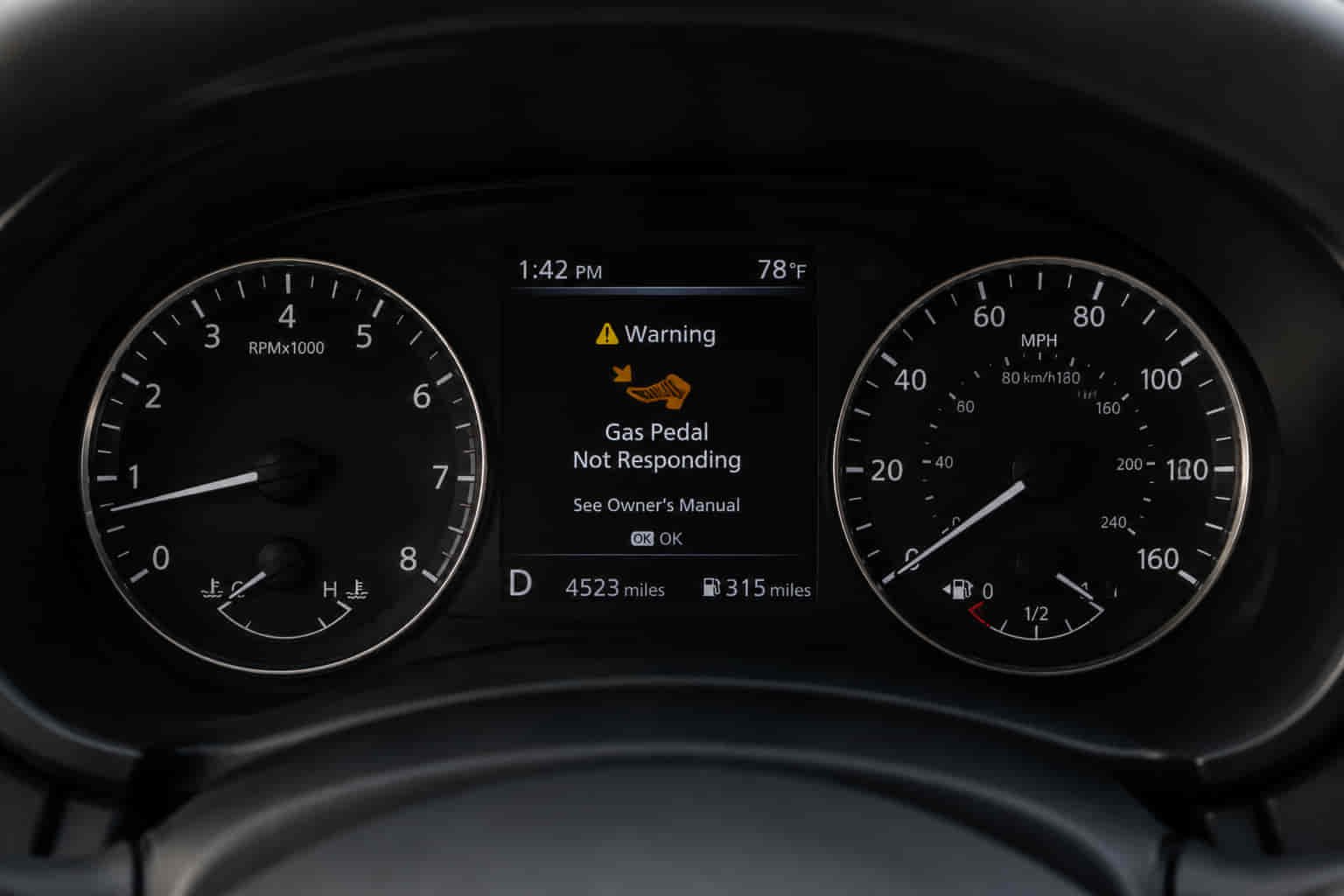
A Nissan Altima gas pedal that does not respond can be one of the most concerning drivability problems because it directly affects the vehicle’s ability to accelerate. In some situations, pressing the accelerator pedal produces little or no change in engine speed. In others, the vehicle accelerates slowly, hesitates during takeoff, or becomes stuck at reduced power levels despite significant pedal input. These symptoms often indicate a failure within the electronic throttle control system rather than a mechanical problem with the pedal itself.
Unlike older vehicles that used a physical throttle cable, modern Nissan Altima models rely on a drive-by-wire system. When the driver presses the accelerator pedal, the Accelerator Pedal Position Sensor measures pedal movement and sends data to the Engine Control Module. The Engine Control Module then commands the electronic throttle body to regulate airflow entering the engine. This process occurs continuously and requires accurate communication between multiple sensors, control modules, and electronic components.
Because the entire acceleration system depends on electronic signals, even a minor fault can disrupt throttle response. A failing accelerator pedal sensor, dirty throttle body, malfunctioning throttle position sensor, damaged wiring harness, low battery voltage, software issue, or transmission-related problem can all cause the gas pedal to stop responding normally. In some cases, the vehicle may intentionally enter a reduced power or limp mode to protect critical drivetrain components from further damage.
Understanding how the Nissan Altima electronic throttle system works is essential for identifying the root cause of acceleration problems. Some issues can be resolved through simple maintenance procedures, while others require advanced diagnostics and component replacement.
This guide explains the most common Nissan Altima gas pedal not responding problems, how each fault affects throttle operation, and the most effective solutions for restoring normal acceleration performance.
Why Is My Nissan Altima Gas Pedal Not Responding?
A Nissan Altima gas pedal may stop responding when the electronic throttle control system cannot properly translate pedal input into throttle movement. Unlike traditional cable-operated systems, modern Altima models rely entirely on electronic communication between the accelerator pedal, Engine Control Module (ECM), throttle body, and multiple supporting sensors. If communication fails anywhere in this chain, acceleration performance can be reduced or lost completely.
The electronic throttle system constantly monitors driver input and engine operating conditions. Every time the accelerator pedal is pressed, the Accelerator Pedal Position Sensor sends voltage signals to the ECM. The ECM interprets this information and commands the electronic throttle body to open the throttle plate. This process occurs thousands of times during a normal drive and requires accurate data transmission between all connected components.
Because several systems participate in throttle control, identical symptoms can have very different causes. A faulty pedal sensor may produce the same loss of acceleration as a dirty throttle body, damaged wiring harness, weak battery, software malfunction, or transmission-related fault. This is why replacing parts without proper diagnosis often fails to solve the problem.
Modern Nissan Altima models also contain multiple safety strategies designed to protect the engine and transmission. When the ECM detects abnormal sensor readings or communication failures, it may intentionally reduce throttle response to prevent mechanical damage. As a result, the vehicle may appear to have a failed gas pedal when the underlying issue is actually a protective response triggered by another system fault.
Understanding the relationship between the accelerator pedal, throttle body, ECM, and transmission is essential for identifying the true source of acceleration problems and avoiding unnecessary repairs.
Is the Vehicle in Limp Mode?
Limp mode is one of the most common reasons a Nissan Altima gas pedal becomes partially or completely unresponsive. This protective operating mode is designed to prevent further damage when the vehicle detects a serious fault affecting engine performance, transmission operation, or electronic throttle control.
When limp mode is activated, the Engine Control Module intentionally limits engine power and throttle response. The system does this because unrestricted acceleration could worsen an existing problem or create unsafe operating conditions. Rather than allowing normal performance, the vehicle restricts speed and acceleration to help protect critical drivetrain components.
Drivers often describe limp mode as a situation where the gas pedal feels disconnected from the engine. Pressing the accelerator may produce only a small increase in speed, and the vehicle may struggle to accelerate beyond a specific range. In some cases, engine speed becomes limited regardless of pedal position. These symptoms frequently create the impression that the accelerator pedal has failed when the vehicle is actually responding exactly as programmed.
Several faults can trigger limp mode in a Nissan Altima. Electronic throttle control errors, accelerator pedal sensor failures, throttle body malfunctions, transmission problems, Mass Air Flow sensor issues, and severe engine management faults are among the most common causes. Once the fault is detected, the ECM stores diagnostic trouble codes that help identify the source of the problem.
A check engine light often accompanies limp mode activation. Retrieving diagnostic trouble codes is usually the fastest way to determine why the vehicle entered reduced power operation. In many cases, restoring normal throttle response requires repairing the underlying fault rather than replacing the accelerator pedal itself.
Because limp mode is a symptom rather than a root cause, identifying what triggered the protective strategy is the most important step in the diagnostic process.
Is the Accelerator Pedal Position Sensor Failing?
A failing Accelerator Pedal Position Sensor is one of the most direct causes of a Nissan Altima gas pedal not responding. The sensor measures pedal movement and converts it into electrical signals that tell the Engine Control Module how much acceleration the driver is requesting. If these signals become inaccurate or inconsistent, the ECM may limit or disable throttle response.
The Accelerator Pedal Position Sensor is mounted within the pedal assembly and continuously tracks pedal position through multiple voltage circuits. Modern drive-by-wire systems use redundant sensor signals to improve safety and verify accuracy. The ECM constantly compares these signals to ensure they remain within expected ranges. If the readings no longer match, the system may assume a fault exists and reduce engine power.
Sensor failure often develops gradually. Drivers may initially notice hesitation during acceleration, delayed throttle response, or inconsistent engine behavior. As the condition worsens, the vehicle may enter limp mode and display warning lights. Eventually, the gas pedal may appear completely unresponsive because the ECM no longer trusts the incoming sensor data.
Electrical wear, internal circuit deterioration, moisture intrusion, connector corrosion, and wiring damage are among the most common causes of sensor failure. Because the sensor operates every time the vehicle is driven, long-term wear can eventually affect accuracy and reliability.
One of the defining characteristics of a failing pedal position sensor is inconsistent throttle response. The vehicle may accelerate normally under certain conditions but fail to respond during others. This intermittent behavior often helps distinguish sensor-related faults from mechanical engine problems.
Diagnosing the sensor typically requires monitoring live data through a scan tool capable of displaying pedal position values. Abnormal voltage readings, signal dropouts, or mismatched sensor outputs usually confirm the fault. Once the defective sensor is identified, replacing the accelerator pedal assembly often restores normal communication and eliminates throttle response problems.
Is the Electronic Throttle Body Dirty or Faulty?
A dirty or malfunctioning electronic throttle body is one of the most common causes of Nissan Altima acceleration problems. The throttle body controls the amount of air entering the engine and directly influences how the vehicle responds to accelerator pedal input. If the throttle plate cannot move freely or the electronic motor responsible for controlling it becomes defective, throttle response may become delayed, inconsistent, or completely unavailable.
Modern Nissan Altima models use an electronically controlled throttle body instead of a traditional cable-operated design. When the driver presses the gas pedal, the Engine Control Module calculates the required airflow and commands the throttle body to adjust the throttle plate accordingly. This process depends on precise communication between the accelerator pedal, ECM, and throttle body assembly.
Over time, carbon deposits, oil vapors, and intake contaminants accumulate around the throttle plate and throttle bore. These deposits restrict airflow and interfere with smooth throttle movement. As buildup increases, the throttle plate may stick, move slowly, or fail to reach the position requested by the ECM. The result is hesitation, reduced acceleration, poor throttle response, and, in severe cases, a complete loss of acceleration.
Electronic failures can create similar symptoms. The throttle actuator motor, internal position sensors, and circuit boards inside the throttle body can deteriorate with age and use. When these components fail, the ECM may detect abnormal throttle operation and place the vehicle into reduced power mode to prevent unintended acceleration or engine damage.
Drivers often notice rough idle, inconsistent acceleration, engine hesitation, and a check engine light before complete throttle failure occurs. In many cases, diagnostic trouble codes related to throttle position, actuator performance, or electronic throttle control are stored within the vehicle’s memory.
Throttle body cleaning can often restore normal operation when contamination is the primary issue. However, if electronic components inside the throttle body have failed, replacement is usually required. Proper diagnosis is important because many throttle-related symptoms can also originate from sensors located elsewhere in the system.
Is the Throttle Position Sensor Malfunctioning?
A faulty Throttle Position Sensor can prevent a Nissan Altima from responding correctly to accelerator pedal input because the Engine Control Module relies on this sensor to monitor throttle plate position. If the sensor provides inaccurate information, the ECM may limit throttle operation or activate fail-safe strategies that reduce engine power.
The Throttle Position Sensor continuously measures the angle of the throttle plate inside the throttle body. This information allows the ECM to verify that the throttle plate is moving exactly as commanded. The system compares desired throttle position with actual throttle position and makes adjustments in real time to maintain accurate control.
When the sensor begins to fail, communication between the throttle body and ECM becomes unreliable. The ECM may receive voltage readings that fluctuate unexpectedly, fall outside normal operating ranges, or conflict with other sensor inputs. Because throttle control is considered a critical safety system, the ECM often responds by limiting acceleration and reducing engine performance.
One of the most common symptoms of a failing Throttle Position Sensor is hesitation during acceleration. Drivers may experience delayed throttle response, sudden power loss, inconsistent engine speed, or unexpected surging. In more severe cases, the vehicle may enter limp mode and refuse to accelerate normally regardless of pedal position.
Heat exposure, vibration, internal wear, electrical connector corrosion, and wiring damage are common causes of sensor failure. Because the sensor operates continuously whenever the engine is running, long-term wear eventually affects its accuracy.
Live scan tool data is often the most effective method for diagnosing throttle position sensor problems. Smooth and predictable voltage changes should occur as the throttle plate moves. Sudden voltage spikes, dropouts, or erratic readings typically indicate a defective sensor or related wiring issue.
Replacing a faulty Throttle Position Sensor restores accurate communication between the throttle body and ECM, allowing the electronic throttle control system to function normally once again.
Is the Mass Air Flow Sensor Causing Acceleration Problems?
A contaminated or malfunctioning Mass Air Flow Sensor can cause a Nissan Altima gas pedal to feel unresponsive because the sensor provides critical airflow data used by the Engine Control Module to calculate engine load and throttle requirements. When airflow measurements become inaccurate, the ECM may struggle to deliver proper fuel and throttle commands.
The Mass Air Flow Sensor is located within the intake system and measures the amount of air entering the engine. This information is combined with data from other sensors to determine fuel delivery, ignition timing, throttle operation, and overall engine performance. Accurate airflow measurements are essential for maintaining smooth acceleration.
When contamination accumulates on the sensor element, airflow readings become distorted. Dust, dirt, oil residue, and debris can interfere with the sensor’s ability to accurately measure incoming air. As a result, the ECM may underestimate or overestimate engine load, leading to hesitation, sluggish acceleration, reduced power, and poor throttle response.
A failing Mass Air Flow Sensor can also trigger protective operating strategies. If airflow data becomes unreliable, the ECM may limit engine performance to prevent potential damage or unstable operation. This can create symptoms that closely resemble accelerator pedal or throttle body failures.
Drivers frequently notice rough idle, poor fuel economy, hesitation during acceleration, inconsistent power delivery, and check engine lights before complete sensor failure occurs. Because these symptoms overlap with many other drivability problems, proper diagnosis is essential.
Cleaning the sensor can sometimes restore normal performance if contamination is the root cause. However, damaged sensor electronics typically require replacement. Monitoring airflow data through a diagnostic scan tool is often the most reliable way to determine whether the sensor is operating within normal parameters.
Although the Mass Air Flow Sensor does not directly control the gas pedal, its influence on engine management makes it an important component when diagnosing Nissan Altima acceleration problems and throttle response failures.
Is a Faulty Brake Switch Limiting Throttle Response?
A faulty brake switch can cause a Nissan Altima gas pedal to become unresponsive because the electronic throttle control system continuously monitors both brake pedal and accelerator pedal inputs. Modern vehicles are programmed to prioritize braking over acceleration for safety reasons. If the system incorrectly believes the brake pedal is being pressed, throttle response may be reduced or disabled entirely.
The brake switch is mounted near the brake pedal assembly and sends a signal to the Engine Control Module whenever the brake pedal is applied. This information is used by multiple systems, including cruise control, transmission controls, traction control, and electronic throttle management. Accurate brake switch operation is essential because the ECM uses this data to determine whether acceleration requests should be honored.
When the brake switch fails, it may send incorrect signals indicating that the brakes are engaged even when the driver is not touching the pedal. As a result, the ECM may ignore accelerator pedal inputs or significantly reduce throttle response. This safety strategy prevents unintended acceleration but can create symptoms that feel identical to a failed gas pedal.
Drivers often notice additional warning signs before complete throttle limitations occur. Cruise control may stop functioning, brake lights may remain illuminated unexpectedly, transmission behavior may become inconsistent, and acceleration performance may deteriorate without any obvious engine-related symptoms.
Because the brake switch is a relatively inexpensive component, it is frequently overlooked during diagnosis. However, a malfunctioning switch can create significant drivability problems despite being a small part of the overall throttle control system. Verifying brake switch operation should be part of any comprehensive diagnosis when investigating Nissan Altima acceleration issues.
Is the Engine Control Module Causing the Problem?
The Engine Control Module can cause a Nissan Altima gas pedal to stop responding if it cannot properly process information from the electronic throttle control system. The ECM serves as the primary decision-making unit responsible for interpreting sensor inputs and controlling engine operation. Every acceleration request ultimately passes through this module before reaching the throttle body.
The ECM continuously receives information from the Accelerator Pedal Position Sensor, Throttle Position Sensor, Mass Air Flow Sensor, brake switch, transmission system, and multiple additional sensors. It analyzes this information and determines how much throttle opening is appropriate under current operating conditions. If the ECM detects conflicting information, communication failures, or internal faults, it may reduce engine power as a protective measure.
Software corruption, internal circuit failures, voltage irregularities, water intrusion, and communication network problems can all affect ECM performance. In some cases, the module may enter a fail-safe operating mode even though the throttle body and pedal sensors are functioning correctly. This often creates confusion because the symptoms closely resemble mechanical throttle failures.
ECM-related issues frequently produce multiple symptoms simultaneously. Drivers may experience throttle response problems, check engine lights, transmission abnormalities, intermittent starting issues, communication errors, and unexplained warning messages. The presence of several electronic problems at the same time often indicates a control module or network-related fault.
Modern Nissan Altima models rely heavily on software-based vehicle management systems. Even minor communication interruptions between the ECM and other modules can affect throttle operation. Because of this complexity, ECM diagnosis typically requires professional-grade scan tools capable of monitoring live data, communication networks, and manufacturer-specific fault codes.
Although ECM failure is less common than sensor or throttle body issues, it remains a possible cause when more common components have been eliminated through proper testing.
Is Low Battery Voltage Affecting the Throttle System?
Low battery voltage can interfere with Nissan Altima throttle operation because the electronic throttle control system depends on stable electrical power. Modern vehicles contain numerous electronic modules and sensors that require consistent voltage levels to communicate accurately. When voltage drops below normal operating thresholds, throttle-related systems may begin behaving unpredictably.
Many drivers associate battery problems only with starting difficulties. However, battery voltage influences virtually every electronic system within the vehicle. The Engine Control Module, throttle body actuator, Accelerator Pedal Position Sensor, transmission control systems, and communication networks all rely on adequate electrical power to function correctly.
When battery voltage becomes unstable, sensor readings may become inaccurate and communication between modules may be interrupted. The ECM may receive incomplete or conflicting information and respond by limiting throttle operation. In some situations, the vehicle enters reduced power mode because the system can no longer guarantee accurate throttle control.
Several conditions can contribute to voltage-related throttle problems. Aging batteries, failing alternators, corroded battery terminals, poor ground connections, and damaged charging system components can all reduce available voltage. These issues become more noticeable during cold weather, heavy electrical loads, or extended periods of inactivity.
Drivers experiencing low-voltage problems often report multiple electrical symptoms occurring simultaneously. Dashboard warning lights may appear unexpectedly, electronic accessories may behave erratically, engine performance may become inconsistent, and throttle response may deteriorate without any obvious mechanical fault.
Battery testing should be considered an essential part of the diagnostic process whenever a Nissan Altima exhibits unexplained acceleration problems. Verifying battery condition and charging system performance can eliminate one of the most commonly overlooked causes of electronic throttle control issues.
Is Wiring Damage Interrupting Sensor Signals?
Damaged wiring can prevent a Nissan Altima gas pedal from responding because the electronic throttle control system depends on uninterrupted communication between sensors, control modules, and actuators. Every acceleration request generated by the Accelerator Pedal Position Sensor must travel through wiring circuits before reaching the Engine Control Module and throttle body. If these signals become interrupted, distorted, or lost, throttle operation can be severely affected.
Modern Nissan Altima vehicles contain extensive wiring networks that connect dozens of electronic systems. The accelerator pedal assembly, throttle body, Mass Air Flow Sensor, brake switch, transmission control systems, and Engine Control Module all rely on electrical circuits to exchange information. Even a minor wiring defect can disrupt communication and trigger reduced power operation.
Wiring damage can develop for several reasons. Heat exposure within the engine compartment can degrade insulation over time. Moisture intrusion can create corrosion inside connectors. Road debris and vibration may damage harnesses, while previous repairs or aftermarket installations can accidentally compromise wiring integrity. Rodent damage is another surprisingly common cause of sensor communication failures.
One of the most challenging aspects of wiring-related faults is their inconsistency. A damaged wire may function normally under certain conditions and fail under others. Drivers often report intermittent acceleration problems that appear without warning and disappear temporarily. These unpredictable symptoms frequently make wiring faults more difficult to diagnose than component failures.
The Engine Control Module continuously monitors sensor signals for abnormalities. If voltage readings become unstable or communication is interrupted, the system may activate fail-safe strategies to protect the engine and drivetrain. As a result, the vehicle may enter limp mode even though the accelerator pedal, throttle body, and sensors remain mechanically functional.
Thorough wiring inspection is often necessary when common causes have been eliminated. Identifying damaged circuits, loose connectors, poor grounds, or corrosion can restore proper communication and resolve throttle response issues without replacing major components.
Is the CVT Transmission Triggering Reduced Power Mode?
The continuously variable transmission can cause a Nissan Altima gas pedal to feel unresponsive if the transmission control system activates a protective operating mode. Although many drivers associate acceleration problems with the engine or throttle body, transmission-related faults can produce nearly identical symptoms.
The Nissan Altima CVT continuously communicates with the Engine Control Module to coordinate power delivery. Engine output, throttle position, transmission temperature, hydraulic pressure, and vehicle speed are constantly monitored to ensure smooth operation. When the transmission detects conditions that could lead to damage, it may request reduced engine power.
This protective strategy is designed to preserve transmission integrity. Excessive transmission temperatures, pressure control issues, internal component wear, slipping conditions, and sensor failures can all trigger reduced power operation. Once activated, the system may limit throttle response to reduce stress on the transmission.
Drivers often describe CVT-related reduced power mode as sluggish acceleration or delayed throttle response. The gas pedal may appear functional, but the vehicle accelerates slowly and struggles to gain speed. In severe cases, engine speed may be restricted regardless of pedal position.
Transmission-related faults frequently generate additional symptoms. Abnormal engine RPM behavior, delayed engagement, transmission overheating warnings, shuddering, and unusual driving characteristics may accompany acceleration problems. These indicators help distinguish transmission-related issues from pure throttle control failures.
Because the CVT and engine management systems are closely integrated, proper diagnosis requires evaluating both systems together. A transmission problem can easily be mistaken for a throttle problem if diagnostic trouble codes and live data are not analyzed correctly.
Could a Software Issue Be Limiting Acceleration?
Software-related faults can limit acceleration in a Nissan Altima even when all mechanical and electronic components are functioning correctly. Modern vehicles rely heavily on software to manage engine performance, throttle response, transmission operation, and safety systems. A programming error or corrupted control strategy can interfere with normal throttle behavior.
The Engine Control Module uses software algorithms to process information from dozens of sensors and determine appropriate throttle commands. These algorithms control everything from idle speed and fuel delivery to acceleration response and fail-safe operation. If software becomes corrupted or contains calibration errors, throttle performance may be affected.
Manufacturers occasionally release software updates to address drivability concerns, improve component compatibility, or correct known operating issues. Certain Nissan Altima models have received software revisions designed to improve throttle response, transmission operation, and communication between electronic control systems.
Software-related problems often produce symptoms that mimic hardware failures. Drivers may experience hesitation, delayed acceleration, intermittent reduced power operation, or inconsistent throttle response despite all sensors and actuators testing within specification. This similarity makes diagnosis challenging without access to manufacturer-specific diagnostic tools.
Electrical interruptions can also contribute to software-related issues. Severe battery discharge, unstable voltage conditions, failed module programming procedures, and communication network faults may affect stored operating data. In some situations, control modules may require reprogramming or software updates to restore normal operation.
Although software faults are less common than sensor failures or throttle body problems, they should not be overlooked when traditional diagnostic procedures fail to identify a clear cause. Updating control module software can sometimes resolve persistent acceleration issues without replacing any physical components.
How Can You Drive a Nissan Altima With a Non-Responsive Gas Pedal?
Driving a Nissan Altima with a non-responsive gas pedal should only be considered a temporary measure intended to move the vehicle to a safe location or repair facility. A loss of throttle response indicates a fault within a critical vehicle system, and continued operation may increase safety risks or cause additional damage.
The first priority is determining whether the vehicle has entered limp mode. Many Nissan Altima models intentionally reduce acceleration while preserving limited drivability. If the vehicle still responds slightly to accelerator input, it may be possible to drive cautiously at reduced speeds. However, performance limitations should be expected.
Drivers should avoid aggressive acceleration attempts because repeated throttle requests will not resolve the underlying fault. Instead, maintaining steady speeds and minimizing traffic exposure reduces risk while traveling to a safe destination. Routes involving steep inclines, heavy traffic, or high-speed highways should be avoided whenever possible.
If warning lights are flashing, engine operation is unstable, or the vehicle struggles to maintain safe speeds, driving should be discontinued immediately. Severe throttle control failures can create hazardous conditions and may indicate faults requiring immediate repair.
The emergency objective is not restoring performance but ensuring safety until proper diagnosis can be completed. Once the vehicle reaches a secure location, diagnostic trouble codes should be retrieved and the underlying cause identified before normal operation resumes.
How Much Does It Cost to Fix a Nissan Altima Gas Pedal Problem?
The cost of repairing a Nissan Altima gas pedal problem can vary significantly because multiple components within the electronic throttle control system can cause acceleration failures. Some repairs involve basic maintenance procedures, while others require advanced diagnostics, electronic module replacement, or transmission-related repairs.
The least expensive repairs typically involve sensor cleaning or basic electrical corrections. Cleaning a contaminated Mass Air Flow Sensor or throttle body often restores normal throttle operation when dirt and carbon buildup are responsible for the problem. These services generally require minimal labor and are often completed during routine maintenance.
Accelerator Pedal Position Sensor failures usually require replacement of the pedal assembly because the sensor is integrated into the unit. Depending on the model year and labor requirements, replacement costs commonly range from moderate to relatively affordable compared with larger drivetrain repairs.
Electronic throttle body replacement is one of the more common repairs associated with severe throttle response issues. Because the throttle body contains electronic actuators and position sensors, replacement costs are generally higher than those associated with basic sensor failures. Additional throttle relearn procedures may also be necessary after installation.
Engine Control Module and Body Control Module repairs represent some of the most expensive possibilities. These systems often require specialized programming, software configuration, and advanced diagnostic procedures. Fortunately, module failures are far less common than sensor, wiring, or throttle body problems.
Transmission-related repairs can create the highest repair costs. If a CVT-related fault triggers reduced power operation, diagnosis and repair expenses may increase substantially depending on the nature of the transmission problem. This is why accurate diagnosis is critical before replacing components. Identifying the true source of the fault often prevents unnecessary spending and shortens repair time.
How Can You Prevent Nissan Altima Acceleration Problems?
Preventing Nissan Altima acceleration problems begins with maintaining the electronic throttle control system before symptoms develop. Most throttle-related failures occur gradually and provide warning signs long before complete loss of acceleration occurs.
Regular throttle body maintenance is one of the most effective preventive measures. Over time, carbon deposits accumulate inside the throttle body and restrict airflow. Periodic inspection and cleaning help maintain smooth throttle plate movement and reduce the likelihood of hesitation or reduced throttle response.
Air intake system maintenance also plays an important role. Replacing engine air filters at recommended intervals helps protect the Mass Air Flow Sensor from contamination. A clean intake system allows sensors to provide accurate airflow measurements and supports proper engine management operation.
Battery health is another frequently overlooked factor. Modern Nissan Altima vehicles rely heavily on stable electrical voltage to support sensor communication and electronic throttle operation. Monitoring battery condition and replacing aging batteries before failure occurs helps maintain reliable system performance.
Drivers should also pay attention to warning lights and changes in vehicle behavior. Hesitation during acceleration, inconsistent throttle response, reduced fuel economy, rough idle, and intermittent check engine lights often indicate developing issues that can be addressed before major failures occur.
Routine inspections of electrical connectors, wiring harnesses, and charging system components further reduce the risk of communication-related faults. Because modern drive-by-wire systems depend entirely on electronic communication, maintaining electrical integrity is just as important as maintaining mechanical components.
Preventive maintenance is almost always less expensive than emergency repairs. Addressing minor issues early helps preserve throttle system reliability and reduces the likelihood of unexpected acceleration problems.
Read more: Nissan Kicks Key Not Detected
When Should You Visit a Nissan Dealer for a Gas Pedal Issue?
A Nissan dealer should be consulted when basic troubleshooting fails to identify or resolve the cause of a gas pedal problem. While some acceleration issues originate from maintenance-related items such as dirty throttle bodies or contaminated sensors, others involve advanced electronic systems that require manufacturer-level diagnostics.
Persistent throttle response problems after cleaning the throttle body, testing the battery, and inspecting obvious components often indicate deeper communication or control system faults. In these situations, professional diagnostic equipment is necessary to evaluate live sensor data, module communication networks, and manufacturer-specific fault codes.
Dealer-level diagnostics become particularly valuable when multiple warning lights appear simultaneously. Problems involving the Engine Control Module, transmission control systems, electronic throttle control software, and communication networks frequently require specialized tools unavailable through basic scan devices.
Drivers should seek professional assistance immediately if the vehicle repeatedly enters limp mode, loses acceleration unexpectedly during driving, or displays warning messages related to throttle control, reduced engine power, transmission operation, or electronic system failures. These conditions may indicate faults capable of affecting vehicle safety and reliability.
Professional diagnosis is also recommended when wiring faults, software issues, or intermittent electronic failures are suspected. These problems often require advanced testing procedures that go beyond standard component replacement. Attempting repairs without identifying the root cause can lead to unnecessary expenses and continued drivability issues.
Although many Nissan Altima gas pedal problems can be traced to relatively common causes such as sensor failures or throttle body contamination, unresolved acceleration issues should never be ignored. Early diagnosis helps prevent secondary damage, improves vehicle reliability, and often reduces overall repair costs by correcting faults before they affect additional systems.