Modern Nissan vehicles rely on dozens of electronic control systems to ensure smooth engine performance, safe driving, and reliable cruise control operation. When the Engine Control Module detects an abnormal signal from one of these systems, it stores a Diagnostic Trouble Code (DTC) to help identify the source of the problem. One of the codes that often creates confusion among Nissan owners is P1564.
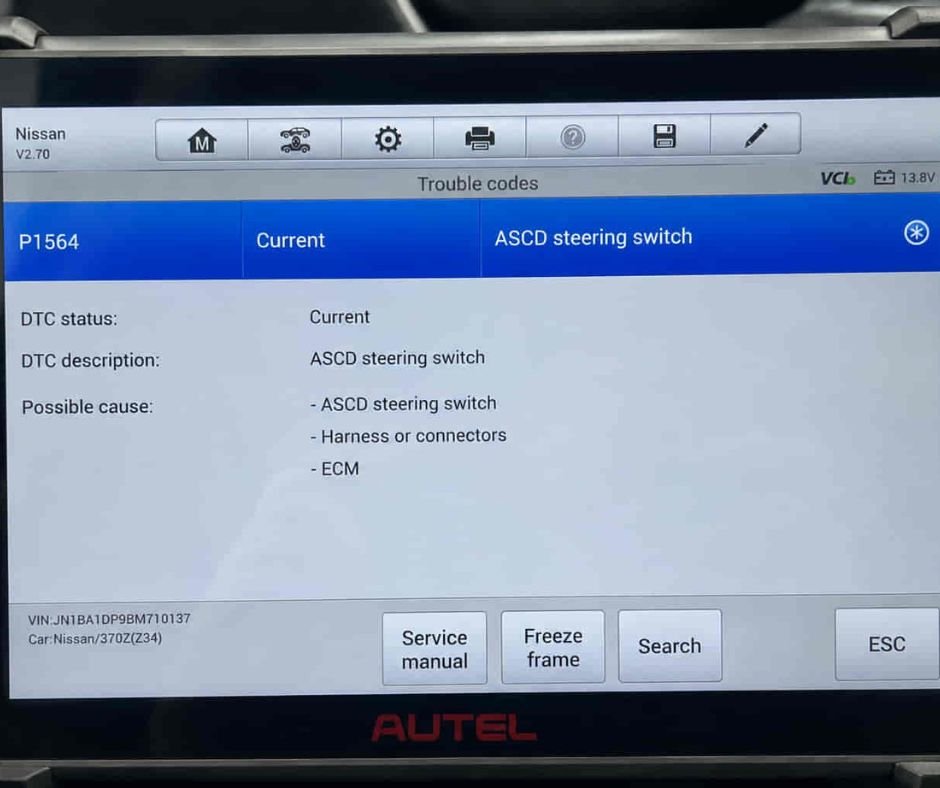
Unlike many powertrain fault codes that indicate engine or transmission failures, Nissan P1564 is commonly associated with the Automatic Speed Control Device (ASCD) steering switch circuit. In most Nissan models, the ECM continuously monitors resistance values generated by the cruise control buttons located on the steering wheel. When those values fall outside the expected range because of a faulty switch, damaged clock spring, loose wiring, or poor electrical connections, the ECM records the P1564 code and may disable the cruise control system to prevent incorrect operation.
Although this diagnostic code rarely causes immediate engine damage, ignoring it can lead to recurring electrical issues, unreliable cruise control performance, and additional fault codes if the underlying problem continues to develop. Understanding the exact cause is essential because replacing the wrong component often fails to resolve the issue and increases repair costs unnecessarily.
This guide explains the ten most common causes of Nissan P1564, how each problem affects the cruise control system, the symptoms you should expect, the correct diagnostic procedure, and the most effective repair solutions based on Nissan service practices.
What Does Nissan P1564 Mean?
Nissan P1564 indicates that the Engine Control Module (ECM) has detected an abnormal signal from the Automatic Speed Control Device (ASCD) steering switch circuit. In most Nissan vehicles equipped with factory cruise control, the steering wheel buttons communicate with the ECM through predetermined resistance values. Every time the driver presses a cruise control button such as ON/OFF, SET, RESUME, or CANCEL, the switch sends a unique voltage signal through the clock spring and wiring harness. If the ECM receives an unexpected voltage, an open circuit, a short circuit, or resistance outside the specified range, it stores Diagnostic Trouble Code P1564 and disables cruise control until the fault is corrected.
Unlike engine performance codes that directly affect combustion or fuel delivery, P1564 primarily concerns the communication between the cruise control switch assembly and the electronic control system. Because the ECM continuously verifies signal accuracy, even a minor interruption caused by corrosion, worn switch contacts, or damaged steering wheel wiring can trigger the code. This explains why some vehicles continue to drive normally while the cruise control system suddenly stops functioning.
The exact behavior depends on the Nissan model and production year. Vehicles such as the Altima, Maxima, Pathfinder, Murano, Frontier, Xterra, Titan, Navara, and several Infiniti models that share similar electronic architectures commonly report P1564 after prolonged use of the steering wheel controls or after repairs involving the steering column. In many cases, the code appears without any noticeable engine hesitation because the malfunction is isolated within the cruise control input circuit rather than the engine management system itself.
Understanding the meaning of P1564 is essential because many vehicle owners mistakenly replace the throttle body, accelerator pedal sensor, or even the ECM after reading generic OBD-II descriptions online. Nissan-specific service information identifies the ASCD steering switch circuit as the primary diagnostic target, making an accurate understanding of the code the first step toward an effective repair.
What Are the Top 10 Causes of Nissan P1564 Code?
A faulty ASCD steering switch is the most common cause of Nissan P1564, but it is not the only one. The cruise control system depends on multiple electrical components working together to deliver stable resistance signals to the ECM. A failure anywhere along this communication path can interrupt signal transmission and generate the diagnostic code.
The most frequent cause is normal wear inside the steering wheel switch assembly. After thousands of button presses over several years, the internal contacts gradually become contaminated or worn. Electrical resistance begins fluctuating beyond factory specifications, causing the ECM to interpret the signal as invalid. Drivers often notice intermittent cruise control operation before the warning code finally appears.
A damaged clock spring is another leading contributor. The clock spring is a spiral cable located behind the steering wheel that maintains electrical communication while allowing the wheel to rotate freely. Continuous steering movement eventually fatigues the ribbon cable inside the assembly. Once individual conductors begin to crack, cruise control signals become unstable, especially when turning the steering wheel. In many vehicles, this failure also affects the horn, steering wheel audio controls, or airbag warning light because they share the same clock spring assembly.
Electrical wiring problems frequently trigger P1564 as vehicles age. Vibration, excessive heat inside the engine compartment, moisture intrusion, or improper previous repairs can damage insulation or loosen terminal connections. Even a small increase in electrical resistance caused by oxidation inside a connector may alter the voltage received by the ECM enough to register a fault.
Corrosion is particularly common in regions with high humidity, coastal environments, or roads treated with deicing chemicals. Moisture entering connectors gradually oxidizes metal terminals, increasing resistance and disrupting signal quality. Since cruise control switches operate using low-voltage reference signals, even minor corrosion can create intermittent communication failures that become increasingly difficult to diagnose.
Improper repairs performed on the steering column represent another overlooked cause. After replacing an airbag module, installing an aftermarket steering wheel, repairing collision damage, or servicing the steering column, technicians may accidentally pinch the wiring harness, misalign the clock spring, or fail to secure electrical connectors completely. These installation errors often produce P1564 immediately after the repair, despite all electronic components remaining functional.
Mechanical damage inside the steering wheel can also affect switch performance. A steering wheel that has experienced impact damage may place uneven pressure on the switch assembly or partially deform internal plastic supports. Over time, this changes the contact pressure inside the buttons and causes inconsistent resistance values whenever specific cruise control functions are activated.
In some situations, the ECM itself misinterprets incoming signals because of software irregularities or internal circuit failures. Although ECM defects are considerably less common than switch or wiring problems, they should not be ignored after every other component has passed factory diagnostic procedures. Manufacturers generally recommend confirming circuit integrity before considering ECM replacement because unnecessary module replacement significantly increases repair costs and often fails to resolve the original problem.
Battery voltage instability can also contribute to communication errors within electronic control systems. Weak batteries, poor grounding points, or unstable charging voltage from a failing alternator occasionally interfere with low-voltage sensor circuits. While these conditions rarely serve as the sole cause of P1564, they may amplify existing weaknesses within the cruise control circuit and trigger intermittent diagnostic codes.
Aftermarket electronic accessories introduce another possible source of electrical interference. Remote start systems, alarm modules, steering wheel control adapters, and non-original audio equipment sometimes require modifications to the factory wiring harness. Incorrect wiring practices or poor-quality electrical splices can introduce resistance changes or electrical noise that affects the ASCD steering switch circuit.
Finally, simple connector looseness remains one of the easiest yet most frequently overlooked causes. Routine maintenance, steering column adjustments, dashboard disassembly, or previous repairs may leave connectors only partially engaged. Because the cruise control system relies on stable electrical continuity, even a slightly loose connector can interrupt communication long enough for the ECM to detect an abnormal condition and store Nissan P1564.
What Symptoms Appear With Nissan P1564 Code?
The most noticeable symptom of Nissan P1564 is the loss of cruise control functionality, although additional electrical symptoms may develop depending on the underlying cause. Since the code originates from the ASCD steering switch circuit, the engine often continues operating normally while the cruise control system is automatically disabled by the Engine Control Module as a protective measure. Many drivers first discover the problem when pressing the SET or RESUME button without any response, even though the vehicle accelerates and shifts normally under manual control.
Cruise control may fail completely or operate intermittently before the diagnostic code becomes permanent. A driver may activate cruise control successfully during one trip but find that the system refuses to engage during the next. This inconsistent behavior usually indicates an electrical connection that changes with steering wheel movement, vibration, or temperature. As damaged wiring, worn switch contacts, or a deteriorating clock spring continue to degrade, the interruption becomes more frequent until the ECM consistently detects an abnormal input signal.
Another common symptom is an illuminated Check Engine Light. Nissan programs the ECM to monitor the resistance values transmitted by the ASCD steering switch whenever the ignition is on. Once the measured voltage falls outside the expected operating range for a specified period, the control module stores P1564 in memory and commands the malfunction indicator lamp to alert the driver. In some vehicles, the cruise control indicator on the instrument cluster may also flash or fail to illuminate when the system is switched on.
Multiple steering wheel functions may stop working simultaneously if the clock spring is damaged. Modern Nissan vehicles route electrical signals for the cruise control buttons, horn, audio controls, voice command switches, and, in many cases, paddle shifters through the same rotating cable assembly. A partially broken clock spring can therefore produce several unrelated symptoms that appear at the same time. Drivers frequently report that the horn stops functioning, steering wheel audio buttons respond inconsistently, or warning lights associated with the Supplemental Restraint System appear shortly before P1564 is stored.
Intermittent symptoms often make diagnosis more challenging than permanent failures. Electrical resistance changes caused by heat expansion, moisture, or steering wheel position can temporarily restore communication before the problem reappears. A vehicle may leave the repair shop without displaying any fault, only for the code to return after several days of normal driving. This behavior explains why technicians often combine scan tool data with resistance measurements and wiring inspections instead of relying solely on active fault codes.
Although P1564 rarely produces noticeable engine performance problems, secondary electrical faults may appear if wiring damage extends beyond the cruise control circuit. Shared power supplies or ground connections can influence other electronic systems, resulting in additional diagnostic trouble codes that complicate the repair process. Correct diagnosis therefore requires identifying the primary electrical fault instead of replacing components based only on stored codes.
How Do You Diagnose Nissan P1564 Step by Step?
Accurate diagnosis of Nissan P1564 begins by confirming the fault before replacing any component because several electrical problems can generate the same diagnostic code. Replacing the cruise control switch without verifying the condition of the clock spring, wiring harness, or electrical connectors frequently results in unnecessary repair costs while leaving the original fault unresolved.
The diagnostic process starts with connecting a professional OBD-II scanner capable of reading manufacturer-specific Nissan data. After confirming that P1564 is active or stored in history, technicians record freeze-frame information, battery voltage, and any additional diagnostic trouble codes. This information helps determine whether the cruise control circuit is the only affected system or whether a broader electrical issue exists within the vehicle.
Once the diagnostic code has been confirmed, the steering wheel controls should be inspected under normal operating conditions. Every cruise control button should produce a consistent response without sticking, excessive resistance, or delayed activation. Physical damage caused by spilled liquids, worn button membranes, or impact to the steering wheel may immediately reveal the source of the problem before more advanced electrical testing becomes necessary.
The next stage focuses on measuring electrical continuity throughout the ASCD steering switch circuit. Technicians compare resistance values generated by each switch position with Nissan factory specifications while observing whether the readings remain stable during repeated button operation. Fluctuating or inconsistent resistance indicates internal switch deterioration even when the buttons appear mechanically intact from the outside.
Attention then shifts to the clock spring because it serves as the communication bridge between the rotating steering wheel and the stationary steering column wiring. The steering wheel is rotated gradually from lock to lock while monitoring electrical continuity. If resistance changes unexpectedly or the signal disappears at specific steering angles, the spiral cable inside the clock spring is likely fractured. This diagnostic method helps identify failures that remain hidden when the steering wheel stays in its centered position.
Electrical connectors and wiring harnesses require equally detailed inspection because many P1564 cases originate outside the switch assembly itself. Connectors should be examined for corrosion, moisture intrusion, bent terminals, overheated plastic housings, or partially disengaged locking tabs. Wiring insulation should be inspected carefully for abrasion against steering column brackets or dashboard components, particularly in vehicles that have undergone collision repairs or aftermarket accessory installation.
Battery voltage and charging system performance should also be verified before concluding the diagnosis. Low system voltage, unstable alternator output, or poor grounding can distort reference voltages within sensitive electronic circuits. Although these conditions rarely create P1564 independently, correcting voltage instability eliminates an important variable during the diagnostic process and prevents inaccurate conclusions.
Only after every switch, connector, wiring section, clock spring, and power supply has been tested should the Engine Control Module become a diagnostic consideration. ECM failures associated with P1564 are uncommon compared with mechanical wear inside the steering wheel controls or electrical wiring defects. For this reason, experienced technicians treat the control module as the final possibility rather than the first component to replace, ensuring that repairs remain both technically accurate and cost-effective.
How Do You Fix Nissan P1564 Based on the Cause?
The correct repair for Nissan P1564 depends entirely on identifying the component responsible for disrupting communication within the ASCD steering switch circuit. Because several electrical components share the same signal path, replacing parts without proper diagnosis often leaves the fault unresolved while increasing repair expenses. An effective repair strategy focuses on restoring stable electrical communication between the steering wheel controls and the Engine Control Module rather than replacing components based solely on the stored diagnostic code.
The most common repair involves replacing the ASCD steering switch assembly after confirming that its resistance values no longer meet factory specifications. Internal switch contacts naturally wear after years of repeated use, causing unstable voltage signals that the ECM interprets as invalid inputs. Installing a new switch restores consistent resistance across every cruise control function, allowing the control module to recognize button commands correctly and clear the fault after verification.
A damaged clock spring requires complete replacement because the ribbon cable inside the assembly cannot be repaired reliably. The clock spring continuously twists and untwists as the steering wheel rotates, making it one of the most heavily stressed electrical components in the steering system. Even a small fracture inside the ribbon cable can interrupt cruise control communication only at specific steering angles, creating intermittent faults that become increasingly frequent over time. Replacing the clock spring restores uninterrupted electrical continuity not only for the cruise control buttons but also for the horn, steering wheel audio controls, voice commands, and airbag circuits when applicable.
Repairing damaged wiring is another common solution, particularly on older vehicles or those that have undergone collision repairs. Electrical conductors that become stretched, pinched, or exposed may create excessive resistance or intermittent open circuits. Professional repairs typically involve replacing the damaged wire section rather than adding temporary splices whenever possible. Using factory-quality terminals, heat-shrink protection, and proper routing reduces the likelihood of future electrical failures caused by vibration or moisture intrusion.
Cleaning corroded electrical connectors can resolve P1564 when oxidation is the primary source of increased circuit resistance. Corrosion prevents low-voltage signals from reaching the ECM accurately, even though the wiring itself remains intact. Technicians generally clean affected terminals using electrical contact cleaner, remove oxidation from connector pins, verify terminal tension, and apply dielectric grease where recommended to reduce future moisture contamination. If corrosion has severely damaged the connector housing or terminal plating, replacing the entire connector provides a more reliable long-term solution.
Loose connectors should never be overlooked because they often produce intermittent faults that appear difficult to reproduce during inspection. A connector that is not fully locked into position may maintain electrical contact while the vehicle remains stationary but disconnect momentarily when exposed to steering movement or road vibration. Securing or replacing the connector frequently restores stable communication without requiring additional component replacement.
Vehicles equipped with aftermarket steering wheels, remote start systems, alarm modules, or steering wheel control interfaces should be inspected carefully for installation errors. Non-original wiring modifications occasionally introduce incorrect resistance values or electrical interference into the ASCD circuit. Returning the wiring to its original factory configuration often eliminates the fault without replacing any Nissan components. This step is particularly important when P1564 appears shortly after electronic accessories have been installed.
Software-related repairs are considerably less common but remain possible on certain Nissan models. Manufacturers periodically release ECM calibration updates to improve communication reliability or address known software anomalies. If every mechanical and electrical component passes inspection, technicians may verify whether an updated ECM calibration is available before considering hardware replacement. Reprogramming the control module is significantly less expensive than replacing it and should always be completed first whenever applicable.
Engine Control Module replacement represents the final repair option after every other diagnostic possibility has been eliminated. ECM failures associated with P1564 occur far less frequently than switch, wiring, or clock spring failures. Because the module requires programming, immobilizer synchronization, and vehicle-specific configuration after installation, replacing it prematurely often results in unnecessary labor costs without correcting the original problem. Confirming every circuit according to factory diagnostic procedures remains the most reliable approach before authorizing ECM replacement.
After completing any repair, technicians should erase all stored diagnostic trouble codes and perform a functional verification rather than simply confirming that the Check Engine Light has turned off. Every cruise control button should respond correctly during a road test, steering wheel functions should operate consistently through the full steering range, and the scan tool should confirm that P1564 does not return after multiple ignition cycles. This final verification ensures the root cause has been eliminated instead of temporarily masked.
How Much Does It Cost to Fix Nissan P1564?
The cost to repair Nissan P1564 varies because the diagnostic code identifies an electrical communication problem rather than a single defective component. Repair expenses depend on which part has failed, the vehicle model, labor rates, and whether genuine Nissan replacement parts or aftermarket alternatives are used. A complete diagnosis is therefore more valuable than estimating repair costs based solely on the stored fault code.
When the ASCD steering switch is the source of the problem, repair costs are generally among the lowest because the switch assembly is relatively accessible after removing the steering wheel trim. Most owners can expect a moderate repair bill that includes both replacement parts and labor. Vehicles with integrated multifunction steering wheel controls may require slightly higher component costs because several button assemblies are incorporated into one unit.
Clock spring replacement is typically more expensive than replacing the steering switch because the steering wheel and airbag module must be removed before the spiral cable can be accessed safely. Additional time is required to center the new clock spring correctly and verify that the steering angle remains aligned after installation. Although the repair involves more labor, replacing a defective clock spring often restores multiple steering wheel functions simultaneously, making it a cost-effective solution when several symptoms appear together.
Wiring repairs can vary significantly in price because labor requirements depend on the location and extent of the damage. Repairing a loose connector or cleaning corroded terminals generally requires minimal labor, while replacing damaged wiring inside the steering column or dashboard may involve several hours of disassembly. Electrical diagnosis often consumes more time than the actual repair because technicians must isolate the exact location where signal integrity has been lost.
Connector replacement usually represents one of the least expensive repair scenarios when corrosion has not spread into the surrounding wiring harness. Replacing individual terminals or connector housings restores proper electrical contact without requiring major component replacement. However, if moisture has damaged multiple sections of the harness, the overall repair cost increases due to the additional labor required to restore factory wiring quality.
ECM-related repairs represent the highest potential expense associated with P1564. Besides the cost of the control module itself, programming, immobilizer registration, and system initialization are required before the vehicle can operate normally. Because these procedures require specialized diagnostic equipment, technicians rarely recommend ECM replacement unless every other component has been tested and confirmed to be functioning correctly.
Vehicle owners should also consider diagnostic charges when estimating total repair costs. Professional diagnosis may initially appear to increase the repair bill, but it often prevents unnecessary replacement of expensive components that are operating correctly. Replacing the steering switch, clock spring, and ECM sequentially without confirming the actual fault usually costs substantially more than performing a comprehensive electrical diagnosis at the beginning of the repair process.
Choosing original equipment parts also influences long-term repair value. Genuine Nissan components generally provide resistance characteristics that precisely match factory specifications, reducing the possibility of recurring communication faults. High-quality aftermarket parts can also perform reliably when manufactured to OEM standards, but lower-quality alternatives occasionally produce inconsistent resistance values that allow intermittent cruise control problems to return after installation. Selecting reliable replacement parts therefore contributes not only to repair durability but also to preventing future diagnostic trouble codes.
Can You Drive With Nissan P1564 Code?
Yes, you can usually continue driving a Nissan with the P1564 code, but you should not ignore the problem because the underlying electrical fault may become more severe over time. Since P1564 primarily affects the Automatic Speed Control Device (ASCD) steering switch circuit, most vehicles retain normal engine performance, transmission operation, braking capability, and steering response. The Engine Control Module typically disables the cruise control system as a protective measure after detecting an invalid input signal, allowing the vehicle to remain drivable under normal conditions.
The level of risk depends on the component responsible for triggering the code. If the fault is limited to a worn cruise control switch, the only noticeable inconvenience may be the inability to activate cruise control during highway driving. However, when the code is caused by a failing clock spring or damaged steering column wiring, additional steering wheel functions may gradually stop working. Drivers may experience intermittent horn operation, unresponsive audio controls, or warning lights related to the Supplemental Restraint System if the electrical damage extends to circuits shared by the airbag module.
Ignoring P1564 for an extended period can also complicate future diagnosis. Electrical resistance inside damaged wiring or corroded connectors rarely improves naturally. Instead, vibration, humidity, and repeated steering wheel movement typically accelerate deterioration until intermittent faults become permanent. A vehicle that initially loses only cruise control may later develop multiple electrical problems originating from the same damaged circuit.
Long-distance highway driving deserves additional consideration because cruise control contributes to driver comfort and speed consistency during extended trips. Operating without cruise control does not create a direct safety hazard, but increased driver fatigue can occur during prolonged journeys. For fleet vehicles or drivers who frequently travel long distances, repairing the fault promptly helps restore both convenience and overall driving efficiency.
Drivers should seek immediate inspection if P1564 appears together with an airbag warning light, steering wheel control failures, or multiple communication-related diagnostic trouble codes. These symptoms may indicate a deteriorating clock spring or wiring fault that affects several critical electrical systems simultaneously. Addressing the issue early reduces repair complexity and minimizes the possibility of additional component failures.
Which Nissan Models Commonly Show P1564?
Nissan P1564 appears most frequently on models equipped with factory cruise control systems that use resistance-based steering wheel switches. Although the exact diagnostic strategy varies slightly between production years, Nissan has applied a similar ASCD communication design across numerous passenger cars, SUVs, pickup trucks, and luxury Infiniti vehicles. As these vehicles accumulate mileage, normal wear within the steering wheel controls and clock spring assembly gradually increases the likelihood of electrical communication faults.
The Nissan Altima is among the models most frequently associated with P1564 because of its widespread production and extensive use of integrated steering wheel controls. Drivers commonly report intermittent cruise control operation before the diagnostic code becomes permanent, particularly on higher-mileage vehicles where switch contacts have experienced years of continuous use.
The Nissan Maxima shares a similar electronic cruise control architecture and often develops identical symptoms. Since many Maxima models include additional steering wheel functions such as audio controls, Bluetooth controls, and voice command buttons, clock spring deterioration may affect several systems simultaneously. Diagnosing these combined symptoms helps technicians identify the underlying electrical failure more efficiently.
SUV models including the Pathfinder, Murano, Xterra, and Armada also experience P1564 because they use comparable steering wheel communication systems. These vehicles are frequently driven under demanding environmental conditions, including off-road use, towing, or exposure to moisture and dust, all of which can accelerate connector corrosion and wiring deterioration over time.
Pickup trucks such as the Frontier, Navara, and Titan regularly appear in repair databases for steering wheel electrical faults after extended service life. Continuous vibration, commercial use, and frequent steering input place additional stress on wiring connections inside the steering column, increasing the possibility of intermittent resistance changes that trigger P1564.
Several Infiniti models equipped with Nissan electronic control systems also report the same diagnostic code. Luxury vehicles typically incorporate additional steering wheel electronics, increasing the number of components that depend on the clock spring for electrical communication. Although the diagnostic procedure remains largely identical, technicians should always verify model-specific wiring diagrams and resistance specifications because connector layouts may differ between platforms.
Vehicle age generally influences the likelihood of P1564 more than engine size or transmission type. Cars that have accumulated significant mileage naturally experience greater wear within steering wheel switches, rotating electrical connectors, and wiring harnesses. Preventive inspection of these components during routine maintenance can identify early signs of deterioration before a diagnostic trouble code is stored.
What Codes Are Related to Nissan P1564?
Nissan P1564 often appears alongside other diagnostic trouble codes affecting the cruise control system, steering wheel controls, or electronic communication circuits. Understanding these related codes helps technicians identify whether the problem is isolated to the ASCD steering switch or whether multiple electrical systems share the same underlying fault.
Codes associated with the cruise control system frequently indicate abnormal switch inputs, communication failures, or interruptions within the steering wheel control circuit. Because several cruise control buttons operate through different resistance values inside a single switch assembly, deterioration of one component can influence multiple diagnostic routines performed by the Engine Control Module.
Steering wheel communication faults are also commonly accompanied by airbag system diagnostic codes when the clock spring begins to fail. Since the spiral cable carries electrical signals for the cruise control buttons, horn, steering wheel audio controls, and Supplemental Restraint System, damage within the assembly can generate faults across several electronic modules simultaneously. Diagnosing only one stored code without considering related systems may result in incomplete repairs.
Low-voltage electrical problems sometimes produce additional communication codes involving the Body Control Module, steering angle sensor, or CAN network. Poor grounding, battery voltage instability, and connector corrosion affect more than one electronic circuit, making comprehensive electrical testing essential whenever multiple diagnostic trouble codes are present.
Sensor-related powertrain codes occasionally appear at the same time as P1564, particularly when voltage fluctuations influence several reference circuits simultaneously. While these secondary codes do not necessarily originate from the cruise control system, identifying the first fault that developed often prevents unnecessary replacement of unrelated engine management components.
Repair professionals typically evaluate diagnostic trouble codes as part of an integrated electrical system rather than isolated failures. Reviewing freeze-frame data, monitoring live sensor information, and confirming circuit integrity provide a more accurate diagnosis than clearing individual codes repeatedly without identifying the original electrical defect. This systematic approach reduces repeat repairs and improves long-term reliability.
Read more: Nissan C1130
How Do You Prevent Nissan P1564 From Coming Back?
Preventing Nissan P1564 requires maintaining the integrity of the entire ASCD steering switch circuit instead of focusing on a single component. Since the diagnostic code results from abnormal electrical communication, preventive maintenance should prioritize protecting connectors, wiring, steering wheel controls, and rotating electrical assemblies from premature wear and environmental damage.
Keeping the steering wheel controls clean significantly extends switch life. Dirt, spilled beverages, skin oils, and airborne contaminants gradually enter the gaps surrounding the buttons, increasing mechanical resistance and accelerating contact wear inside the switch assembly. Periodic cleaning with appropriate automotive interior products helps maintain consistent button operation without introducing moisture into the electrical components.
Protecting the steering column from unnecessary mechanical stress also contributes to long-term reliability. Forcefully pulling on the steering wheel while entering or exiting the vehicle places additional strain on the clock spring and surrounding wiring. Although the assembly is designed to withstand continuous steering movement, repeated external pressure may shorten its service life over many years of use.
Routine inspection of electrical connectors during scheduled maintenance allows technicians to identify loose terminals, moisture intrusion, or early corrosion before communication problems develop. Applying manufacturer-approved dielectric grease where appropriate helps reduce oxidation in humid or coastal environments, preserving stable electrical resistance throughout the circuit.
Owners planning to install aftermarket steering wheels, remote start systems, alarm modules, or multimedia equipment should ensure that all modifications follow factory wiring standards. Improper electrical splices, incorrect connector adapters, or poorly insulated wiring frequently introduce intermittent resistance changes that eventually trigger cruise control diagnostic codes. Professional installation minimizes these risks while preserving the original integrity of the electrical system.
Maintaining a healthy charging system also supports reliable communication between electronic control modules. A fully charged battery, stable alternator output, and secure grounding points help ensure that low-voltage reference circuits operate within their intended range. Regular battery testing during routine servicing can identify declining electrical performance before voltage instability begins affecting sensitive control systems.
Finally, addressing minor steering wheel electrical symptoms as soon as they appear is the most effective preventive strategy. Intermittent cruise control operation, delayed button response, occasional horn failure, or sporadic steering wheel control malfunctions rarely resolve without repair. Investigating these warning signs early allows technicians to correct developing electrical faults before they progress into permanent failures that trigger Nissan P1564 and additional diagnostic trouble codes.