
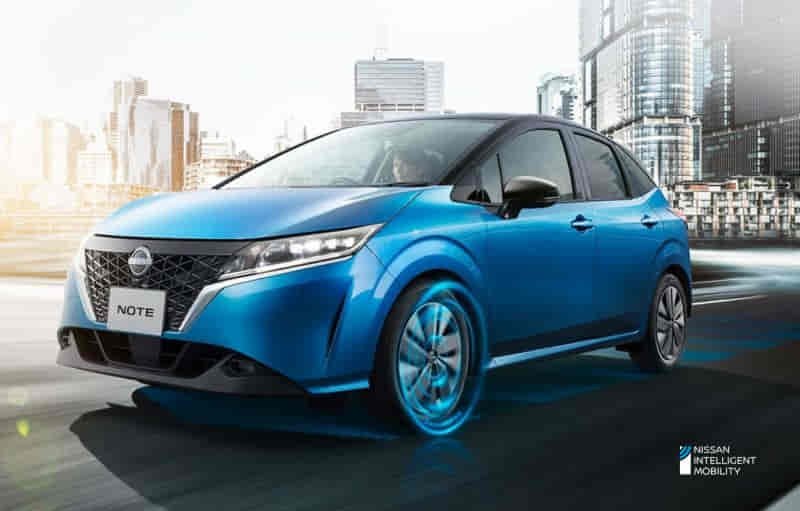
Nissan Note Hybrid has become one of the most fuel-efficient hatchbacks in the Japanese domestic market thanks to Nissan’s e-POWER technology. Unlike conventional hybrid vehicles that combine engine power with direct wheel drive, the Nissan Note e-POWER system uses a gasoline engine solely as an electricity generator while the electric motor drives the wheels at all times. This configuration delivers smoother acceleration, higher energy recovery during deceleration, and lower fuel consumption in urban driving.
Fuel economy varies considerably between Nissan Note Hybrid models because each generation introduces improvements in battery management, motor efficiency, regenerative braking, vehicle weight, drivetrain configuration, and aerodynamic design. Official laboratory figures measured under WLTC or JC08 standards also differ from real-world consumption, making it important to compare both testing data and everyday driving performance before choosing a specific model.
This guide ranks the Nissan Note Hybrid models with the best fuel consumption while explaining why some versions achieve significantly better efficiency than others. It also compares different generations, identifies the factors influencing fuel economy, and helps buyers determine which Nissan Note Hybrid delivers the best balance between running costs and daily usability.
Which Nissan Note Hybrid Model Has the Best Fuel Economy?
The Nissan Note E13 e-POWER 2WD delivers the best fuel consumption among all Nissan Note Hybrid models currently available. Under the WLTC testing cycle, this model achieves approximately 28.4–29.5 km/L depending on the trim level, making it one of the most fuel-efficient compact hatchbacks produced by Nissan. Earlier E12 e-POWER models remain highly economical, but improvements in motor efficiency, battery control software, and regenerative braking allow the second-generation E13 platform to reduce fuel consumption further.
Several engineering changes explain why the E13 generation consumes less fuel than its predecessor. Nissan redesigned the e-POWER drivetrain by integrating a lighter electric motor, a more efficient inverter, and an upgraded battery management system. The gasoline engine also operates within a narrower range of high-efficiency revolutions because it no longer needs to respond directly to wheel speed. Instead, it generates electricity only when required, allowing the electric motor to provide immediate torque while minimizing unnecessary fuel use.
Driving conditions also influence which model performs best. In urban traffic, frequent braking enables regenerative braking to recover kinetic energy and recharge the battery repeatedly. Because electric propulsion dominates low-speed driving, fuel consumption often approaches or even exceeds official ratings. Highway driving produces different results because sustained high speeds require the gasoline engine to generate electricity continuously, reducing the efficiency advantage compared with city operation.
Vehicle configuration further affects overall fuel economy. Front-wheel-drive versions generally consume less fuel than four-wheel-drive models because they have lower mechanical resistance and reduced curb weight. Larger wheels, sport-oriented suspension packages, and additional equipment packages may also increase energy demand, producing slightly higher fuel consumption despite sharing the same hybrid powertrain.
When comparing Nissan Note Hybrid models, buyers should therefore evaluate more than the official fuel economy figure. Real-world efficiency depends on drivetrain configuration, annual mileage, traffic conditions, climate, maintenance quality, and individual driving habits. Considering these variables provides a far more accurate picture of long-term operating costs than relying solely on standardized laboratory testing.
What Are the Top 10 Nissan Note Hybrid Models With the Best Fuel Economy?
The Nissan Note E13 X e-POWER ranks as the most fuel-efficient model in the lineup because it combines Nissan’s second-generation e-POWER system with a lightweight front-wheel-drive platform. Official WLTC ratings reach nearly 29.5 km/L, while most owners report real-world fuel consumption between 24 and 28 km/L depending on traffic conditions. The electric motor delivers instant torque from a standstill, allowing the gasoline engine to operate primarily within its most efficient load range. This operating strategy reduces unnecessary fuel consumption during acceleration and stop-and-go driving, making the E13 X e-POWER particularly economical for urban commuters.
The Nissan Note E13 X FOUR e-POWER offers excellent fuel economy despite using an all-wheel-drive system. Additional drivetrain components inevitably increase vehicle weight and mechanical resistance, causing fuel consumption to be slightly higher than the two-wheel-drive version. Even so, the model commonly achieves more than 26 km/L under WLTC testing, providing one of the highest efficiency figures among compact AWD hybrid hatchbacks. Buyers living in regions with snow, heavy rain, or steep roads often consider this modest increase in fuel consumption an acceptable trade-off for improved traction and driving stability.
The Nissan Note E13 Autech e-POWER maintains competitive fuel economy while adding premium styling and upgraded equipment. Larger alloy wheels, additional comfort features, and sport-oriented suspension settings increase curb weight slightly, yet the highly efficient e-POWER drivetrain continues to deliver impressive efficiency. Most drivers experience fuel consumption between 23 and 27 km/L during mixed driving conditions, demonstrating that premium trim levels do not significantly compromise operating costs.
The Nissan Note Autech Crossover adapts the same hybrid system for drivers seeking greater ride height and improved versatility. Increased ground clearance and crossover-inspired exterior components create slightly higher aerodynamic drag than the standard hatchback. Although these changes reduce fuel economy marginally, the model remains substantially more efficient than many conventional gasoline-powered compact crossovers. Its ability to combine hybrid efficiency with practical everyday usability makes it attractive for families who frequently encounter uneven roads or rural environments.
Among first-generation e-POWER vehicles, the Nissan Note E12 e-POWER Medalist continues to be one of the strongest performers. The model introduced Nissan’s innovative series-hybrid architecture to the mass market and quickly gained recognition for exceptionally low running costs. Under favorable city driving conditions, many owners continue to achieve fuel economy exceeding 30 km/L, particularly when smooth acceleration and regenerative braking are used effectively. Although official testing standards differ from the newer WLTC cycle, the Medalist remains one of the most economical used hybrid vehicles available.
The Nissan Note E12 e-POWER X provides nearly identical mechanical performance while targeting buyers seeking a lower purchase price. Its simpler equipment specification reduces overall vehicle weight slightly, allowing fuel economy to remain highly competitive. Drivers who prioritize affordability often choose this version because it delivers nearly the same hybrid efficiency without the additional cost associated with premium interior features or advanced convenience technologies.
The Nissan Note E12 NISMO e-POWER demonstrates that improved driving dynamics do not necessarily eliminate fuel efficiency. Nissan recalibrated steering response, suspension tuning, and throttle mapping to create a more engaging driving experience while retaining the same basic hybrid architecture. Wider tires and sport-oriented chassis settings slightly increase rolling resistance, yet fuel consumption remains significantly lower than similarly sized gasoline-powered performance hatchbacks. This balance allows enthusiastic drivers to enjoy responsive handling without sacrificing the primary economic advantage of hybrid ownership.
Special editions such as the Nissan Note E13 90th Anniversary Edition preserve the same efficient e-POWER drivetrain while introducing cosmetic enhancements and additional technology features. Because the powertrain remains unchanged, differences in fuel consumption are generally minimal. Buyers selecting these limited-production variants benefit from modern safety equipment, premium cabin finishes, and nearly identical operating costs compared with the standard E13 range.
The Nissan Note E13 Black Arrow Edition also achieves strong fuel economy despite its distinctive styling package. Exterior enhancements such as black trim, unique wheels, and upgraded interior appointments have little influence on hybrid system efficiency. Real-world fuel consumption remains comparable to other E13 front-wheel-drive models, demonstrating that appearance-focused upgrades rarely affect overall energy efficiency when mechanical specifications remain unchanged.
Earlier Nissan Note Hybrid variants equipped with the original hybrid system rather than e-POWER generally record lower fuel economy than later models. Conventional hybrid configurations rely more heavily on direct engine power, reducing the advantages associated with full-time electric motor propulsion. Nevertheless, these vehicles still outperform many similarly sized gasoline hatchbacks and continue to represent an economical choice for buyers seeking reliable transportation at a lower purchase price.
Comparing these ten Nissan Note Hybrid models reveals that overall fuel economy depends on far more than official laboratory figures. Generation improvements, drivetrain configuration, vehicle weight, wheel size, aerodynamic characteristics, and intended driving environment all contribute to long-term efficiency. While the E13 X e-POWER consistently delivers the best balance between official ratings and real-world performance, nearly every Nissan Note Hybrid offers significantly lower fuel costs than an equivalent conventional petrol hatchback, making the model range one of the strongest choices for drivers prioritizing economical daily transportation.
Read more: Nissan Patrol Gear Not Shifting
How Does Nissan Note Hybrid Fuel Consumption Compare Across Model Years?
Fuel consumption has improved noticeably from the first-generation Nissan Note E12 e-POWER to the latest E13 e-POWER because Nissan redesigned nearly every component of the hybrid powertrain. Although both generations use a series hybrid system in which the gasoline engine generates electricity instead of directly driving the wheels, the second-generation platform extracts more energy from every liter of fuel through higher motor efficiency, improved battery management, and smarter energy distribution. As a result, most E13 models achieve official fuel economy figures approaching 30 km/L under the WLTC cycle, while many E12 models were measured under the older JC08 standard with ratings typically ranging between 34 and 37 km/L. Since JC08 generally produces more optimistic figures than WLTC, direct numerical comparisons can be misleading unless both standards are considered.
The Nissan Note E12 introduced e-POWER technology in 2016 and fundamentally changed how compact hybrid vehicles operated. Instead of combining engine power with an electric motor to drive the wheels simultaneously, Nissan adopted a series hybrid architecture where the electric motor became the sole source of propulsion. This configuration delivered smoother acceleration, immediate torque, and outstanding fuel economy in urban environments where regenerative braking could recover energy frequently. However, the first-generation system still relied on earlier battery chemistry, less efficient power electronics, and an older 1.2-liter three-cylinder generator engine that operated less efficiently during sustained high-speed driving.
The E13 generation addressed many of these limitations through extensive engineering upgrades. Nissan developed a second-generation e-POWER system featuring a lighter electric motor, a more compact inverter, lower internal friction, and improved thermal management. The gasoline engine also achieved higher thermal efficiency, allowing it to generate electricity while consuming less fuel under identical driving conditions. These improvements reduced both energy losses and engine operating time, enabling the vehicle to maintain battery charge more effectively without sacrificing acceleration or refinement.
Battery management also became considerably more intelligent in the newer generation. The control software continuously predicts driver demand, road gradients, traffic conditions, and regenerative braking opportunities before determining when the gasoline engine should operate. Rather than simply reacting to battery state of charge, the system proactively balances electricity generation and energy recovery to minimize unnecessary fuel consumption. This predictive control strategy is particularly effective in congested urban traffic, where frequent acceleration and deceleration provide multiple opportunities to capture otherwise wasted kinetic energy.
Vehicle architecture contributes further to the efficiency gains observed in the E13. Nissan introduced a stiffer yet lighter chassis, improved suspension geometry, and enhanced aerodynamic performance. Reduced body flex allows suspension components to operate more efficiently, while better airflow around the vehicle lowers aerodynamic drag during highway cruising. Although each individual improvement appears relatively small, their combined effect produces measurable reductions in overall fuel consumption throughout the vehicle’s operating range.
Real-world ownership data generally supports the engineering improvements observed on paper. Drivers of E12 e-POWER models commonly report average fuel consumption between 20 and 26 km/L depending on climate, driving style, and traffic density. Owners of E13 models frequently achieve averages between 23 and 28 km/L under similar conditions, with experienced eco-driving techniques occasionally producing figures that exceed 30 km/L during predominantly urban journeys. The difference is particularly noticeable in heavy traffic because the updated regenerative braking system captures energy more efficiently while the refined engine management system reduces unnecessary generator operation.
Choosing between different model years therefore depends on balancing purchase price against long-term operating costs. The E12 remains an exceptionally economical used hybrid that offers impressive efficiency for budget-conscious buyers. Meanwhile, the E13 delivers superior fuel economy, quieter operation, smoother power delivery, and more advanced driver assistance technologies. Buyers who expect higher annual mileage often recover the additional purchase cost of the newer generation through lower fuel expenses over several years of ownership, while drivers with shorter commuting distances may still find the first-generation e-POWER provides outstanding value relative to its acquisition cost.
Why Does Fuel Consumption Differ Between Nissan Note Hybrid Models?
Fuel consumption differs between Nissan Note Hybrid models because each version combines different powertrain calibrations, drivetrain layouts, vehicle weights, aerodynamic characteristics, and equipment specifications. Although every e-POWER model uses the same fundamental principle of an electric motor driving the wheels while a gasoline engine generates electricity, the efficiency of that system changes according to how much energy the vehicle requires during everyday driving. Even two Nissan Note models equipped with identical engines can produce noticeably different fuel economy because their mechanical configurations and operating conditions are not the same.
The e-POWER system itself is the largest factor influencing fuel economy. Nissan continuously refined this technology from the E12 to the E13 generation by increasing inverter efficiency, improving battery management software, and reducing mechanical energy losses inside the electric motor. These engineering improvements allow more of the fuel’s chemical energy to reach the wheels instead of being lost as heat. As a result, newer e-POWER models require the gasoline engine to operate less frequently, particularly during low-speed city driving where regenerative braking continuously replenishes battery charge.
Vehicle weight also has a direct relationship with fuel consumption. A heavier vehicle requires more energy to accelerate, climb hills, and maintain speed. Higher trim levels such as the Autech edition include additional comfort features, larger infotainment systems, premium seating materials, and enhanced sound insulation. While these upgrades improve driving comfort, they also increase curb weight. Four-wheel-drive models introduce additional mechanical components including an extra electric drive system for the rear axle, further increasing total vehicle mass and causing slightly higher fuel consumption compared with equivalent front-wheel-drive versions.
Wheel size and tire specifications influence efficiency through rolling resistance. Larger alloy wheels generally require wider tires, increasing the contact area between the tire and the road surface. This creates greater rolling resistance, meaning the electric motor must consume more energy to maintain the same speed. Sport-oriented trims often prioritize handling performance over maximum efficiency by using performance tires that generate additional grip but also increase energy demand. Conversely, standard models equipped with smaller wheels and low rolling resistance tires typically achieve the best fuel economy under identical driving conditions.
Aerodynamics become increasingly important as vehicle speed rises. At urban speeds below approximately 60 km/h, most of the energy consumed by the vehicle is used for acceleration and overcoming rolling resistance. Once highway speeds exceed 80 km/h, aerodynamic drag becomes the dominant force affecting fuel consumption. Small design differences such as roof spoilers, crossover body cladding, wider wheels, or raised ride height increase air resistance, requiring the gasoline engine to generate more electricity to sustain cruising speed. This explains why crossover-inspired variants generally consume slightly more fuel than standard hatchback versions despite sharing the same hybrid powertrain.
Driving conditions often have a greater impact on fuel consumption than the model itself. Stop-and-go urban traffic allows the regenerative braking system to recover energy during every deceleration, enabling the electric motor to reuse electricity that would otherwise be lost as heat through conventional braking. In contrast, long-distance highway driving provides fewer opportunities for energy recovery. The gasoline engine must therefore operate more consistently to generate electricity, reducing the efficiency advantage that makes e-POWER particularly effective in city environments.
Ambient temperature also influences hybrid efficiency because both the lithium-ion battery and gasoline engine perform differently under extreme weather conditions. During cold weather, the engine may operate longer to warm itself and maintain battery temperature, increasing fuel consumption during short trips. High summer temperatures can also reduce battery efficiency because additional energy is required to cool the battery pack and power the air conditioning system. Drivers living in regions with moderate climates generally experience fuel economy closer to official WLTC figures than those operating in extremely hot or cold environments.
Maintenance plays an equally important role in preserving fuel efficiency throughout the vehicle’s lifespan. Dirty air filters restrict engine airflow, worn spark plugs reduce combustion efficiency, underinflated tires increase rolling resistance, and neglected hybrid cooling systems may affect battery performance. Regular servicing ensures that every component operates within its designed efficiency range, allowing the e-POWER system to deliver consistent fuel economy over hundreds of thousands of kilometers.
Driver behavior ultimately determines how much of the vehicle’s engineering potential is realized. Smooth acceleration, gradual braking, and maintaining a constant cruising speed minimize unnecessary energy consumption while maximizing regenerative braking opportunities. Aggressive throttle inputs, rapid acceleration, and repeated high-speed driving force the gasoline engine to generate electricity more frequently, significantly increasing fuel usage. For many owners, adopting efficient driving habits can improve real-world fuel economy by 10% to 20% without making any mechanical modifications to the vehicle.
Understanding these factors demonstrates that Nissan Note Hybrid fuel consumption is not determined by engine specifications alone. Instead, it results from the interaction between vehicle engineering, environmental conditions, maintenance quality, and driving behavior. Buyers comparing different Nissan Note Hybrid models should therefore evaluate how and where the vehicle will be driven rather than relying exclusively on official laboratory fuel economy ratings.
What Is the Difference Between WLTC, JC08, and Real-World Fuel Economy?
WLTC, JC08, and real-world fuel economy measure the same characteristic of a vehicle—how efficiently it consumes fuel—but they do so under different conditions and with different testing methodologies. Understanding the differences between these measurements is essential when comparing Nissan Note Hybrid models because the same vehicle can appear significantly more or less efficient depending on which testing standard is used. Buyers who compare only the published fuel economy figures without considering the testing cycle may develop unrealistic expectations about everyday fuel consumption.
The JC08 cycle was Japan’s official fuel economy testing standard for many years and was used to certify vehicles such as the first-generation Nissan Note E12 e-POWER. This laboratory test emphasized low-speed urban driving with gentle acceleration, relatively short travel distances, and limited high-speed operation. Because the testing conditions were highly controlled and less demanding than everyday driving, vehicles often achieved exceptionally high fuel economy ratings. Many Nissan Note Hybrid models certified under JC08 recorded figures exceeding 35 km/L, creating the impression that these vehicles would consistently deliver similar efficiency on public roads. In practice, however, everyday traffic, weather conditions, road gradients, and driver behavior produce lower results than laboratory testing.
The WLTC, or Worldwide Harmonized Light Vehicles Test Cycle, replaced JC08 to provide a more realistic representation of modern driving conditions. Unlike the earlier Japanese testing method, WLTC includes a broader combination of urban, suburban, and highway driving while introducing stronger acceleration, higher cruising speeds, and longer testing durations. This wider operating range better reflects how most drivers actually use their vehicles throughout the day. As a result, official WLTC fuel economy figures are generally lower than JC08 ratings even though the vehicle itself has not changed. For example, a Nissan Note Hybrid that achieved approximately 37 km/L under JC08 may receive a WLTC rating closer to 28–30 km/L simply because the newer testing procedure places greater demands on the hybrid powertrain.
The difference between these testing standards does not indicate that one generation is less efficient than another. Instead, it reflects the evolution of fuel economy certification toward more representative testing conditions. Comparing an E12 model certified under JC08 directly with an E13 model certified under WLTC without adjusting for the testing method leads to inaccurate conclusions. In many cases, the newer E13 is actually more fuel-efficient despite displaying a numerically lower official rating because WLTC is considerably more stringent than JC08.
Real-world fuel economy provides another perspective by measuring how much fuel owners actually consume during everyday driving. Unlike laboratory testing, real-world efficiency varies according to traffic congestion, road quality, ambient temperature, passenger load, driving style, maintenance condition, and accessory usage such as air conditioning or heating. Two drivers operating identical Nissan Note Hybrid models can easily record fuel consumption that differs by several kilometers per liter simply because their commuting patterns and driving habits are different.
Urban driving often allows the Nissan Note e-POWER system to outperform expectations because regenerative braking repeatedly converts kinetic energy into electricity. Every time the vehicle slows down, part of the energy that would normally be lost through friction brakes is stored in the battery and reused during the next acceleration. This energy recovery mechanism enables many owners to achieve fuel economy close to official WLTC ratings in heavy city traffic. Conversely, sustained highway driving offers fewer opportunities for regenerative braking, requiring the gasoline engine to generate electricity more continuously and increasing overall fuel consumption.
Seasonal weather conditions also influence the difference between laboratory ratings and real-world performance. Cold temperatures reduce battery efficiency and require the engine to operate longer while warming the powertrain and cabin. Hot climates increase the electrical load placed on the hybrid system because the air conditioning compressor consumes additional energy. Frequent short trips further widen the gap between official and actual fuel economy because the hybrid system has less opportunity to reach its optimal operating temperature before the journey ends.
For prospective buyers, real-world fuel economy should be viewed as the most practical indicator of long-term operating costs, while WLTC and JC08 figures remain valuable for comparing vehicles tested under the same certification standard. Evaluating all three measurements together provides a more complete understanding of Nissan Note Hybrid fuel consumption than relying on a single published number. This approach allows buyers to select a model whose efficiency matches both laboratory expectations and everyday driving requirements.
How Can You Improve Nissan Note Hybrid Fuel Economy?
Improving Nissan Note Hybrid fuel economy depends more on driving technique and vehicle maintenance than on modifying the hybrid system itself. The e-POWER powertrain is engineered to maximize efficiency automatically, but its performance is heavily influenced by how efficiently energy is generated, recovered, and consumed during everyday driving. Owners who understand how the system operates can consistently achieve fuel consumption figures close to or even exceeding the official WLTC rating without making mechanical upgrades.
One of the most effective ways to improve fuel economy is to accelerate progressively rather than aggressively. The electric motor in the Nissan Note e-POWER produces maximum torque almost instantly, making the vehicle feel responsive even with light throttle input. Rapid acceleration demands a large amount of electrical energy in a short period, forcing the gasoline engine to start sooner and operate at higher loads to replenish the battery. Gradual acceleration allows the hybrid control unit to balance battery usage with electricity generation more efficiently, reducing unnecessary fuel consumption over the course of a journey.
Maintaining a consistent cruising speed further improves overall efficiency because it minimizes repeated acceleration and deceleration. Every sudden increase in speed requires additional electrical energy, while every unnecessary braking event wastes momentum that could otherwise propel the vehicle forward. Although regenerative braking recovers part of this energy, the recovery process is never 100 percent efficient. Driving smoothly with adequate following distance enables the vehicle to preserve momentum naturally, reducing the frequency with which the engine must generate additional electricity.
Regenerative braking is one of the defining advantages of Nissan’s e-POWER technology, and using it effectively can significantly reduce fuel consumption during urban driving. Rather than braking abruptly at the last moment, drivers should anticipate traffic flow and release the accelerator earlier. This approach allows the regenerative braking system to convert more kinetic energy into electrical energy before the friction brakes engage. The recovered electricity is stored in the lithium-ion battery and immediately becomes available for the next acceleration, reducing the workload placed on the gasoline engine.
Many Nissan Note Hybrid models are equipped with e-Pedal or enhanced regenerative braking modes that simplify efficient driving. Activating these features increases energy recovery whenever the accelerator is released, allowing drivers to control vehicle speed with fewer brake pedal inputs. In congested city traffic where acceleration and deceleration occur repeatedly, e-Pedal operation enables the battery to recover a considerable amount of energy that would otherwise be dissipated as heat. This operating characteristic explains why many owners achieve better fuel economy during city driving than during constant-speed highway travel.
Vehicle maintenance also plays an essential role in preserving hybrid efficiency throughout the vehicle’s lifespan. Tire pressure has a direct influence on rolling resistance, and even a small reduction below the manufacturer’s recommended specification increases the energy required to move the vehicle. Properly inflated tires reduce friction with the road surface, allowing the electric motor to operate more efficiently. Regular wheel alignment provides similar benefits by ensuring that all four tires roll in the intended direction without creating unnecessary resistance.
Routine servicing of the gasoline engine remains equally important even though it does not directly propel the wheels. Clean engine oil reduces internal friction, while replacing air filters and spark plugs at the recommended intervals maintains efficient combustion when the engine operates as an electricity generator. A neglected engine consumes more fuel to produce the same amount of electrical energy, reducing one of the primary economic advantages of the e-POWER system.
The hybrid battery should also operate within its optimal temperature range to maximize efficiency. Extreme heat or prolonged exposure to high ambient temperatures may reduce battery performance and accelerate long-term degradation. Ensuring that battery cooling vents remain unobstructed allows the thermal management system to regulate battery temperature effectively. A healthy battery stores and releases electrical energy more efficiently, reducing the frequency with which the gasoline engine must recharge the system.
Reducing unnecessary vehicle weight provides another practical method for lowering fuel consumption. Carrying heavy cargo permanently in the luggage compartment increases the energy required for every acceleration and hill climb. Roof racks, bicycle carriers, and external storage boxes also increase aerodynamic drag, particularly at highway speeds where air resistance becomes the dominant factor affecting fuel economy. Removing unused accessories allows the vehicle to operate closer to its designed efficiency.
Climate control usage can also influence real-world fuel consumption. During hot weather, the air conditioning compressor draws electrical power from the hybrid system, while cabin heating during winter often requires the gasoline engine to operate longer until sufficient heat is produced. Using climate control efficiently, selecting moderate temperature settings, and ventilating the cabin before driving on extremely hot days can reduce the additional energy demand placed on the hybrid system.
Planning journeys strategically further enhances fuel efficiency. Combining multiple short trips into a single longer journey allows the hybrid system to reach its optimal operating temperature more quickly, reducing the amount of fuel consumed during engine warm-up. Selecting routes with fewer traffic lights and less congestion also increases the opportunities for steady-speed driving while minimizing unnecessary acceleration and braking.
Improving Nissan Note Hybrid fuel economy is therefore not the result of a single driving technique but rather the combination of efficient acceleration, intelligent regenerative braking, proper vehicle maintenance, optimized tire condition, controlled vehicle weight, and thoughtful route planning. When these practices are applied consistently, many owners experience fuel consumption that closely matches or even surpasses official efficiency ratings, demonstrating the full potential of Nissan’s e-POWER hybrid technology.
How Does Nissan Note Compare With Other Hybrid Hatchbacks?
The Nissan Note e-POWER competes with some of the most fuel-efficient hybrid hatchbacks on the market, including the Toyota Aqua, Toyota Yaris Hybrid, Honda Fit Hybrid, and Mazda2 Hybrid. While each model aims to reduce fuel consumption and operating costs, they achieve this goal through different hybrid architectures. Understanding these differences helps buyers choose a vehicle that matches their driving habits rather than selecting a model based solely on official fuel economy figures.
The most significant distinction between the Nissan Note Hybrid and its competitors is the e-POWER system. Unlike Toyota Hybrid Synergy Drive or Honda’s e:HEV system, which allow both the gasoline engine and electric motor to drive the wheels under certain conditions, Nissan uses a series hybrid configuration. In the Nissan Note, the electric motor is always responsible for propelling the vehicle, while the gasoline engine functions exclusively as a generator that produces electricity. This design creates an electric vehicle-like driving experience with smooth acceleration, immediate torque, and quiet operation at low speeds without requiring external charging.
When comparing fuel consumption, the latest Nissan Note E13 e-POWER performs competitively against the Toyota Aqua and Toyota Yaris Hybrid. Under the WLTC testing cycle, these vehicles generally achieve official fuel economy figures ranging from approximately 28 to 36 km/L depending on drivetrain configuration and trim level. Although Toyota models often record slightly higher laboratory ratings, the difference becomes much smaller during real-world driving. In urban environments characterized by frequent stopping and starting, the Nissan Note’s regenerative braking system allows it to recover substantial amounts of energy, enabling many owners to achieve fuel economy close to that of Toyota’s highly regarded hybrid system.
Driving characteristics represent another area where Nissan differentiates itself from competing hybrid hatchbacks. Because the electric motor always drives the wheels, acceleration feels linear and immediate without the engine speed fluctuations commonly associated with conventional hybrid systems. During low-speed driving, the gasoline engine frequently remains off, creating a quieter cabin and smoother driving experience. Even when the engine starts to generate electricity, its operation is largely independent of vehicle speed, producing a refined driving sensation that closely resembles a fully electric vehicle.
The Toyota Aqua continues to be one of the strongest competitors because of its exceptionally mature hybrid technology and proven long-term reliability. Toyota’s power-split hybrid system efficiently combines engine and electric motor output, particularly during steady highway cruising where direct mechanical drive minimizes energy conversion losses. As a result, the Aqua often demonstrates superior efficiency during long-distance travel compared with series hybrid vehicles that rely entirely on electrical energy conversion.
The Toyota Yaris Hybrid offers similar strengths while targeting drivers seeking a slightly larger vehicle with modern safety technology and premium interior refinement. Its hybrid system performs exceptionally well across a broad range of driving conditions, making it a popular choice for buyers who divide their driving between urban commuting and motorway travel. Although its driving feel differs from Nissan’s electric-focused e-POWER system, both vehicles deliver remarkably low operating costs over extended ownership.
Honda Fit Hybrid adopts a different engineering philosophy through the e:HEV hybrid system, which intelligently switches between electric drive, hybrid drive, and direct engine drive according to road conditions. This flexibility enables the Fit Hybrid to optimize efficiency across a wide range of vehicle speeds. The cabin also offers one of the most spacious interiors in the compact hatchback segment, making it particularly attractive for families requiring maximum passenger and cargo space without sacrificing fuel economy.
The Mazda2 Hybrid shares much of its engineering with Toyota’s hybrid technology, emphasizing reliability, efficient fuel consumption, and predictable driving behavior. Although it lacks the distinctive electric driving experience provided by Nissan’s e-POWER system, it remains a highly efficient alternative for buyers prioritizing proven hybrid performance and straightforward ownership.
Ownership costs extend beyond fuel consumption alone. Nissan Note Hybrid models generally require less brake maintenance because regenerative braking reduces wear on conventional brake components. Their electric motor also eliminates many of the mechanical complexities associated with traditional automatic transmissions. However, Toyota’s hybrid systems have accumulated decades of global reliability data, providing buyers with additional confidence regarding long-term durability and resale value. Honda likewise enjoys a strong reputation for dependable hybrid engineering, while Mazda benefits from sharing proven hybrid technology in selected markets.
The best hybrid hatchback therefore depends on individual priorities rather than a single specification. Drivers who value an electric vehicle-like driving experience, responsive acceleration, and outstanding efficiency in city traffic often find the Nissan Note e-POWER to be the most satisfying choice. Buyers who regularly travel long highway distances may prefer Toyota’s hybrid architecture because of its excellent cruising efficiency. Those seeking maximum cabin versatility may lean toward the Honda Fit Hybrid, while drivers prioritizing established hybrid reliability across global markets may also favor Toyota’s offerings.
Viewed as a whole, the Nissan Note Hybrid remains one of the strongest competitors in the compact hybrid segment. Its innovative e-POWER technology, excellent urban fuel economy, refined driving characteristics, and competitive operating costs enable it to stand alongside the Toyota Aqua, Toyota Yaris Hybrid, Honda Fit Hybrid, and Mazda2 Hybrid as one of the most practical fuel-efficient hatchbacks available for daily transportation.
Which Nissan Note Hybrid Model Should You Buy?
The best Nissan Note Hybrid model depends on how the vehicle will be used, because every generation and trim level offers a different balance between fuel economy, purchase price, technology, and driving performance. Although the latest E13 e-POWER consistently delivers the highest overall efficiency, earlier E12 models continue to provide excellent value for buyers seeking low running costs at a significantly lower purchase price. Evaluating ownership costs, annual mileage, driving environment, and desired features provides a more accurate basis for selecting the right model than focusing exclusively on official fuel consumption figures.
Drivers whose primary objective is achieving the lowest possible fuel consumption should consider the Nissan Note E13 X e-POWER. This model combines the second-generation e-POWER system with a lightweight front-wheel-drive configuration that maximizes energy efficiency. Under mixed driving conditions, many owners consistently record fuel economy between 24 and 28 km/L, while careful urban driving can produce figures approaching the official WLTC rating. The refined electric motor, upgraded battery management system, and improved thermal efficiency of the gasoline generator enable this version to deliver the lowest long-term fuel costs across the Nissan Note Hybrid range.
Urban commuters benefit most from the Nissan Note E13 because its hybrid system was specifically optimized for stop-and-go traffic. Frequent braking allows regenerative braking to recover substantial amounts of energy, while low-speed electric propulsion minimizes engine operation during daily commuting. The instant torque delivered by the electric motor also improves responsiveness when accelerating away from traffic lights or navigating congested city streets. These characteristics make the E13 particularly suitable for drivers who spend most of their time in metropolitan environments.
Buyers operating in regions with snow, mountainous terrain, or frequent rainfall may find the Nissan Note X FOUR e-POWER to be the more practical choice despite its slightly higher fuel consumption. The additional electric drive system powering the rear wheels improves traction and vehicle stability without introducing the complexity of a conventional mechanical four-wheel-drive system. Although fuel economy is marginally lower than the equivalent front-wheel-drive version, many drivers consider the enhanced confidence and year-round usability well worth the small increase in operating costs.
For value-conscious buyers entering the hybrid market, the Nissan Note E12 e-POWER remains one of the strongest used-car options available. Its introduction marked the beginning of Nissan’s series hybrid technology, and the vehicle continues to demonstrate impressive reliability and fuel efficiency years after its release. Well-maintained examples frequently achieve real-world fuel consumption above 20 km/L while costing substantially less than newer E13 models. Lower depreciation also allows buyers to recover more of their investment over the course of ownership.
Drivers who place equal importance on comfort and efficiency should consider premium trims such as the Nissan Note Autech e-POWER or Medalist. These models introduce upgraded interior materials, enhanced seating comfort, advanced safety technologies, and distinctive exterior styling while maintaining fuel economy that remains highly competitive within the hybrid hatchback segment. Although additional equipment slightly increases vehicle weight, the effect on everyday fuel consumption is relatively small compared with the improvements in overall driving experience.
Long-distance drivers should also evaluate how different hybrid systems perform beyond urban traffic. While the Nissan Note e-POWER remains highly efficient on highways, its greatest advantage appears in city driving where regenerative braking is used frequently. Buyers whose annual mileage consists primarily of motorway travel may find the difference in real-world fuel economy between the Nissan Note and competing hybrids such as the Toyota Aqua or Toyota Yaris Hybrid considerably smaller than official laboratory figures suggest. Matching the vehicle to the dominant driving environment therefore produces better long-term ownership satisfaction than selecting a model based solely on published specifications.
Technology and safety features have improved significantly between generations as well. The E13 introduces Nissan’s latest ProPILOT driver assistance technologies, improved infotainment systems, enhanced collision avoidance functions, and a quieter cabin. These upgrades contribute to a more refined ownership experience while supporting higher resale values in many used-car markets. Buyers intending to keep the vehicle for many years may therefore justify the higher purchase price through improved comfort, safety, and future market value in addition to lower fuel consumption.
Maintenance history should receive equal attention regardless of model year. A well-maintained E12 with complete service records often represents a better investment than a neglected E13. Regular oil changes, hybrid battery inspections, cooling system maintenance, and proper tire care all influence long-term fuel economy and reliability. Because the e-POWER system depends on efficient cooperation between the gasoline engine, battery, inverter, and electric motor, preventative maintenance helps preserve both performance and operating efficiency throughout the vehicle’s lifespan.
Overall, the Nissan Note E13 X e-POWER offers the best combination of fuel economy, modern technology, refinement, and long-term efficiency for most buyers. The Nissan Note X FOUR e-POWER provides additional capability for challenging road conditions, while the E12 e-POWER remains an outstanding choice for budget-conscious drivers seeking dependable hybrid performance. Selecting the right Nissan Note Hybrid ultimately depends on balancing purchase price, annual driving distance, road conditions, desired equipment, and expected ownership period rather than considering fuel consumption as the only purchasing criterion.
Final Thoughts
The Nissan Note Hybrid remains one of the most fuel-efficient compact hatchbacks because its e-POWER technology prioritizes electric driving without requiring external charging. Unlike conventional hybrid systems that alternate between engine and electric motor propulsion, Nissan’s series hybrid architecture allows the electric motor to power the wheels continuously while the gasoline engine generates electricity only when needed. This design reduces fuel consumption during urban driving, improves acceleration response, and delivers a smoother driving experience that closely resembles a battery electric vehicle.
Comparing fuel consumption across different Nissan Note Hybrid models demonstrates that newer generations consistently improve efficiency through advances in powertrain engineering rather than larger engines or batteries. The E13 e-POWER introduces a more efficient electric motor, improved inverter technology, enhanced battery management software, and better thermal efficiency, enabling it to outperform the earlier E12 generation in both official WLTC testing and everyday driving. At the same time, well-maintained E12 models continue to provide exceptional value for buyers seeking affordable hybrid ownership with low running costs.
Official fuel economy figures should always be interpreted alongside real-world driving conditions. Testing standards such as WLTC and JC08 provide a useful benchmark for comparing vehicles, but actual fuel consumption depends on traffic density, driving style, ambient temperature, road conditions, vehicle maintenance, and annual mileage. Drivers who adopt smooth acceleration, effective regenerative braking, proper tire maintenance, and consistent servicing frequently achieve fuel economy that closely matches or even exceeds manufacturer expectations.
Choosing the best Nissan Note Hybrid ultimately depends on individual priorities. Buyers focused on maximum fuel efficiency and modern technology will benefit most from the E13 X e-POWER. Drivers requiring additional traction throughout the year may prefer the X FOUR e-POWER despite its slightly higher fuel consumption. Budget-conscious buyers can still enjoy impressive hybrid performance by selecting a well-maintained E12 e-POWER, which continues to rank among the most economical used hybrid hatchbacks available.
As fuel prices continue to fluctuate and environmental regulations become increasingly stringent, vehicles capable of delivering exceptional fuel economy without compromising practicality will remain highly desirable. The Nissan Note Hybrid has established itself as one of the strongest contenders in this segment by combining low operating costs, proven reliability, refined electric driving characteristics, and everyday usability. Whether purchasing a new or used model, understanding the factors that influence Nissan Note Hybrid fuel consumption enables buyers to select the version that offers the greatest long-term value while minimizing ownership expenses.