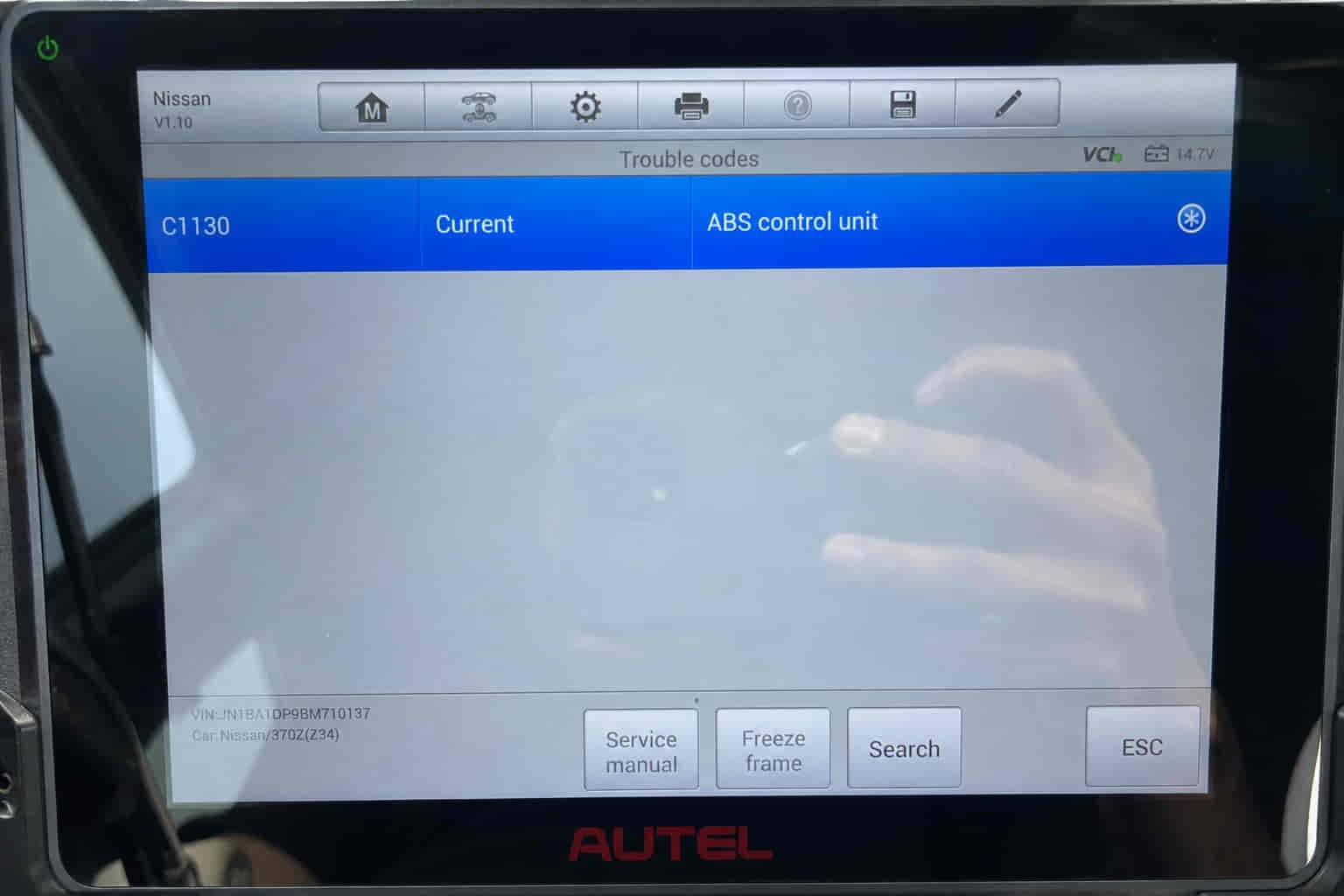
Several Nissan models are more likely to display the C1130 diagnostic trouble code (DTC) because they share similar ABS and engine control system architectures. Although C1130 is not tied to a single vehicle, it is frequently reported on models such as the Altima, Sentra, Rogue, X-Trail, and Pathfinder. In most cases, the code indicates that the ABS control module has detected an engine-related malfunction or has stopped receiving the engine signal required for proper traction and brake control. As a result, the root cause often lies outside the ABS system itself.
Knowing which Nissan models commonly experience C1130 helps owners and technicians narrow the diagnosis much faster. Instead of replacing ABS components immediately, they can inspect related systems such as the Engine Control Module (ECM), wheel speed sensors, CAN communication network, battery voltage, and wiring harness. This targeted approach reduces unnecessary repairs and lowers diagnostic costs.
This guide lists the eight Nissan models that most commonly show the C1130 code, explains why these vehicles are more susceptible, outlines the symptoms drivers are likely to notice, and describes the diagnostic and repair procedures typically recommended by professional technicians. It also covers related fault codes, estimated repair costs, and preventive maintenance practices that can reduce the likelihood of the code returning.
What Does Nissan C1130 Mean?
Nissan C1130 is an ABS-related diagnostic trouble code that indicates the Anti-lock Braking System (ABS) control module has detected an engine malfunction signal from the Engine Control Module (ECM). Contrary to what many vehicle owners assume, C1130 does not confirm that the ABS module itself has failed. Instead, it tells the technician that the ABS system has received information indicating an existing engine-related fault that could affect vehicle stability and traction control.
On most Nissan vehicles, the ABS control module continuously exchanges operating data with the ECM through the Controller Area Network (CAN) bus. This communication includes engine torque, throttle position, vehicle speed, wheel speed, and other parameters required by systems such as Traction Control System (TCS) and Vehicle Dynamic Control (VDC). When the ECM stores a powertrain fault severe enough to influence engine output, the ABS module records C1130 to indicate that brake intervention may no longer function under normal conditions.
Because C1130 depends on information supplied by another control module, it is generally considered a secondary fault code rather than the root cause of the problem. Professional technicians rarely diagnose C1130 in isolation. Instead, they begin by scanning the ECM for stored engine codes, as these codes often explain why the ABS module generated C1130. For example, an engine misfire, an electronic throttle control malfunction, or a crankshaft position sensor failure can trigger the ECM to limit engine performance. Once the ABS module detects this condition, it stores C1130 to notify the driver that stability-related functions may be restricted until the primary engine fault has been repaired.
This design allows Nissan vehicles to prioritize vehicle safety. Rather than attempting to operate traction control with incomplete or inaccurate engine information, the ABS system temporarily limits its intervention. As a result, resolving the underlying engine fault usually clears C1130 after the diagnostic trouble codes are erased and normal communication between the ECM and ABS module is restored.
Which Nissan Models Commonly Show the C1130 Code?
The C1130 trouble code appears most frequently on Nissan models equipped with integrated ABS, Vehicle Dynamic Control, and CAN-based engine management systems. Although the code can be stored on many Nissan vehicles, service records and technician reports consistently show higher occurrence rates among models that share similar electrical architectures and braking control strategies.
The Nissan Altima is one of the models most commonly associated with C1130 because it combines advanced electronic brake control with multiple engine management systems. When the ECM detects faults affecting ignition timing, throttle response, or crankshaft synchronization, the ABS module frequently records C1130 as a companion code. This pattern is especially common on Altima models equipped with continuously variable transmissions (CVTs), where engine torque management plays an important role in traction control.
The Nissan Sentra also experiences C1130 regularly due to its shared electronic platform with several compact Nissan vehicles. Aging wheel speed sensor wiring, deteriorated electrical connectors, low battery voltage, and engine-related diagnostic codes can all interrupt communication between the ECM and ABS module. Since these vehicles are widely used for daily commuting, accumulated mileage often increases the likelihood of electrical connection problems that contribute to the appearance of C1130.
Compact SUVs such as the Nissan Rogue, X-Trail, and Qashqai frequently display C1130 because they rely heavily on Vehicle Dynamic Control when driving on wet, uneven, or low-traction surfaces. These systems constantly exchange engine torque and wheel speed information to maintain vehicle stability. If engine performance data becomes unavailable, the ABS controller immediately recognizes the communication interruption and stores C1130 to prevent incorrect brake intervention.
Larger Nissan vehicles, including the Pathfinder, Frontier, and Patrol, may also generate C1130, particularly after prolonged operation in demanding environments. Off-road driving, vibration, moisture intrusion, and corrosion around wiring harnesses or ABS connectors increase the possibility of intermittent communication failures. Although the underlying causes differ from passenger sedans, the diagnostic principle remains the same: the ABS control unit is responding to an engine-related condition rather than identifying an internal ABS failure.
Because Nissan has used similar electronic control strategies across multiple vehicle generations, technicians generally approach C1130 using the same diagnostic methodology regardless of the specific model. The differences usually lie in component locations, wiring layouts, and common failure points instead of the meaning of the diagnostic code itself.
Why Do These Nissan Models Experience the C1130 Code More Often?
Certain Nissan models experience C1130 more frequently because their braking, stability, and engine management systems depend on continuous real-time communication between multiple electronic control modules. As vehicles become more electronically integrated, a fault in one subsystem can immediately affect several others, causing secondary diagnostic trouble codes such as C1130 to appear.
One of the primary reasons is the extensive use of CAN bus communication. Instead of operating independently, the Engine Control Module, ABS control module, Transmission Control Module, and Body Control Module exchange hundreds of data messages every second. If the ECM detects a fault that limits engine performance or temporarily stops transmitting critical operating information, the ABS controller recognizes the interruption and records C1130. This architecture improves safety but also increases the likelihood of secondary communication codes.
Electrical reliability also plays a significant role. Many Nissan vehicles begin experiencing wiring deterioration after years of exposure to engine heat, road vibration, water intrusion, and corrosion. Connectors located near wheel wells, engine compartments, and ABS hydraulic units are particularly vulnerable because they are exposed to moisture, dirt, and temperature fluctuations. Even a slight increase in electrical resistance can interrupt communication long enough for the ABS module to register C1130.
Battery condition is another contributing factor that is often overlooked during diagnosis. Modern Nissan vehicles require stable system voltage for every control module to communicate correctly. A weak battery, deteriorating alternator, or unstable charging system may not immediately prevent the engine from starting, but voltage fluctuations can disrupt data transmission between modules. In many cases, technicians have found that restoring proper charging voltage eliminates intermittent communication faults without replacing expensive electronic components.
Finally, these Nissan models often accumulate high mileage while retaining their original sensors, harnesses, and connectors. As components age, small electrical irregularities become more common, increasing the probability of communication-related diagnostic codes. This explains why C1130 is reported more frequently on older vehicles, even when no major ABS component has actually failed. Understanding these system interactions enables technicians to identify the true source of the problem instead of replacing parts based solely on the presence of the C1130 code.
What Symptoms Usually Appear with Nissan C1130?
The most common symptoms of Nissan C1130 include illuminated ABS, Check Engine, Traction Control, or Vehicle Dynamic Control warning lights, along with reduced stability control performance. Because C1130 is a secondary diagnostic trouble code, the symptoms usually originate from the primary engine or communication fault rather than from the ABS system itself. Drivers often notice multiple warning indicators appearing simultaneously because several electronic control modules share the same operating data.
The first symptom is typically the ABS warning light remaining illuminated after the engine starts. When the ABS control module loses critical information from the Engine Control Module, it temporarily disables anti-lock braking functions that rely on accurate engine torque calculations. Under normal driving conditions, the vehicle may continue to brake normally. However, during emergency braking or on slippery roads, the ABS may not intervene as effectively because it cannot verify all required operating parameters.
Many Nissan vehicles also display the Check Engine Light together with the traction control or Vehicle Dynamic Control indicator. This combination is an important diagnostic clue because it suggests that C1130 is reacting to an existing powertrain fault instead of identifying a brake system failure. Once the Engine Control Module stores a fault affecting throttle response, ignition timing, crankshaft position, or another engine management function, the ABS controller immediately records C1130 to indicate that stability-related features are operating under restricted conditions.
Drivers may also experience temporary deactivation of cruise control or traction control. These systems require continuous communication between the ECM and ABS module to adjust engine torque and braking force during acceleration or cornering. When communication becomes unreliable, Nissan’s control strategy disables these functions to prevent incorrect vehicle responses. Although the vehicle usually remains drivable, electronic driving assistance features become unavailable until the primary malfunction is repaired.
In some situations, no noticeable driving symptoms occur beyond the illuminated warning lights. This is especially common when C1130 is triggered by intermittent communication problems, weak battery voltage, or temporary CAN network interruptions. Even if vehicle performance appears normal, the stored code should not be ignored because it may indicate an electrical issue that can become more severe over time.
Which Fault Codes Often Appear Together with C1130?
Nissan C1130 rarely appears by itself because it depends on another malfunction occurring within the engine management or vehicle communication system. Professional technicians therefore treat C1130 as a supporting diagnostic code and always search for additional Diagnostic Trouble Codes (DTCs) before replacing any ABS-related components.
Engine-related fault codes are the most common companions to C1130. Misfire codes, electronic throttle control faults, crankshaft position sensor failures, camshaft position sensor errors, and mass airflow sensor malfunctions frequently appear first inside the Engine Control Module. These primary faults affect engine operation, prompting the ABS control module to record C1130 because accurate engine information is no longer available for traction and stability calculations. Repairing the engine fault usually causes C1130 to disappear after the control modules complete a successful self-test.
Communication codes also appear regularly alongside C1130. Faults such as U1000 and U1001 indicate interruptions within the CAN communication network that connects the Engine Control Module, ABS controller, Transmission Control Module, and other electronic systems. Damaged wiring, loose connectors, water intrusion, or unstable battery voltage can all reduce communication quality and cause multiple modules to store related fault codes simultaneously. In these situations, repairing the communication network resolves several codes at once rather than addressing each module individually.
ABS-specific codes may also accompany C1130 when wheel speed information becomes unreliable. Faults involving wheel speed sensors, ABS actuator circuits, hydraulic control units, or brake pressure sensors can affect how the ABS controller interprets engine data. Although these codes require inspection of braking components, technicians still verify that no engine-related malfunction exists before replacing expensive ABS assemblies. This systematic diagnostic process prevents unnecessary repairs and significantly improves repair accuracy.
Because C1130 functions as a secondary warning, identifying the earliest stored diagnostic code remains the most effective strategy. Freeze frame data, live sensor readings, and module communication status provide valuable evidence for determining which fault occurred first and which codes simply resulted from the original malfunction.
How Do You Diagnose Nissan C1130 Correctly?
Diagnosing Nissan C1130 correctly begins with identifying the primary fault that caused the ABS module to store the code rather than focusing on the ABS system itself. Replacing wheel speed sensors or the ABS module without locating the original engine or communication problem often leads to unnecessary repair costs and repeated warning lights.
The diagnostic process starts by performing a complete scan of every control module using a professional OBD-II scanner capable of accessing Nissan-specific systems. Reading only the Engine Control Module is insufficient because C1130 originates inside the ABS controller. A full system scan reveals whether engine, transmission, body control, or communication modules have stored additional diagnostic codes that explain why C1130 appeared. Freeze frame data should also be reviewed because it records vehicle operating conditions at the exact moment the fault occurred, including engine speed, battery voltage, coolant temperature, and vehicle speed.
After identifying the primary diagnostic codes, technicians inspect the electrical system for voltage stability and communication integrity. Battery voltage should remain within manufacturer specifications both before and after engine start because unstable voltage frequently disrupts CAN network communication. Wiring harnesses, ground connections, ABS connectors, and Engine Control Module terminals should be inspected carefully for corrosion, loose pins, moisture intrusion, or physical damage. Even minor increases in electrical resistance can interrupt data transmission long enough to trigger communication-related fault codes.
Once electrical integrity has been confirmed, live data analysis becomes the next critical step. Monitoring wheel speed sensors, engine torque values, throttle position, brake switch status, and CAN communication parameters while driving allows technicians to identify intermittent failures that static testing cannot detect. If all communication signals remain stable and the primary engine fault has been repaired, clearing the diagnostic codes and completing a road test verifies whether C1130 returns. Only when the code reappears after these procedures should advanced testing of the ABS control module or Engine Control Module be considered.
How Much Does It Cost to Repair Nissan C1130?
The cost to repair Nissan C1130 varies depending on the underlying fault because the code itself identifies a secondary system response rather than a failed component. Repair expenses can range from a simple electrical repair costing less than $100 to replacing major electronic control modules that exceed $1,500. The most important factor affecting repair cost is identifying the primary Diagnostic Trouble Code before replacing any parts.
Minor repairs are usually associated with wiring damage, loose electrical connectors, blown fuses, or low battery voltage. These problems interrupt communication between the Engine Control Module and the ABS control module without requiring component replacement. Since technicians only need to repair the electrical circuit and clear the stored codes, labor represents the largest portion of the repair bill. Correcting these issues early prevents unnecessary replacement of expensive electronic modules.
Moderate repair costs are commonly related to failed wheel speed sensors, damaged ABS sensor wiring, malfunctioning crankshaft position sensors, or electronic throttle control components. Although these parts belong to different vehicle systems, they can all trigger engine-related Diagnostic Trouble Codes that ultimately cause the ABS controller to store C1130. Replacing the defective component and recalibrating the system usually restores normal communication between the control modules.
The highest repair costs occur when the ABS control module, Engine Control Module, or CAN communication network has suffered internal failure. Electronic control modules require specialized diagnostic equipment to verify their operation because communication problems can easily be mistaken for module failure. Professional repair facilities therefore inspect wiring integrity, power supply, and ground circuits before recommending module replacement. This diagnostic sequence significantly reduces unnecessary repair costs and improves long-term reliability.
Vehicle model, production year, regional labor rates, and the availability of replacement parts also influence the final repair cost. Newer Nissan models equipped with advanced driver assistance systems generally require additional calibration after repairs, increasing labor time. For this reason, a complete diagnostic inspection is considerably more cost-effective than replacing components based solely on the presence of the C1130 code.
Can You Continue Driving with Nissan C1130?
Most Nissan vehicles remain drivable after storing the C1130 code, but continuing to drive without diagnosing the underlying problem is not recommended. The code itself rarely causes immediate loss of braking performance because the hydraulic brake system continues operating normally. However, electronic safety functions that rely on communication between the Engine Control Module and ABS control module may become partially or completely disabled.
Under normal driving conditions, many drivers notice little difference beyond illuminated warning lights on the dashboard. Everyday acceleration, steering, and braking often remain unaffected because mechanical braking components continue functioning independently of the electronic control systems. This explains why some owners continue driving for weeks before seeking professional diagnosis. Despite the absence of obvious drivability issues, the vehicle is operating with reduced electronic safety support.
The greatest concern arises during emergency situations where traction control, Vehicle Dynamic Control, or Anti-lock Braking System intervention becomes necessary. These systems continuously calculate engine torque, wheel speed, steering angle, and braking force to maintain vehicle stability. If communication between electronic control modules has been interrupted, the vehicle may no longer receive corrective braking or engine torque reduction during sudden maneuvers. Wet roads, loose gravel, snow, and high-speed cornering therefore present greater risks when C1130 remains unresolved.
The level of risk also depends on the primary fault responsible for triggering C1130. If the code resulted from a temporary voltage fluctuation or intermittent communication issue, vehicle operation may remain relatively stable. Conversely, if the Engine Control Module has detected engine misfires, throttle control failures, or crankshaft position sensor faults, continued driving may lead to reduced engine performance, increased fuel consumption, or even engine stalling. Diagnosing the original fault is therefore far more important than evaluating C1130 in isolation.
Drivers should regard C1130 as an indication that another system requires immediate attention rather than as evidence of an ABS failure. Scheduling a diagnostic inspection as soon as possible minimizes safety risks, prevents secondary damage, and often reduces overall repair costs.
How Can You Prevent Nissan C1130 from Returning?
Preventing Nissan C1130 requires maintaining reliable communication between the Engine Control Module, ABS control module, and other electronic control systems throughout the vehicle. Since C1130 usually develops as a consequence of another malfunction, preventive maintenance should focus on preserving electrical integrity rather than servicing the ABS system alone.
Routine inspection of the vehicle’s electrical system is one of the most effective preventive measures. Battery voltage should remain within manufacturer specifications because low voltage frequently disrupts communication across the CAN network. A weak battery or deteriorating charging system may continue starting the engine while simultaneously creating intermittent communication faults between multiple control modules. Periodic battery testing and charging system inspections help eliminate this common source of diagnostic trouble codes.
Electrical connectors and wiring harnesses should also be inspected during regular maintenance, particularly around the ABS hydraulic unit, wheel speed sensors, and Engine Control Module. Moisture, corrosion, road salt, and engine heat gradually degrade connector terminals, increasing electrical resistance and reducing communication reliability. Cleaning corroded terminals, securing loose connectors, and repairing damaged wiring before complete failure occurs significantly reduces the likelihood of recurring communication errors.
Regular engine maintenance indirectly helps prevent C1130 because the ABS controller depends on accurate engine operating information. Replacing worn ignition components, servicing air intake systems, maintaining proper fuel delivery, and addressing Check Engine Light warnings promptly reduce the possibility of engine-related Diagnostic Trouble Codes that can trigger C1130 as a secondary fault. Ignoring minor engine issues often allows them to develop into larger communication problems affecting multiple vehicle systems.
Finally, every repair involving the engine management, braking, or electrical system should be followed by a complete diagnostic scan and road test. Clearing stored Diagnostic Trouble Codes without verifying normal module communication can allow hidden faults to remain active. Confirming that all control modules exchange data correctly after repairs ensures the underlying cause has been eliminated and greatly decreases the chance of Nissan C1130 returning in the future.
Read more: Nissan Qashqai Auto Hold Not Working
Final Thoughts
Nissan C1130 is best understood as a warning that another system has already developed a fault rather than as proof of an ABS system failure. Although the code is stored by the ABS control module, it typically reflects an engine-related malfunction or a communication issue between electronic control units. Identifying this relationship is essential because replacing ABS components without diagnosing the original problem rarely resolves the issue.
Vehicles such as the Nissan Altima, Sentra, Rogue, X-Trail, Qashqai, Pathfinder, Frontier, and Patrol commonly display C1130 because they share similar electronic architectures that rely on continuous communication between the Engine Control Module and the ABS control module. When engine performance data becomes unavailable or communication across the CAN network is interrupted, the ABS system records C1130 to indicate that traction and stability functions may be operating with limited capability.
Accurate diagnosis always begins with scanning every control module, reviewing freeze frame data, inspecting battery voltage and wiring integrity, and identifying the primary Diagnostic Trouble Code that appeared before C1130. Following this diagnostic sequence allows technicians to repair the actual source of the malfunction instead of replacing parts based solely on a secondary warning code. This approach improves repair accuracy, reduces unnecessary expenses, and minimizes the likelihood of recurring faults.
Routine maintenance also plays a significant role in preventing Nissan C1130. Keeping the electrical system in good condition, repairing engine faults promptly, protecting wiring harnesses from corrosion, and verifying module communication after every repair help maintain reliable operation of the vehicle’s integrated control systems. As Nissan vehicles continue to incorporate more advanced electronic technologies, proactive maintenance becomes increasingly important for ensuring long-term reliability and preserving the performance of safety systems such as ABS, Traction Control, and Vehicle Dynamic Control.