Many people ask whether a Mercedes truck is actually a Nissan. The question often appears because some Mercedes commercial vehicles share parts and platforms with Nissan models. This similarity creates confusion among buyers who want to know what they are really purchasing.
The short answer is no. A Mercedes truck is not automatically a Nissan. Mercedes-Benz designs and builds most of its trucks independently. However, the company partnered with Nissan and Renault to develop a small number of commercial vehicles and pickup trucks. Those models share selected components, but Mercedes still applies its own engineering, design, technology, and quality standards.
Automakers often share platforms to reduce development costs and speed up production. Even so, shared architecture does not create identical vehicles. Suspension tuning, cabin materials, safety features, software, and driving characteristics can differ significantly. These changes help each manufacturer maintain its own identity and target different customer groups.
This guide explains which Mercedes trucks share a relationship with Nissan and which models remain entirely Mercedes products. You will also learn why the partnership existed, how the vehicles differ, and what those differences mean for reliability, performance, ownership costs, and buying decisions.
Is the Mercedes Truck a Nissan?
The short answer is no. A Mercedes truck is not automatically a Nissan. Mercedes-Benz develops and manufactures most of its trucks independently. However, several models resulted from a partnership between Mercedes-Benz, Nissan, and Renault. Those vehicles share selected platforms or components, but they remain distinct products with different engineering standards and brand identities.
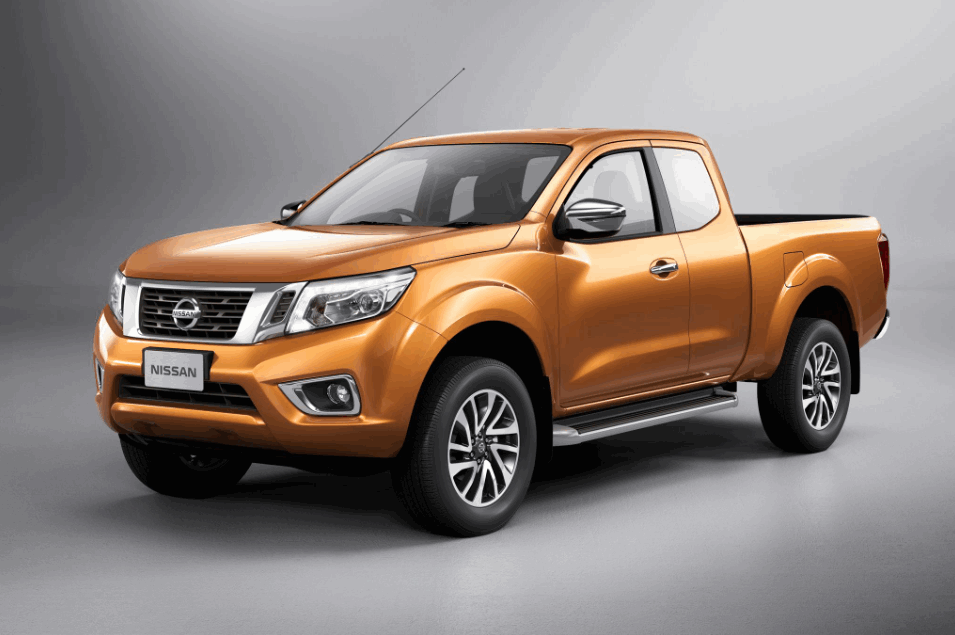
The confusion mainly comes from the Mercedes X-Class and the Mercedes Citan. Both vehicles originated from collaborative projects under the Renault-Nissan-Mitsubishi Alliance. For example, the Mercedes X-Class shares its basic platform with the Nissan Navara, while the Mercedes Citan is closely related to the Renault Kangoo. Although these models use common foundations, Mercedes redesigned key areas to match its own quality expectations. The company refined the suspension, upgraded the interior, improved safety systems, and introduced model-specific technology to create a different driving experience.
Most Mercedes trucks have no direct connection to Nissan. Heavy-duty models such as the Actros, Arocs, Atego, and eActros are fully developed by Mercedes-Benz for commercial transport. These trucks use Mercedes-designed engines, transmissions, chassis, and electronic systems. They also follow the company’s engineering philosophy, which focuses on durability, efficiency, safety, and long-distance performance. As a result, they differ completely from Nissan’s commercial vehicle lineup.
Platform sharing has become a common strategy across the automotive industry. Manufacturers use this approach to reduce development costs, shorten production time, and enter new market segments more efficiently. Sharing a platform does not mean two vehicles are identical. Each manufacturer adjusts the design, technology, handling, comfort, and performance to meet its own standards and customer expectations.
When someone asks whether a Mercedes truck is a Nissan, the correct answer depends on the specific model. A few Mercedes vehicles share their foundations with Nissan products because of a strategic partnership. However, the majority of Mercedes trucks remain genuine Mercedes-Benz vehicles that the company designed, engineered, and built under its own brand standards.
Which Mercedes Trucks Share a Platform With Nissan?
Mercedes-Benz has shared platforms with Nissan on only a small number of vehicles. The best known example is the Mercedes X-Class. It uses the same basic ladder-frame chassis as the Nissan Navara because both models came from the Renault-Nissan-Mitsubishi Alliance. Even so, Mercedes did not simply change the badge. The company invested significant resources to improve comfort, handling, and overall driving quality before launching the vehicle.
Mercedes engineers modified several key components to create a more premium pickup. They retuned the suspension for a smoother ride and more precise handling. They also improved steering response and added stronger sound insulation. Inside the cabin, the X-Class featured higher-quality materials, a redesigned dashboard, and advanced infotainment systems that distinguished it from the Navara. These changes gave the truck a driving experience that aligned more closely with the Mercedes-Benz brand.
The partnership also influenced Mercedes’ compact commercial van segment. The first-generation Mercedes Citan shared its architecture with the Renault Kangoo, while Nissan sold a closely related model called the NV250 in several markets. Although these vehicles shared major structural components, Mercedes upgraded safety equipment, interior finishes, and onboard technology. As a result, customers received a vehicle that reflected Mercedes standards rather than a direct copy of either partner’s model.
Platform sharing does not mean every component comes from the same manufacturer. Mercedes often developed its own suspension settings, electronic systems, cabin features, and optional powertrains. These modifications created noticeable differences in ride quality, refinement, and overall ownership experience. Buyers could recognize the shared foundation, but they also experienced the characteristics expected from a Mercedes-Benz vehicle.
Today, these shared-platform models represent only a small part of the Mercedes commercial vehicle lineup. Most Mercedes trucks, including heavy-duty and medium-duty models, have no engineering relationship with Nissan. Instead, Mercedes continues to develop those vehicles independently to meet the demands of professional transport, logistics, construction, and long-distance freight operations.
Why Did Mercedes and Nissan Work Together?
Mercedes-Benz and Nissan formed a strategic partnership to reduce development costs, expand their product portfolios, and improve production efficiency. Instead of designing every vehicle from the ground up, both companies shared selected platforms, technologies, and manufacturing resources. This strategy allowed them to enter competitive market segments more quickly while maintaining their individual brand identities.
The collaboration officially began in 2010 when Daimler AG and the Renault-Nissan Alliance announced a global cooperation agreement. The partnership covered passenger cars, commercial vans, pickup trucks, and powertrain development. Each company contributed its own expertise to specific projects. Mercedes focused on premium engineering and advanced technology, while Nissan provided proven pickup platforms and extensive manufacturing experience. Renault also supported several commercial vehicle programs with established van architectures.
The alliance offered clear advantages for every manufacturer involved. Mercedes reduced research and production expenses without sacrificing quality. Nissan gained access to premium engineering knowledge and expanded its international business opportunities. Renault strengthened its position in the light commercial vehicle market through additional production volume. As a result, all three companies improved efficiency while lowering the financial risks associated with developing entirely new vehicles.
Customers also benefited from this collaboration. Shared development reduced production costs and accelerated the release of new models. At the same time, Mercedes continued to customize suspension systems, interior materials, safety technologies, and driving dynamics. These improvements ensured that vehicles such as the Mercedes X-Class delivered a premium ownership experience despite sharing part of their engineering foundation with Nissan.
Although the partnership produced several successful projects, it never meant that Mercedes became part of Nissan or vice versa. Each company remained an independent manufacturer with its own engineering standards, design philosophy, and product strategy. Today, the alliance serves as an example of how modern automakers can cooperate on selected technologies while continuing to compete in the global automotive market.
How Is a Mercedes Truck Different From a Nissan Truck?
A Mercedes truck differs from a Nissan truck in design, engineering, technology, and driving experience. Even when both vehicles share the same platform, Mercedes applies its own development standards to create a product that reflects the brand’s premium positioning. The shared foundation provides a starting point, but Mercedes invests in extensive refinements before bringing the vehicle to market.
One of the biggest differences appears in ride quality and handling. Mercedes engineers recalibrate the suspension to improve comfort and stability on different road surfaces. They also fine-tune the steering system to deliver greater precision and better driver feedback. These adjustments create a smoother driving experience, especially during long journeys or when carrying heavy loads. Nissan models often prioritize practicality and durability, while Mercedes balances utility with refinement.
The cabin also separates the two brands. Mercedes typically installs higher-quality materials, modern dashboard layouts, and more advanced infotainment systems. Many models include premium features such as digital displays, enhanced driver assistance systems, and additional comfort options. These upgrades create a more sophisticated interior without changing the vehicle’s primary purpose as a commercial truck or pickup.
Performance and safety provide another important distinction. Mercedes often introduces its own engine options, transmission calibrations, and electronic control systems. The company also integrates advanced safety technologies, including intelligent braking assistance, lane-keeping support, adaptive cruise control, and driver monitoring features. These systems improve confidence behind the wheel while supporting everyday commercial operations.
Brand positioning further explains the differences between the two manufacturers. Nissan focuses on delivering dependable vehicles with strong value for money, while Mercedes emphasizes premium quality, advanced engineering, and long-term driving comfort. For this reason, two trucks that share the same platform can still appeal to different buyers. The underlying architecture may be similar, but the overall ownership experience remains distinctly Mercedes-Benz.
Conclusion
The answer is straightforward. A Mercedes truck is not automatically a Nissan. While Mercedes-Benz and Nissan worked together on several projects, only a limited number of vehicles share platforms or selected mechanical components. Most Mercedes trucks remain independent products that Mercedes designs, engineers, and manufactures according to its own standards.
The partnership mainly involved models such as the Mercedes X-Class and selected commercial vans. Even in those cases, Mercedes introduced significant upgrades to the suspension, interior, technology, safety systems, and overall driving experience. These improvements created vehicles that reflected the brand’s premium identity instead of becoming simple rebadged versions of Nissan models.
Understanding this distinction helps buyers make better purchasing decisions. Rather than assuming every Mercedes truck shares the same origin, it is more useful to evaluate the specific model, its engineering, and its intended purpose. By comparing features, performance, ownership costs, and long-term reliability, you can determine whether a Mercedes truck or a Nissan truck offers the better fit for your personal or business needs.