
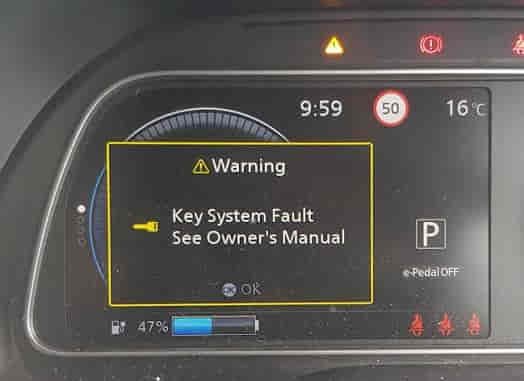
A Nissan Leaf Key Not Detected warning means the vehicle cannot communicate with the Intelligent Key system, preventing normal unlocking or starting functions. In many cases, the problem is not the key itself. A weak key fob battery, a failing 12V battery, signal interference, or a malfunctioning vehicle component can all trigger the same warning message.
The Nissan Leaf relies on several systems working together to recognize the key. The Intelligent Key, key antennas, Body Control Module (BCM), immobilizer system, and 12V battery continuously exchange signals to verify authorization before the vehicle starts. If any part of this communication process fails, the vehicle may display a Key Not Detected message even when the key fob is inside the cabin.
Some causes are simple and inexpensive to fix. Replacing a CR2025 battery in the key fob may solve the problem within minutes. Other issues, such as a faulty key antenna, BCM failure, or lost key programming, require more advanced diagnostics and repair procedures.
This guide explains 11 common Nissan Leaf Key Not Detected problems, how each issue affects the Intelligent Key system, the symptoms to look for, and the most effective solutions. You will also learn how to start a Nissan Leaf when the key is not detected, how much common repairs cost, and what maintenance practices help prevent future key detection failures.
Why Does My Nissan Leaf Say Key Not Detected?
A Nissan Leaf displays a Key Not Detected warning when the vehicle cannot communicate with the Intelligent Key system. The warning does not necessarily indicate a defective key fob. Instead, it means the vehicle is unable to verify the presence of an authorized key required to unlock functions and start the vehicle.
The Intelligent Key system depends on communication between multiple components, including the key fob, key antennas, Body Control Module (BCM), immobilizer system, push-button start system, and the vehicle’s 12V battery. If any component fails to transmit or receive the required signal, the authentication process is interrupted and the warning appears.
Because several systems participate in key recognition, diagnosing the root cause requires understanding how power supply, radio frequency communication, and vehicle security systems interact. In many cases, the issue originates from a weak battery or communication failure rather than a defective key.
Is the Key Fob Battery Dead?
A weak or depleted key fob battery is the most common cause of Nissan Leaf key detection problems. The Intelligent Key continuously transmits identification signals that allow the vehicle to verify authorization. When battery voltage drops below the required level, signal strength decreases and communication becomes unreliable.
Most key fob batteries fail gradually rather than suddenly. Drivers often notice reduced operating range before complete failure occurs. Remote locking functions may require multiple button presses, and the vehicle may recognize the key intermittently before eventually displaying a Key Not Detected warning.
The Nissan Leaf key fob typically uses a CR2025 lithium battery. Under normal operating conditions, this battery lasts between two and four years. Factors such as frequent remote operation, extreme temperatures, and prolonged storage can shorten battery life.
Replacing the battery restores signal strength immediately if battery depletion is the underlying cause. Because the replacement process requires minimal cost and effort, checking battery condition should be the first diagnostic step whenever key detection issues occur.
Is the Key Fob Too Far From the Vehicle?
The Nissan Leaf can only detect the Intelligent Key within a specific communication range. If the key is outside this range or shielded by surrounding objects, the vehicle may fail to recognize its presence.
Signal strength decreases as distance increases. The problem becomes more noticeable when the key is stored inside a backpack, purse, luggage compartment, or heavily insulated pocket. Metal objects positioned near the key can further reduce signal transmission by absorbing or reflecting radio frequency waves.
Drivers frequently encounter this issue when carrying multiple electronic devices together. Smartphones, power banks, laptops, and metallic accessories can partially obstruct communication between the key fob and vehicle antennas.
Moving the key closer to the push-button start system often restores detection immediately. If the warning disappears when the key is placed near the dashboard or start button, the issue is likely related to communication range rather than hardware failure.
Is RF Signal Interference Blocking Communication?
Radio frequency interference can prevent a functional Intelligent Key from communicating with the vehicle. The Nissan Leaf uses wireless communication channels that may be affected by competing electronic signals generated by nearby devices or infrastructure.
Interference is more common in locations containing dense electronic activity. Parking structures, airports, government facilities, telecommunications equipment, and commercial buildings often generate electromagnetic signals capable of disrupting key authentication.
Consumer electronics can also contribute to communication problems. Bluetooth devices, wireless routers, aftermarket vehicle accessories, security systems, and mobile phones occasionally operate on frequencies that create interference with the Intelligent Key system.
Unlike mechanical failures, radio frequency interference typically changes depending on location. A vehicle that cannot detect the key in one environment may function normally after being moved elsewhere. This behavior helps distinguish interference from defective components.
Is the 12V Battery Weak or Dead?
A weak or discharged 12V battery is one of the most overlooked causes of Nissan Leaf key detection problems. Although the Nissan Leaf is an electric vehicle powered by a high-voltage traction battery, the Intelligent Key system, Body Control Module, immobilizer, antennas, and many electronic control units rely on the 12V battery to operate correctly. When voltage drops below normal levels, these systems may fail to communicate, causing the vehicle to display a Key Not Detected warning.
Many owners assume the high-voltage battery powers every electrical component in the vehicle. In reality, the 12V battery acts as the primary power source for the vehicle’s low-voltage electronics. If the battery becomes weak, electronic modules may shut down temporarily, reboot unexpectedly, or fail to process incoming signals from the key fob. As a result, the vehicle may incorrectly assume that no authorized key is present.
A failing 12V battery often produces additional symptoms before complete failure occurs. The instrument cluster may flicker during startup, warning lights may appear randomly, power accessories may respond slowly, and the vehicle may occasionally refuse to enter READY mode. In many cases, key detection issues appear weeks before the battery completely fails.
Battery aging is the most common cause of voltage loss. Most Nissan Leaf 12V batteries last between three and five years depending on climate, charging habits, and driving frequency. Vehicles that remain parked for extended periods often experience accelerated battery degradation because the battery continues supporting standby electrical systems.
Testing battery voltage is one of the most effective diagnostic procedures when troubleshooting a Key Not Detected warning. A healthy battery typically measures around 12.6 volts when fully charged. Readings below 12.2 volts often indicate a weakened battery, while readings below 12 volts usually suggest significant discharge. Restoring proper voltage through charging or battery replacement frequently resolves key recognition issues without requiring additional repairs.
Is the Intelligent Key Antenna Faulty?
A faulty Intelligent Key antenna can prevent the Nissan Leaf from detecting an authorized key even when the key fob is functioning correctly. The antenna network serves as the communication bridge between the vehicle and the Intelligent Key system. If one or more antennas stop transmitting or receiving signals, key authentication may fail entirely.
The Nissan Leaf uses multiple antennas positioned throughout the vehicle to determine whether the key is located inside or outside the cabin. These antennas continuously search for an authorized key whenever a door handle is touched or the start button is pressed. The system relies on precise signal exchanges to verify the key’s location before granting access or allowing startup.
A damaged antenna often creates inconsistent behavior. The vehicle may detect the key in certain areas of the cabin but fail to recognize it elsewhere. Some owners notice that placing the key near the start button temporarily restores functionality, while normal detection remains unreliable. These symptoms frequently indicate weakened antenna performance rather than a defective key fob.
Electrical faults, wiring damage, connector corrosion, and moisture intrusion are common causes of antenna failure. Because the antennas communicate directly with the Body Control Module, even minor signal disruptions can interrupt the authentication process. In some cases, diagnostic trouble codes stored within the vehicle’s electronic control systems can help identify which antenna is malfunctioning.
Unlike battery-related issues, antenna failures typically require professional diagnosis because specialized diagnostic equipment is needed to verify signal transmission and module communication. Once the defective antenna is identified, replacing the affected component usually restores normal key detection performance.
Has the Key Fob Lost Its Programming?
A Nissan Leaf may display a Key Not Detected warning if the Intelligent Key is no longer properly registered to the vehicle. Key programming allows the vehicle’s security system to recognize a specific encrypted identification code stored within the key fob. When this registration becomes corrupted or is lost, the vehicle can no longer verify authorization.
Modern Nissan vehicles use encrypted communication protocols designed to prevent unauthorized access. During the registration process, the key fob and vehicle exchange security credentials that remain stored in memory. If this information becomes damaged or mismatched, authentication fails even though the key battery and hardware remain fully functional.
Programming loss is relatively uncommon but can occur after certain electrical events. A severely discharged 12V battery, control module replacement, software updates, failed programming attempts, or previous key registration errors can sometimes interfere with stored key data. Vehicles that have undergone electronic repairs may be more likely to experience registration-related problems.
One indication of programming failure is that every button on the key fob appears functional while the vehicle still displays a Key Not Detected warning. In some situations, a spare key may continue working normally while the affected key becomes unusable. This difference helps distinguish programming issues from broader vehicle communication failures.
Re-registering the key typically restores communication if programming loss is the underlying cause. Depending on the model year and security system configuration, the procedure may require dealer-level diagnostic equipment or specialized locksmith tools. Once registration is completed successfully, the vehicle should immediately recognize the key and eliminate the warning message.
Is the Push Button Start System Malfunctioning?
A malfunctioning push button start system can prevent the Nissan Leaf from recognizing an authorized key even when the key fob is functioning normally. The start button serves as a critical communication point between the Intelligent Key system, Body Control Module, and vehicle security systems. If the button fails to send the correct signals, the authentication process may stop before key verification is completed.
The Nissan Leaf performs several electronic checks when the start button is pressed. The vehicle first confirms key presence, then validates security credentials through the immobilizer system before allowing startup. A faulty start button can interrupt this sequence, causing the system to display a Key Not Detected warning despite the key being located inside the cabin.
Button-related failures often develop gradually. Drivers may notice delayed responses when pressing the start button, inconsistent startup behavior, or situations where repeated button presses are required before the vehicle enters READY mode. In some cases, the vehicle may recognize the key intermittently, creating the impression that the key fob itself is defective.
Physical wear is one of the most common causes of push button start problems. Over thousands of operating cycles, internal contacts can deteriorate and become less responsive. Electrical connector issues, moisture intrusion, and communication faults between the button assembly and control modules can also interfere with normal operation.
Because the push button start system interacts directly with multiple electronic control units, diagnosing the fault often requires scanning the vehicle for diagnostic trouble codes. Identifying the exact source of communication failure is essential before replacing components, as symptoms can closely resemble those caused by key fob, antenna, or BCM issues.
Is the Immobilizer System Preventing Key Recognition?
The immobilizer system can prevent a Nissan Leaf from starting if it cannot verify that the detected key is authorized for the vehicle. The immobilizer is a built-in security system designed to prevent theft by blocking vehicle operation when authentication requirements are not met.
Every Nissan Intelligent Key contains a unique encrypted identifier. When the key enters the vehicle, the immobilizer system compares this identifier against stored security data. If verification fails, the vehicle may display a Key Not Detected warning or refuse to start even though the key is physically present.
Immobilizer-related issues are often more complex than simple battery or signal problems because they involve encrypted communication between security modules. Corrupted software, damaged security data, failed control units, and synchronization errors between electronic modules can all interfere with authentication. In some cases, replacing vehicle electronics without proper programming can create conflicts within the security system.
Drivers experiencing immobilizer faults may notice additional symptoms beyond key detection errors. Security warning lights may remain illuminated on the dashboard, startup attempts may fail repeatedly, and spare keys may produce the same results as the primary key. These indicators suggest the problem originates within the vehicle’s security architecture rather than the key fob itself.
Resolving immobilizer issues often requires specialized diagnostic equipment capable of accessing security-related control modules. Because anti-theft systems use encrypted communication protocols, repairs frequently involve software synchronization, key re-registration, or module programming procedures that cannot be performed through basic troubleshooting methods.
Is the Body Control Module Failing?
A failing Body Control Module can disrupt key detection because it acts as the central communication hub for many of the Nissan Leaf’s electronic systems. The BCM manages interactions between the Intelligent Key system, door locks, immobilizer, interior electronics, and multiple vehicle sensors. When the module develops faults, key authentication can become unreliable or fail completely.
The Body Control Module continuously processes information from antennas positioned throughout the vehicle. These antennas report key location data, which the BCM evaluates before authorizing entry and startup functions. If the module cannot process incoming information correctly, the vehicle may incorrectly conclude that no valid key is present.
BCM failures often produce a wide range of symptoms extending beyond key detection problems. Power locks may behave unpredictably, interior lights may malfunction, warning messages may appear without explanation, and electronic accessories may operate inconsistently. When several unrelated electrical issues occur simultaneously, the BCM becomes a likely suspect.
Electrical surges, water intrusion, aging circuitry, and software corruption are among the most common causes of BCM failure. Because the module serves as a communication gateway between numerous vehicle systems, even a minor fault can create widespread operational problems. This complexity often makes BCM-related issues difficult to diagnose without professional equipment.
Confirming a BCM failure generally requires advanced diagnostics capable of evaluating module communication networks and stored fault codes. Once identified, repairs may involve software updates, module reprogramming, or complete replacement depending on the severity of the fault. Restoring proper BCM operation often resolves not only key detection issues but also multiple secondary electrical problems affecting the vehicle.
Has Water Damage Affected the Key Fob?
Water damage can cause a Nissan Leaf key fob to stop communicating with the vehicle even when the battery remains functional. Modern Intelligent Keys contain delicate electronic components that are highly sensitive to moisture exposure. Small amounts of liquid can damage circuitry, create corrosion, or interfere with signal transmission.
Unlike mechanical keys, smart key fobs rely on integrated circuits, radio transmitters, microprocessors, and battery contacts. These components operate using extremely low electrical currents. When moisture enters the housing, electrical pathways can become disrupted, preventing the key from generating a reliable signal.
Water-related failures do not always occur immediately after exposure. In many cases, corrosion develops gradually over days or weeks. A key fob may continue functioning temporarily before experiencing reduced range, intermittent communication failures, or complete loss of functionality. This delayed failure often makes the original cause difficult to identify.
Common sources of water damage include accidental washing machine cycles, heavy rain exposure, spilled beverages, and high-humidity environments. Even brief exposure can allow moisture to penetrate damaged seals or small openings within the key housing.
If water damage is suspected, the key fob should be inspected as soon as possible. Early intervention may prevent further corrosion and reduce the likelihood of permanent electronic damage. However, severe moisture exposure frequently requires complete key replacement because internal electronic components are often difficult to repair reliably.
Is the Key Fob Physically Damaged?
Physical damage can prevent a Nissan Leaf key fob from transmitting the signals required for vehicle authentication. Although the exterior housing may appear intact, internal components can become damaged through repeated impacts, crushing forces, or long-term wear.
The Intelligent Key contains a circuit board, radio transmitter, battery contacts, antenna components, and several microelectronic elements. Any damage affecting these parts can reduce signal strength or interrupt communication entirely. Unlike battery-related problems, physical damage often causes persistent failures that do not improve after replacing the battery.
Dropping a key fob onto hard surfaces is one of the most common causes of internal damage. Repeated impacts can crack solder joints, loosen electronic components, or damage antenna connections. Keys carried in tightly packed bags, pockets, or toolboxes may also experience structural stress over time.
Physical damage frequently produces inconsistent symptoms during the early stages of failure. The key may work normally in certain positions but fail when handled differently. Drivers may notice that applying pressure to specific areas temporarily restores functionality, indicating loose internal connections rather than complete component failure.
Careful inspection can sometimes reveal visible signs of damage such as cracked housings, separated seams, bent battery contacts, or loose buttons. However, many failures occur internally and require disassembly for confirmation. When critical electronic components are damaged, replacing the key fob is often more practical and reliable than attempting extensive repairs.
How Can You Start a Nissan Leaf When the Key Is Not Detected?
A Nissan Leaf can often be started even when the vehicle displays a Key Not Detected warning. Nissan includes an emergency key recognition procedure that allows the Intelligent Key system to authenticate the key through close-range communication when normal wireless detection fails.
The emergency procedure works because the vehicle can read the key’s transponder chip directly when the key fob is positioned near the start button. Even if the key fob battery is weak or signal transmission is limited, the transponder may still contain enough information for the immobilizer system to verify authorization.
In most Nissan Leaf models, placing the Intelligent Key directly against the push-button start switch and pressing the brake pedal while pushing the start button allows the vehicle to attempt an alternative authentication process. This method bypasses many of the communication limitations that prevent standard key detection.
If the vehicle starts successfully using this procedure, the result provides valuable diagnostic information. It suggests that the key itself is likely still programmed correctly and that the issue may involve battery voltage, signal strength, antenna performance, or wireless communication rather than complete key failure.
However, if the emergency procedure also fails, the problem is often more serious. Programming issues, immobilizer faults, BCM failures, damaged key electronics, or severe communication errors become more likely causes. At that point, advanced diagnostics are usually required to determine the exact source of the failure.
How Much Does It Cost to Fix a Nissan Leaf Key Not Detected Problem?
The cost of repairing a Nissan Leaf Key Not Detected problem varies significantly because multiple components can trigger the warning. Some fixes cost less than ten dollars, while others involve advanced diagnostics and electronic module replacement.
The least expensive repair is usually replacing the key fob battery. A replacement CR2025 battery generally costs between $3 and $10 and can often resolve key detection issues immediately. Because battery failure is the most common cause, this remains the first repair most owners should consider.
A replacement Intelligent Key typically costs between $150 and $500 depending on model year, programming requirements, and dealership pricing. The cost includes both the physical key and the electronic registration process required to pair the key with the vehicle’s security system.
If the issue originates from the 12V battery, replacement costs commonly range from $120 to $300. Pricing depends on battery capacity, installation fees, and regional labor rates. Because the 12V battery supports the Intelligent Key system, replacing a weak battery frequently resolves multiple electrical issues simultaneously.
More advanced repairs become significantly more expensive. Intelligent Key antenna replacement may cost between $200 and $600 depending on component location and labor requirements. Body Control Module replacement can exceed $1,000 once programming and diagnostic procedures are included. Immobilizer-related repairs may fall anywhere within this range depending on the affected components and security system requirements.
Accurate diagnosis is important because replacing the wrong component can quickly increase repair costs. A professional inspection often costs far less than unnecessarily replacing a key fob, antenna, or electronic control module that is functioning properly.
How Can You Prevent Nissan Leaf Key Not Detected Errors?
Preventing Nissan Leaf key detection problems primarily involves maintaining the components responsible for vehicle authentication. Most key recognition failures develop gradually and can often be avoided through routine maintenance and early intervention.
Replacing the key fob battery before complete depletion is one of the simplest preventive measures. Many drivers wait until the key stops functioning entirely, but reduced signal strength can create intermittent communication failures long before total battery failure occurs. Replacing the battery every two to three years helps maintain consistent performance.
Protecting the Intelligent Key from physical damage is equally important. Smart keys contain sensitive electronic components that can be affected by impacts, pressure, and moisture exposure. Avoiding drops, preventing water contact, and using a protective key case can extend the lifespan of the internal circuitry.
Maintaining a healthy 12V battery also plays a critical role in preventing key detection issues. Because the Intelligent Key system depends on stable voltage, monitoring battery condition and replacing aging batteries before failure occurs helps ensure reliable communication between electronic modules.
Drivers should also remain aware of environmental factors that affect wireless communication. Storing the key near powerful electronic devices, transmitting equipment, or sources of electromagnetic interference can occasionally reduce signal quality. Keeping the key separate from devices that generate strong radio frequency signals may improve overall system reliability.
Preventive maintenance is generally far less expensive than repairing advanced communication failures. Consistent attention to battery health, key condition, and electronic system performance significantly reduces the likelihood of unexpected Key Not Detected warnings.
Read more: Nissan Qashqai Key Not Detected
When Should You Visit a Nissan Dealer for a Key Not Detected Warning?
A Nissan dealer should be consulted when basic troubleshooting fails to resolve the Key Not Detected warning. While battery replacement, emergency start procedures, and visual inspections can eliminate many common causes, some faults require specialized diagnostic equipment that is not available to most vehicle owners.
Persistent warnings after replacing the key fob battery often indicate deeper communication problems. If the vehicle continues displaying Key Not Detected messages despite a new battery and proper key placement, components such as the Intelligent Key antenna, Body Control Module, immobilizer system, or wiring network may require professional evaluation.
Dealer-level diagnostics become particularly important when security-related systems are involved. Key programming, immobilizer synchronization, BCM configuration, and software updates frequently require manufacturer-specific tools capable of accessing protected vehicle functions. Without these tools, accurately diagnosing the fault becomes significantly more difficult.
Multiple electrical symptoms occurring at the same time also justify professional inspection. Issues such as intermittent starting problems, random warning lights, power lock malfunctions, communication errors, and repeated key detection failures often indicate a shared electronic fault rather than a simple key-related issue.
Owners should also seek professional assistance when spare keys fail to work, emergency start procedures are unsuccessful, or diagnostic trouble codes point toward module communication failures. These situations typically involve electronic systems that require advanced testing methods and specialized repair procedures.
Although many Nissan Leaf Key Not Detected problems have simple solutions, unresolved warnings should not be ignored. Early diagnosis helps prevent secondary electrical issues, reduces the risk of unexpected breakdowns, and often lowers overall repair costs by addressing faults before they become more severe.