
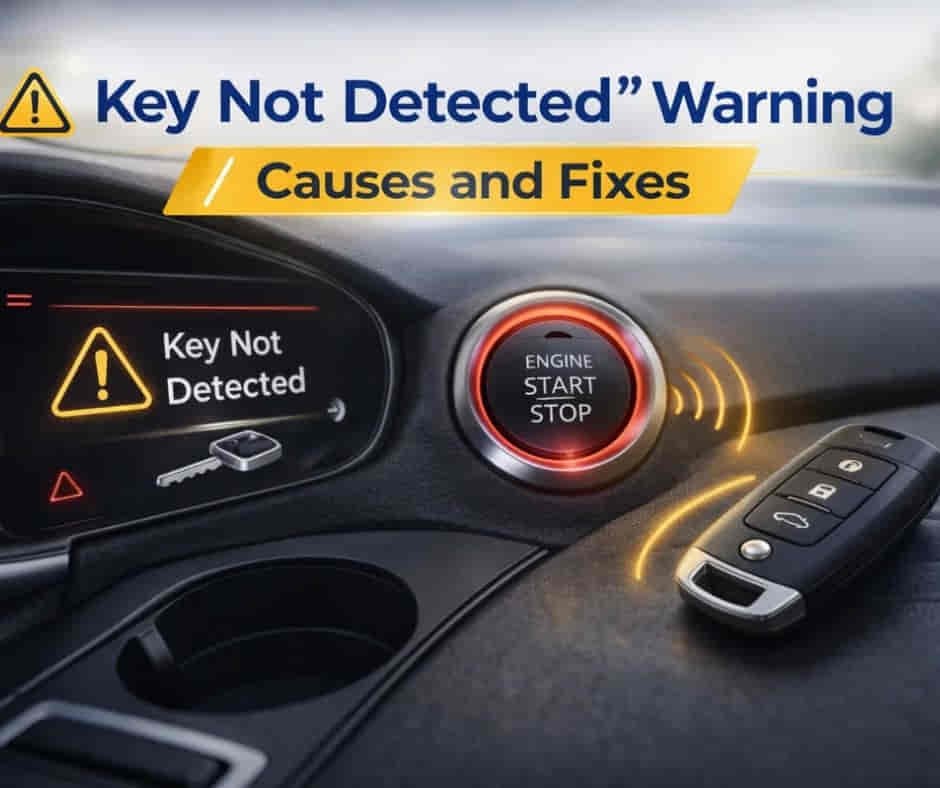
The “Key Not Detected” warning is one of the most common smart key issues reported by Nissan Qashqai owners. When this message appears on the dashboard, the vehicle cannot recognize the Intelligent Key, which may prevent the engine from starting even when the key is inside the cabin. In some cases, the problem is as simple as a depleted key fob battery. In others, it can indicate a fault in the vehicle’s keyless entry system, antenna receiver, Body Control Module (BCM), or immobilizer system.
The good news is that a Key Not Detected error does not automatically mean the key fob needs to be replaced. More than half of these cases are caused by low battery voltage, signal interference, incorrect key placement, or temporary communication failures between the vehicle and the smart key. Many of these issues can be diagnosed and fixed without specialized tools.
Understanding the exact cause is important because different faults require different solutions. Replacing a key battery costs only a few dollars, while replacing a damaged Intelligent Key system component can cost several hundred dollars. Identifying the root cause first helps avoid unnecessary repairs and expenses.
This guide explains the 10 most common causes of Nissan Qashqai Key Not Detected errors, how each problem affects the vehicle, and the practical steps you can take to restore normal operation.
What Does “Key Not Detected” Mean on a Nissan Qashqai?
The “Key Not Detected” warning appears when the Nissan Qashqai cannot establish communication with the Intelligent Key system. The vehicle continuously searches for an authorized smart key through radio frequency signals generated between the key fob and multiple antenna receivers installed throughout the cabin. When this communication process fails, the vehicle assumes that no valid key is present and restricts engine starting, ignition activation, or keyless entry functions.
The Intelligent Key system relies on three primary components: the key fob transmitter, the vehicle’s antenna network, and the Body Control Module (BCM). The key fob transmits an encrypted identification code, the antennas receive the signal, and the BCM verifies whether the key is authorized to operate the vehicle. If any part of this chain stops functioning correctly, the vehicle may display the warning even when the key is physically inside the cabin.
Many drivers assume that the message automatically indicates a defective key. In reality, the warning only confirms that the communication process has failed. A depleted key battery, weak vehicle battery, electromagnetic interference, damaged antenna, software malfunction, or immobilizer fault can all trigger the same dashboard message. This is why accurate diagnosis is more important than immediately replacing parts.
The severity of the issue varies depending on the underlying cause. Some vehicles may continue operating normally after a restart, while others may become completely immobilized. Understanding how the Intelligent Key system works provides the foundation for identifying the exact reason behind the warning and selecting the correct repair strategy.
What Are the 10 Most Common Causes of Nissan Qashqai Key Not Detected Errors?
A dead key fob battery remains the most common cause of Nissan Qashqai key detection failures. The battery inside the smart key powers the transmitter responsible for sending encrypted identification signals to the vehicle. As battery voltage drops below the required threshold, signal strength decreases and communication becomes unreliable. Drivers often notice reduced locking range before the warning appears. In many cases, replacing a low-cost CR2032 battery restores full functionality within minutes.
Distance between the key and the vehicle is another frequent cause. Nissan’s Intelligent Key system operates within a limited detection range. If the key is left in a bag, stored in the cargo area, blocked by metal objects, or positioned too far from the antenna receivers, the system may fail to authenticate the key. This situation commonly occurs when drivers place the key near electronic devices or inside signal-blocking pouches.
Radio frequency interference can disrupt communication between the vehicle and the smart key. Wireless routers, mobile phone transmitters, security systems, parking garage equipment, and aftermarket electronic accessories generate electromagnetic signals that sometimes overlap with keyless entry frequencies. The result is a temporary loss of communication despite both the vehicle and key functioning normally.
Physical damage to the key fob can also trigger detection failures. Internal circuit boards contain delicate electronic components that can crack after repeated drops, water exposure, or excessive pressure. Even if the buttons continue working, damage to the transmitter section may prevent the vehicle from recognizing the key. Moisture intrusion is particularly problematic because corrosion gradually damages electrical pathways inside the key housing.
A weak vehicle battery is another overlooked cause. The Intelligent Key system depends on stable electrical voltage supplied by the vehicle battery. When battery voltage drops significantly, electronic modules begin shutting down non-essential functions to preserve power. Key recognition performance often becomes inconsistent before drivers notice other symptoms such as slow cranking or dashboard warning lights.
The antenna receiver system can also develop faults over time. Nissan Qashqai models use multiple antennas located throughout the cabin to detect key proximity. A failed antenna reduces the vehicle’s ability to locate the key, creating blind spots where recognition becomes impossible. Drivers may notice that the key works in one seating position but not another.
Steering lock module failures have become a documented issue on several Nissan models equipped with Intelligent Key technology. The steering lock module communicates directly with the immobilizer system before engine start authorization is granted. When this module malfunctions, the vehicle may incorrectly interpret the situation as a key recognition failure even though the key itself remains functional.
The Body Control Module serves as the central management unit for keyless entry and vehicle security systems. Software corruption, voltage spikes, water damage, or internal component failure within the BCM can interrupt communication between the key and the vehicle. Because the BCM controls multiple systems simultaneously, drivers may also experience unrelated electrical issues such as lighting or locking malfunctions.
Lost key programming represents another possible cause. Although rare, key synchronization data can become corrupted following battery replacement, module updates, jump-start procedures, or electrical system faults. When this occurs, the vehicle no longer recognizes the stored key identification code and reprogramming becomes necessary.
Finally, immobilizer or software-related faults can prevent proper authentication. Modern Nissan vehicles rely on complex interactions between security modules, encrypted key data, and software logic. Corrupted software, failed module updates, or immobilizer defects may generate a Key Not Detected warning despite all hardware components operating correctly. Professional diagnostic equipment is often required to identify these advanced faults accurately.
How Can You Start a Nissan Qashqai When the Key Is Not Detected?
A Nissan Qashqai can often be started even when the dashboard displays a Key Not Detected warning. Nissan designed the Intelligent Key system with an emergency recognition procedure that allows the vehicle to authenticate the key when normal wireless communication fails. This backup function is particularly useful when the key fob battery is depleted or the radio signal is temporarily disrupted.
The emergency starting process works by allowing the vehicle to read the transponder chip embedded inside the key fob at very close range. Unlike the wireless transmitter, the transponder does not rely on the same battery-powered signal to communicate with the immobilizer system. When the key is placed directly against the designated start button area, the vehicle can often verify the key’s identity and authorize engine startup.
Many Nissan Qashqai owners successfully start their vehicles by pressing the brake pedal and holding the Intelligent Key directly against the Start/Stop button before pressing the button again. This procedure bypasses many of the limitations associated with weak signal transmission and allows the immobilizer system to communicate with the key through short-range detection methods.
If the vehicle still refuses to start after using the emergency procedure, the issue is usually more serious than a depleted key battery. A failed antenna receiver, BCM malfunction, immobilizer fault, or key programming problem may prevent authentication altogether. In these situations, repeated attempts are unlikely to resolve the problem because the failure exists within the vehicle’s security architecture rather than the wireless communication process.
Drivers should also verify that the vehicle battery maintains adequate voltage before pursuing more advanced diagnostics. Modern Nissan systems depend on stable electrical power, and voltage fluctuations can create misleading fault messages that resemble key recognition failures. A battery operating below recommended voltage levels may cause multiple electronic modules to behave unpredictably, including the Intelligent Key system.
Understanding the emergency start procedure is important because it helps separate simple key-related problems from larger electrical or security system faults. If the vehicle starts using the backup method, the problem usually originates from signal transmission. If the vehicle still cannot authenticate the key, further diagnosis of the vehicle’s electronic systems becomes necessary.
How Can You Fix a Nissan Qashqai Key Not Detected Problem?
Fixing a Nissan Qashqai Key Not Detected problem requires identifying the exact point where communication between the vehicle and the Intelligent Key system breaks down. Because multiple components participate in the authentication process, effective troubleshooting begins with the most common and lowest-cost causes before progressing toward more complex repairs.
The first corrective action should always be replacing the key fob battery. Battery degradation occurs gradually, meaning the key may continue functioning intermittently before complete failure occurs. Installing a fresh battery eliminates the most common cause of detection issues and often restores normal operation immediately. After replacement, testing the locking, unlocking, and starting functions helps confirm whether the battery was responsible for the fault.
If replacing the battery does not resolve the issue, attention should shift toward environmental interference. Electronic devices operating on similar frequencies can disrupt communication between the vehicle and key. Moving the vehicle away from communication towers, underground parking systems, industrial equipment, or high-density electronic environments can help determine whether interference is contributing to the warning message.
The condition of the vehicle battery should also be evaluated. A healthy battery typically maintains stable voltage levels required for proper operation of the BCM, immobilizer, and antenna receivers. Batteries approaching the end of their service life frequently create intermittent electronic faults long before complete failure occurs. Testing voltage under load provides a more accurate assessment than relying solely on dashboard indicators.
When both batteries are functioning correctly, the next step involves inspecting the Intelligent Key hardware itself. Physical damage, moisture contamination, and worn internal circuitry can prevent the key from transmitting reliable signals. In many cases, specialized key testing equipment can verify whether the transmitter is operating within factory specifications. This diagnostic process helps determine whether repair or replacement is necessary.
Software-related issues may require a system reset or key reprogramming procedure. Nissan dealerships and qualified automotive locksmiths use manufacturer-specific diagnostic equipment to synchronize keys with the BCM and immobilizer system. Reprogramming becomes necessary when stored authentication data becomes corrupted or when the vehicle no longer recognizes a previously functioning key.
More advanced repairs involve diagnosing vehicle-side components such as antenna receivers, steering lock modules, immobilizer units, and BCM assemblies. These components form the foundation of the keyless entry architecture and can trigger persistent detection failures when damaged. Professional diagnostic scanning is often required because fault codes stored within the vehicle’s control modules provide valuable information about the exact source of the communication breakdown.
The most effective repair strategy is always based on diagnosis rather than assumption. Replacing expensive components without identifying the root cause frequently results in unnecessary expenses while leaving the original fault unresolved. A systematic troubleshooting process reduces repair costs, shortens downtime, and increases the likelihood of restoring reliable Intelligent Key operation.
When Should You Replace the Nissan Qashqai Key Fob?
A Nissan Qashqai key fob should be replaced when the internal electronic components can no longer transmit a reliable authentication signal to the vehicle. While many Key Not Detected errors originate from depleted batteries, repeated communication failures after battery replacement often indicate a deeper hardware problem. Understanding the difference between a battery issue and a key fob failure helps prevent unnecessary repairs and avoids spending money on components that are still functional.
One of the clearest indicators of a failing key fob is inconsistent performance. The vehicle may detect the key only occasionally, require multiple button presses to unlock the doors, or display intermittent Key Not Detected warnings. These symptoms typically occur when internal circuits begin deteriorating. Small cracks in solder joints, worn electronic components, or damaged antennas inside the key can reduce signal quality long before complete failure occurs.
Physical damage is another major reason for key replacement. Smart keys are designed to withstand everyday use, but repeated drops, impact damage, and water exposure can compromise sensitive electronic parts. Moisture is particularly destructive because corrosion continues to spread even after the key appears dry externally. A key fob that has been submerged or exposed to significant water intrusion often develops progressive communication problems over time.
The age of the key can also contribute to failure. Many Nissan key fobs operate reliably for years, but electronic components naturally degrade through thermal cycles, vibration, and repeated use. Vehicles that are more than five years old may experience increased key-related issues simply because the original hardware has accumulated substantial wear.
Repairing a damaged key is sometimes possible, particularly when the issue involves a broken button, damaged housing, or isolated circuit board fault. However, replacement becomes more practical when multiple components are affected or when repair costs approach the price of a new key. In these situations, a replacement key offers greater long-term reliability and reduces the risk of future detection failures.
Drivers should also consider replacement when a key repeatedly loses programming or fails diagnostic testing. Modern Nissan Intelligent Keys contain multiple integrated systems that work together to support keyless entry, immobilizer authentication, and push-button starting. Persistent failures across these functions often indicate internal electronic degradation that cannot be permanently corrected through reprogramming alone.
How Much Does It Cost to Fix a Nissan Qashqai Key Not Detected Error?
The cost of fixing a Nissan Qashqai Key Not Detected error varies significantly because the warning can be triggered by multiple components within the Intelligent Key system. Some repairs require only a low-cost battery replacement, while others involve advanced diagnostics, module programming, or electronic component replacement. Understanding the typical repair range helps vehicle owners make informed decisions during the diagnostic process.
The least expensive repair is replacing the key fob battery. In most markets, a replacement battery costs only a few dollars and can often be installed within minutes. Because battery failure remains the most common cause of detection problems, this is usually the first corrective action recommended by technicians.
Key reprogramming represents the next level of repair expense. When synchronization between the key and vehicle is lost, specialized diagnostic equipment must be used to restore communication. Costs vary depending on region and service provider, but programming fees are generally far lower than replacing major electronic modules. Many independent automotive locksmiths can perform this procedure at a lower cost than dealerships while maintaining equivalent functionality.
Replacing a damaged Intelligent Key significantly increases repair costs. A genuine Nissan smart key includes integrated security components that must be programmed specifically for the vehicle. The total cost typically includes the key itself, programming services, and verification procedures. Vehicles equipped with advanced security features may require additional coding steps, further increasing expenses.
Vehicle-side component failures generally represent the most expensive repair category. Antenna receivers, steering lock modules, immobilizer units, and Body Control Modules contain sophisticated electronics that directly influence key authentication. Replacing these components often requires diagnostic verification, module installation, software configuration, and system calibration. Labor costs can become substantial because technicians must ensure proper communication between multiple vehicle systems after installation.
Diagnostic charges should also be considered when estimating repair costs. Professional troubleshooting may identify the exact cause of the fault before any parts are replaced. Although some vehicle owners attempt to reduce costs by replacing components without testing, this approach frequently results in unnecessary spending because the original problem remains unresolved.
The most cost-effective strategy is identifying the root cause before authorizing repairs. A methodical diagnostic process often reveals simple issues that can be corrected quickly, preventing expensive component replacement and minimizing vehicle downtime.
How Can You Prevent Future Key Detection Problems?
Preventing Nissan Qashqai Key Not Detected errors is easier and less expensive than repairing them. Most key recognition failures develop gradually rather than appearing without warning. Drivers who understand the factors affecting the Intelligent Key system can significantly reduce the likelihood of unexpected starting problems and avoid becoming stranded due to a preventable fault.
The most effective preventive measure is replacing the key fob battery before it reaches the end of its service life. Many owners wait until the battery completely fails, but declining battery voltage often causes intermittent communication issues long before the key stops functioning altogether. Replacing the battery every two to three years helps maintain consistent signal strength and reduces the risk of authentication failures.
Proper storage of the Intelligent Key also contributes to long-term reliability. Smart keys contain sensitive electronic components that can be damaged by impact, excessive heat, moisture, and magnetic interference. Keeping the key in a protective case minimizes physical damage and reduces wear on the internal circuitry. Drivers should avoid placing the key near devices that generate strong electromagnetic fields because repeated exposure may affect signal performance.
Vehicle battery maintenance is equally important. The Intelligent Key system depends on stable electrical power supplied by the vehicle’s charging system. A weak battery can create communication errors, module faults, and inconsistent key detection behavior. Routine battery testing helps identify voltage-related issues before they affect vehicle operation. This is particularly important for older Qashqai models and vehicles frequently driven on short journeys where battery charging is limited.
Keeping the vehicle’s software and electronic systems in good condition further reduces the likelihood of key detection problems. Manufacturers occasionally release software updates that improve communication between control modules and resolve known electronic issues. Vehicles serviced according to manufacturer recommendations are less likely to experience software-related authentication failures than those with neglected maintenance histories.
Drivers should also pay attention to early warning signs. Reduced remote locking range, delayed response from the Start/Stop button, intermittent dashboard warnings, and occasional key recognition failures often indicate a developing problem. Addressing these symptoms early prevents minor faults from escalating into complete system failures that require more expensive repairs.
Preventive maintenance does not eliminate every possible fault, but it significantly improves the reliability of the Intelligent Key system. A proactive approach helps ensure that the vehicle continues recognizing the key consistently and reduces the risk of unexpected breakdowns caused by communication failures.
Read more: Nissan Dualis Not Starting
What Should You Do If None of the Fixes Work?
If the Nissan Qashqai continues displaying a Key Not Detected warning after replacing the key battery, testing the vehicle battery, and attempting the emergency start procedure, the fault likely exists within the vehicle’s electronic architecture. At this stage, further troubleshooting requires specialized diagnostic equipment capable of communicating with Nissan’s security and immobilizer systems.
Professional diagnosis becomes essential because multiple modules participate in the authentication process. The Body Control Module, steering lock module, antenna receivers, immobilizer system, and Intelligent Key all exchange encrypted information before the engine is allowed to start. A failure within any of these components can generate the same dashboard warning, making visual inspection alone unreliable.
A Nissan dealership can access manufacturer-specific diagnostic tools designed to identify communication faults, software errors, and module failures. These systems provide detailed fault codes that reveal whether the issue originates from the key itself, the vehicle’s antenna network, the immobilizer system, or another electronic component. Accurate fault identification prevents unnecessary part replacement and shortens repair time.
An experienced automotive locksmith may also provide an effective solution, particularly when the issue involves key programming, replacement keys, or immobilizer synchronization. Many modern locksmiths use advanced programming equipment capable of performing procedures traditionally limited to dealerships. This can offer a more cost-effective repair option while maintaining proper system functionality.
When seeking professional assistance, drivers should provide as much information as possible about the symptoms. Details such as intermittent detection failures, recent battery replacements, water exposure, electrical repairs, or dashboard warning messages can help technicians narrow the diagnostic process. Accurate information often reduces labor costs because technicians can focus on the most likely causes first.
In rare cases, the problem may involve multiple faults occurring simultaneously. For example, a weak vehicle battery may expose an existing antenna issue or software fault that previously went unnoticed. Comprehensive diagnostic testing ensures that all contributing factors are identified and corrected rather than addressing only the most visible symptom.
Ultimately, a persistent Key Not Detected warning should not be ignored. The Intelligent Key system is directly connected to vehicle security and engine authorization functions. Resolving the issue promptly helps maintain reliability, prevents unexpected starting failures, and ensures that the vehicle continues operating as designed.