
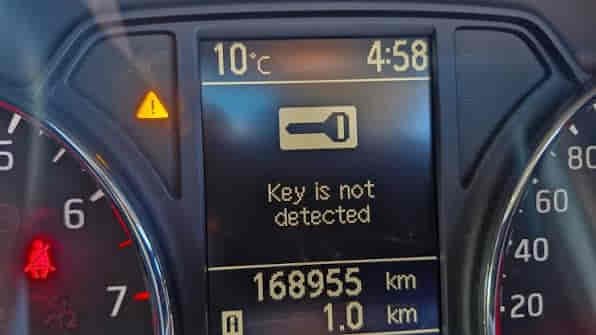
A Nissan X-Trail Key Not Detected warning appears when the vehicle cannot verify the presence of an authorized Intelligent Key. Although many drivers immediately assume the key fob battery is dead, the warning can be triggered by multiple components throughout the vehicle’s electronic security and communication systems. A weak key battery, a failing 12V battery, radio frequency interference, antenna faults, programming errors, or control module failures can all prevent successful key recognition.
The Nissan X-Trail relies on the Intelligent Key system to provide keyless entry and push-button starting functionality. This system continuously exchanges encrypted signals between the key fob, vehicle antennas, Body Control Module (BCM), immobilizer system, and push-button start unit. If communication fails at any point, the vehicle may display a Key Not Detected message even when the key is physically inside the cabin.
In newer Nissan X-Trail models, including T32, T33, and e-POWER variants, key detection systems have become increasingly sophisticated. While these technologies improve convenience and security, they also introduce additional electronic components that can contribute to communication failures. As a result, diagnosing the exact cause of a Key Not Detected warning requires understanding how the entire Intelligent Key ecosystem operates.
Some causes can be fixed within minutes, such as replacing a depleted key fob battery. Others may require advanced diagnostics involving vehicle security systems, key programming procedures, or electronic module testing. Understanding the difference can save both time and unnecessary repair costs.
This guide explains the 11 most common Nissan X-Trail Key Not Detected problems, how each issue affects the Intelligent Key system, and the most effective solutions for restoring normal vehicle operation.
Why Does My Nissan X-Trail Say Key Not Detected?
A Nissan X-Trail displays a Key Not Detected warning when the Intelligent Key system cannot verify the presence of an authorized key. The warning does not automatically mean the key fob is defective. Instead, it indicates that communication between the key and one or more vehicle systems has failed during the authentication process.
The Nissan Intelligent Key system depends on several components working together simultaneously. The key fob transmits encrypted identification data, vehicle antennas receive the signal, the Body Control Module processes the information, and the immobilizer system verifies authorization before startup is permitted. If any part of this communication chain fails, the vehicle may report that the key cannot be detected.
The complexity of the system means that identical warning messages can be caused by completely different problems. A simple battery issue can trigger the same warning as a faulty antenna, damaged key fob, BCM malfunction, or immobilizer fault. This is why replacing the key should never be the first troubleshooting step.
Modern Nissan X-Trail models such as the T32, T33, and e-POWER variants rely heavily on electronic communication networks. As vehicle technology becomes more advanced, the number of components involved in key authentication continues to increase. Understanding how these systems interact is essential for identifying the actual cause of a Key Not Detected warning and avoiding unnecessary repairs.
Is the Key Fob Battery Dead?
A depleted key fob battery is the most common cause of Nissan X-Trail key detection failures. The Intelligent Key requires battery power to transmit radio frequency signals that allow the vehicle to identify and authenticate the key.
Battery deterioration usually occurs gradually rather than suddenly. As battery voltage declines, signal strength becomes weaker and communication reliability decreases. Drivers often notice reduced operating range before complete failure occurs. The vehicle may detect the key intermittently, remote locking functions may become inconsistent, and repeated button presses may be required to perform basic operations.
Most Nissan X-Trail key fobs use a CR2032 lithium battery. Under normal operating conditions, the battery typically lasts between two and four years. Frequent use, extreme temperatures, and prolonged exposure to heat can shorten battery lifespan and accelerate voltage loss.
A weak battery can create misleading symptoms because the key may still function occasionally. Many owners assume the Intelligent Key system is malfunctioning when the actual problem is insufficient battery voltage inside the key fob. Replacing the battery often restores communication immediately and eliminates the warning without additional repairs.
Because battery replacement is inexpensive and requires minimal effort, checking battery condition should always be the first diagnostic step whenever a Nissan X-Trail displays a Key Not Detected message.
Is the Key Fob Too Far From the Vehicle?
The Nissan X-Trail can only detect the Intelligent Key within a specific communication range. If the key is positioned too far from the vehicle or surrounded by materials that weaken radio frequency transmission, the authentication process may fail.
The Intelligent Key system continuously exchanges signals with antennas located throughout the vehicle. Signal strength naturally decreases as distance increases. When the key is stored inside luggage, backpacks, handbags, or deep storage compartments, communication quality may drop below the level required for successful authentication.
Metal objects create additional challenges because they can absorb, reflect, or block radio frequency signals. Keys stored near laptops, tablets, power banks, smartphones, or metal accessories often experience reduced communication performance. In some cases, simply relocating the key within the cabin immediately restores normal operation.
This issue is particularly common among drivers who carry multiple electronic devices. The growing number of wireless products used in daily life increases the likelihood of signal obstruction and communication inconsistencies.
A simple way to confirm a range-related issue is to hold the key directly next to the push-button start switch. If the vehicle recognizes the key immediately, the problem is likely related to signal strength or positioning rather than a defective Intelligent Key. This quick diagnostic step can eliminate unnecessary troubleshooting and help identify the root cause more efficiently.
Is RF Signal Interference Blocking Communication?
Radio frequency interference can prevent a Nissan X-Trail from detecting an otherwise functional Intelligent Key. The vehicle depends on wireless communication between the key fob and multiple antennas throughout the cabin. When external signals interfere with this communication, the authentication process may fail and trigger a Key Not Detected warning.
Modern environments contain significantly more wireless devices than ever before. Mobile phones, Bluetooth accessories, Wi-Fi routers, wireless chargers, security systems, and telecommunications equipment continuously emit radio frequency signals. In certain situations, these signals can overlap with the frequencies used by the Intelligent Key system and reduce communication reliability.
The problem is often location-specific rather than vehicle-specific. Drivers may experience key detection issues in parking garages, shopping centers, airports, industrial facilities, or densely populated urban areas where electromagnetic activity is particularly high. A vehicle that fails to detect the key in one location may operate normally after being moved elsewhere.
Signal interference can also originate from inside the vehicle. Aftermarket electronics, GPS trackers, dash cameras, remote start systems, and poorly installed accessories occasionally create communication conflicts that affect key recognition performance. Because these devices share portions of the vehicle’s electrical and communication infrastructure, even minor interference can disrupt authentication.
One of the easiest diagnostic methods is changing locations. If the warning disappears after moving the vehicle away from a specific environment, interference becomes a likely explanation. Unlike hardware failures, radio frequency interference rarely requires component replacement because the root cause originates outside the Intelligent Key system itself.
Is the 12V Battery Weak or Dead?
A weak 12V battery is one of the most overlooked causes of Nissan X-Trail Key Not Detected warnings. Although the vehicle relies on a larger powertrain system for propulsion, the Intelligent Key system depends heavily on the 12V electrical network to operate correctly.
The Body Control Module, immobilizer system, key antennas, push-button start system, and multiple electronic control units all require stable voltage supplied by the 12V battery. When voltage levels drop below normal operating thresholds, communication between these systems becomes unreliable and key authentication failures can occur.
Many drivers assume a healthy engine or traction battery eliminates the possibility of battery-related problems. However, the Intelligent Key system cannot function properly if the 12V battery cannot support low-voltage electronics. Even a slight reduction in voltage may trigger communication errors long before the battery becomes completely discharged.
A failing battery often creates additional symptoms that extend beyond key detection problems. Dashboard warning lights may appear unexpectedly, electronic accessories may respond slowly, startup procedures may become inconsistent, and the vehicle may occasionally fail to enter READY mode. These symptoms frequently develop weeks before complete battery failure occurs.
Most Nissan X-Trail 12V batteries remain reliable for approximately three to five years. Climate conditions, driving habits, and long periods of inactivity can significantly affect battery lifespan. Vehicles that sit unused for extended periods often experience accelerated battery degradation because electronic systems continue drawing power while parked.
Testing battery voltage is one of the most valuable diagnostic procedures when investigating key recognition failures. Restoring proper voltage through charging or battery replacement often resolves communication problems without requiring further repairs.
Is the Intelligent Key Antenna Faulty?
A faulty Intelligent Key antenna can prevent a Nissan X-Trail from recognizing an authorized key even when the key fob itself is functioning normally. The antenna network acts as the communication bridge between the vehicle and the Intelligent Key system, making it one of the most important components in the authentication process.
Multiple antennas are positioned throughout the Nissan X-Trail to determine whether the key is located inside or outside the vehicle. These antennas continuously exchange signals with the key fob whenever a door is opened, a handle sensor is activated, or the push-button start system is used.
When an antenna becomes damaged, signal transmission may become weak, inconsistent, or completely unavailable. As a result, the vehicle may incorrectly conclude that no authorized key is present. Drivers often notice intermittent behavior where the key is detected in one area of the cabin but not another. Some owners discover that placing the key directly next to the start button temporarily restores operation.
Several conditions can contribute to antenna failure. Wiring damage, connector corrosion, moisture intrusion, physical impact, and electronic component deterioration are among the most common causes. Because the antenna system operates as part of a larger communication network, failures can sometimes mimic symptoms associated with weak batteries or defective key fobs.
Newer Nissan X-Trail T33 and e-POWER models contain more advanced communication systems than earlier generations, increasing reliance on proper antenna performance. A minor disruption within the antenna network can affect multiple convenience and security functions simultaneously.
Diagnosing antenna failures typically requires specialized equipment capable of monitoring signal transmission and module communication. Once the affected antenna is identified, replacement usually restores normal key detection performance and eliminates intermittent authentication issues.
Has the Key Fob Lost Its Programming?
A Nissan X-Trail may display a Key Not Detected warning if the Intelligent Key is no longer properly registered to the vehicle. Key programming creates a secure digital relationship between the key fob and the vehicle’s security system. If this relationship becomes corrupted or is lost, the vehicle cannot verify authorization and may refuse to recognize the key.
The Intelligent Key system relies on encrypted communication designed to prevent unauthorized vehicle access. During the registration process, unique identification data is stored inside both the key fob and the vehicle’s electronic control modules. Every time the driver attempts to unlock or start the vehicle, this information is compared and verified. If the stored data no longer matches, authentication fails.
Programming-related failures are relatively uncommon compared to battery or signal issues, but they can occur after severe battery discharge, control module replacement, software updates, failed programming attempts, or electrical repairs involving security-related systems. In some situations, one key may stop functioning while a spare key continues to operate normally. This behavior often indicates that the issue is isolated to a specific key rather than the vehicle itself.
Drivers experiencing programming loss frequently report that all physical functions of the key appear normal. The buttons may illuminate, battery voltage may be adequate, and remote functions may occasionally respond. Despite this, the vehicle still displays a Key Not Detected warning because authorization data can no longer be validated successfully.
Reprogramming the Intelligent Key usually restores communication if registration loss is the underlying cause. Depending on the Nissan X-Trail model year and security configuration, this procedure may require dealership-level diagnostic equipment or specialized locksmith programming tools capable of accessing protected vehicle functions.
Is the Push Button Start System Malfunctioning?
A malfunctioning push button start system can interrupt the key authentication process and prevent the Nissan X-Trail from recognizing an authorized Intelligent Key. Although many drivers associate key detection problems with the key fob itself, the start button plays a critical role in initiating communication between multiple vehicle systems.
When the start button is pressed, the vehicle begins a series of electronic verification procedures. The Body Control Module communicates with the Intelligent Key system, the immobilizer checks authorization credentials, and multiple control units exchange information before startup permission is granted. If the start button fails to trigger this sequence correctly, the vehicle may incorrectly display a Key Not Detected warning.
Push button start failures often develop gradually. Drivers may notice delayed responses when pressing the button, inconsistent startup behavior, or situations where multiple attempts are required before the vehicle enters READY mode. These symptoms can easily be mistaken for key-related problems because the resulting warning messages appear identical.
Physical wear is one of the most common causes of push button start issues. The component is used every time the vehicle is started and eventually experiences mechanical and electrical fatigue. Internal switch deterioration, damaged connectors, moisture exposure, and communication faults can all reduce reliability over time.
In modern Nissan X-Trail T32, T33, and e-POWER models, the push button start system is integrated with multiple electronic networks. A fault within the button assembly can affect communication with security modules, creating startup failures even when the Intelligent Key is functioning properly.
Diagnosing a push button start malfunction often requires electronic testing rather than visual inspection. Because the system interacts with several control modules simultaneously, professional diagnostics may be necessary to determine whether the fault originates within the button assembly or elsewhere in the communication network.
Is the Immobilizer System Preventing Key Recognition?
The immobilizer system can prevent a Nissan X-Trail from recognizing an authorized key if security verification cannot be completed successfully. This anti-theft system is designed to block vehicle operation whenever authentication requirements are not met, making it one of the most important security features within the Intelligent Key architecture.
Every Nissan Intelligent Key contains a unique encrypted identifier. When the driver attempts to start the vehicle, the immobilizer compares this identifier against security credentials stored within the vehicle’s control modules. If the information does not match, startup authorization is denied regardless of whether the key is physically present.
Immobilizer-related issues often originate from communication failures rather than actual security threats. Corrupted software, synchronization errors, damaged control modules, interrupted communication networks, and electrical faults can all prevent successful verification. Because multiple systems participate in the authentication process, even minor disruptions can trigger security-related startup restrictions.
Several warning signs may indicate an immobilizer problem. Security indicator lights may remain illuminated on the dashboard, startup attempts may repeatedly fail, spare keys may produce identical results, and the Key Not Detected warning may persist despite replacing batteries and performing other basic troubleshooting procedures.
Unlike battery or antenna failures, immobilizer faults generally require specialized diagnostic equipment capable of accessing encrypted security functions. These systems are intentionally protected to prevent unauthorized programming and theft. As a result, repairs often involve software synchronization, module reconfiguration, or key re-registration procedures that cannot be performed through standard troubleshooting methods.
In many cases, immobilizer-related problems become more common after electronic repairs, control module replacement, or severe battery discharge events. Ensuring that all security-related modules remain synchronized is essential for maintaining reliable key recognition and preventing future authentication failures.
Is the Body Control Module Failing?
A failing Body Control Module can cause a Nissan X-Trail to display a Key Not Detected warning because the BCM serves as the central communication hub for many of the vehicle’s electronic systems. The module coordinates information between the Intelligent Key system, immobilizer, door locks, interior electronics, security systems, and multiple control units. If the BCM cannot process or distribute information correctly, key authentication may fail even when the key itself is functioning normally.
The Intelligent Key system depends on the BCM to interpret signals received from vehicle antennas. When a driver approaches the vehicle or presses the start button, the BCM evaluates incoming identification data and determines whether the key is authorized. Any disruption in this process can prevent successful communication and trigger key recognition errors.
BCM failures rarely affect only one feature. Drivers often notice several seemingly unrelated electrical issues occurring at the same time. Power locks may operate unpredictably, interior lights may behave abnormally, warning messages may appear without explanation, and electronic accessories may intermittently stop functioning. When multiple electrical symptoms develop simultaneously, the BCM becomes a strong suspect.
Electrical surges, water intrusion, aging circuitry, software corruption, and manufacturing defects are among the most common causes of BCM failure. Modern Nissan X-Trail models contain extensive electronic networks, and the BCM acts as a gateway for many of these communications. Even a minor fault can affect multiple systems throughout the vehicle.
Diagnosing BCM problems typically requires advanced scan tools capable of monitoring module communication and identifying network-related faults. Once confirmed, repairs may involve software updates, module reprogramming, or complete replacement. Restoring proper BCM operation often resolves not only key detection issues but also several secondary electrical problems affecting the vehicle.
Has Water Damage Affected the Key Fob?
Water damage can prevent a Nissan X-Trail Intelligent Key from transmitting the signals required for vehicle authentication. Modern key fobs contain sensitive electronic components that rely on clean electrical connections and stable communication circuits. Even a small amount of moisture can disrupt these systems and create key detection failures.
Inside the Intelligent Key are microprocessors, antenna components, battery terminals, and radio frequency transmitters. These components operate using low-voltage electrical pathways that are highly vulnerable to corrosion. When moisture enters the housing, oxidation can begin forming on circuit board surfaces and electrical contacts.
One of the most challenging aspects of water damage is that symptoms may not appear immediately. A key fob can continue functioning for days or even weeks after exposure before corrosion progresses enough to affect communication. Drivers often experience intermittent detection failures, reduced operating range, or occasional startup issues before complete failure occurs.
Common causes of water exposure include accidental washing machine cycles, rainwater intrusion, spilled beverages, swimming pool accidents, and high-humidity environments. Even if the outer shell appears undamaged, moisture can penetrate small openings and reach internal electronic components.
Early intervention improves the chances of preventing permanent damage. Removing the battery and allowing the key to dry may help if exposure was minimal. However, severe corrosion usually requires key replacement because damaged circuit boards and communication components cannot always be repaired reliably.
Water damage should be considered whenever a Key Not Detected warning appears shortly after the key has been exposed to moisture. Identifying this connection early can prevent unnecessary replacement of unrelated vehicle components.
Is the Key Fob Physically Damaged?
Physical damage can prevent the Nissan X-Trail Intelligent Key from communicating with the vehicle even when the battery remains fully charged. Smart key systems depend on delicate electronic components that can be damaged by impacts, pressure, vibration, and long-term wear.
The key fob contains a printed circuit board, radio transmitter, antenna system, battery contacts, and several microelectronic components responsible for generating authentication signals. Damage to any of these parts can weaken communication or stop signal transmission entirely.
Repeated drops onto hard surfaces are one of the most common causes of internal key damage. Even when the housing appears intact, impacts can crack solder joints, loosen electronic components, or damage antenna connections hidden inside the key. These failures often develop gradually and become more noticeable over time.
Many physically damaged key fobs continue functioning intermittently before complete failure occurs. Drivers may notice that the vehicle recognizes the key only in certain positions or that button functions work inconsistently. These symptoms often indicate loose internal connections rather than battery-related issues.
Pressure damage is another frequently overlooked problem. Keys carried in overloaded pockets, tool bags, backpacks, or luggage compartments can experience continuous mechanical stress that affects internal circuitry. Over time, this stress may compromise communication performance and trigger authentication errors.
Visual inspection sometimes reveals obvious signs of damage such as cracked housings, loose buttons, broken battery retainers, or separated seams. However, many failures occur entirely inside the key and cannot be identified without disassembly.
When critical internal components are damaged, replacement is usually the most reliable solution. A properly programmed replacement key restores normal communication and eliminates faults caused by structural damage within the original Intelligent Key.
How Can You Start a Nissan X-Trail When the Key Is Not Detected?
A Nissan X-Trail can often be started even when the vehicle displays a Key Not Detected warning. Nissan equips the Intelligent Key system with an emergency authentication procedure that allows the vehicle to recognize the key through close-range communication when normal wireless detection is unavailable.
The emergency procedure works because the Intelligent Key contains a transponder chip that can communicate directly with the vehicle even if the key fob battery is weak. While standard keyless operation relies on radio frequency transmission, the transponder provides a secondary method of authentication that allows the vehicle to verify authorization under certain conditions.
In most Nissan X-Trail models, placing the Intelligent Key directly against the push-button start switch while pressing the brake pedal allows the vehicle to attempt emergency authentication. If communication is successful, the immobilizer system verifies the key and startup authorization is granted.
Successfully starting the vehicle through this method provides valuable diagnostic information. It indicates that the key remains registered to the vehicle and that the underlying issue is more likely related to signal strength, battery voltage, antenna performance, or communication interference rather than complete key failure.
If the emergency procedure does not work, the problem is usually more severe. Key programming errors, immobilizer faults, BCM failures, damaged transponder chips, or communication network issues become more likely explanations. In these situations, advanced diagnostics are generally required to identify the root cause.
Understanding the emergency start procedure is important because it can prevent unnecessary towing and help drivers reach a repair facility while further diagnosis is arranged.
How Much Does It Cost to Fix a Nissan X-Trail Key Not Detected Problem?
The cost of repairing a Nissan X-Trail Key Not Detected problem varies significantly because several different components can trigger the warning. Repair expenses can range from a few dollars for a battery replacement to well over one thousand dollars for advanced electronic repairs.
The least expensive repair is typically replacing the key fob battery. Most Nissan X-Trail Intelligent Keys use a CR2032 battery that generally costs between $3 and $10. Because battery failure is the most common cause of key detection problems, this remains the most cost-effective starting point for diagnosis.
A replacement Intelligent Key is considerably more expensive because programming is usually required. Depending on the model year and market, a new Nissan X-Trail key fob often costs between $150 and $500 including registration and programming fees. Vehicles equipped with newer Intelligent Key technologies may fall toward the higher end of this range.
A weak 12V battery can also create key recognition failures. Replacing the battery typically costs between $120 and $350 depending on battery specifications, installation requirements, and local labor rates. Since the 12V battery supports multiple electronic systems, replacement often resolves several symptoms simultaneously.
More advanced repairs increase costs substantially. Intelligent Key antenna replacement commonly ranges from $200 to $700. Immobilizer repairs, BCM programming, and communication network diagnostics may exceed $1,000 when specialized labor and electronic modules are involved.
Accurate diagnosis remains the most important factor in controlling repair costs. Replacing components without identifying the true source of the fault often leads to unnecessary expenses while the original problem remains unresolved.
How Can You Prevent Nissan X-Trail Key Not Detected Errors?
Preventing Nissan X-Trail key detection problems requires maintaining both the Intelligent Key and the electronic systems responsible for vehicle authentication. Most key recognition failures develop gradually and can often be avoided through routine preventive maintenance.
Replacing the key fob battery before it becomes fully depleted is one of the most effective preventive measures. Many drivers continue using a weakening battery until communication becomes unreliable. Replacing the battery every two to three years helps maintain consistent signal strength and reduces the risk of unexpected authentication failures.
Protecting the Intelligent Key from physical damage is equally important. Internal electronic components are vulnerable to impacts, moisture exposure, and excessive pressure. Using a protective key case and avoiding unnecessary exposure to harsh conditions can significantly extend the lifespan of the key fob.
Maintaining a healthy 12V battery also plays a critical role in system reliability. The Intelligent Key system, BCM, immobilizer, and antenna network all depend on stable voltage supplied by the vehicle’s low-voltage electrical system. Regular battery testing and timely replacement help prevent communication problems caused by declining battery performance.
Environmental awareness can further reduce the likelihood of key detection issues. Storing the key away from strong sources of radio frequency interference and avoiding prolonged exposure to excessive heat or moisture helps preserve communication quality. Drivers who routinely carry multiple electronic devices should also be aware that signal obstruction can occasionally affect key recognition performance.
Preventive maintenance is considerably less expensive than repairing advanced communication failures. Consistent attention to battery health, key condition, and electronic system performance significantly improves long-term reliability.
Read more: Nissan Rogue Key Not Detected
When Should You Visit a Nissan Dealer for a Key Not Detected Warning?
A Nissan dealer should be consulted when basic troubleshooting procedures fail to eliminate the Key Not Detected warning. While battery replacement, emergency startup procedures, and visual inspections can resolve many common issues, some faults require manufacturer-specific diagnostic equipment.
Persistent warnings after replacing the key battery often indicate deeper communication problems. If the vehicle continues displaying Key Not Detected messages despite adequate battery voltage and proper key positioning, components such as the Intelligent Key antenna, BCM, immobilizer system, or communication network may require professional evaluation.
Dealer-level diagnostics become particularly important when security-related systems are involved. Key registration, immobilizer synchronization, software updates, and module configuration procedures frequently require Nissan-specific tools capable of accessing protected vehicle functions. These systems cannot be fully diagnosed through basic troubleshooting methods.
Multiple electrical symptoms occurring at the same time also justify professional inspection. Power lock malfunctions, startup failures, random warning lights, communication errors, and repeated key detection problems often indicate an underlying electronic fault affecting several systems simultaneously.
Drivers should seek professional assistance immediately if spare keys fail to operate, emergency startup procedures do not work, or diagnostic trouble codes indicate module communication failures. These situations typically involve faults that require advanced testing equipment and specialized repair procedures.
Ignoring persistent Key Not Detected warnings can allow minor electrical issues to develop into larger communication failures. Early diagnosis not only improves vehicle reliability but also reduces the likelihood of costly repairs by identifying problems before additional systems become affected.