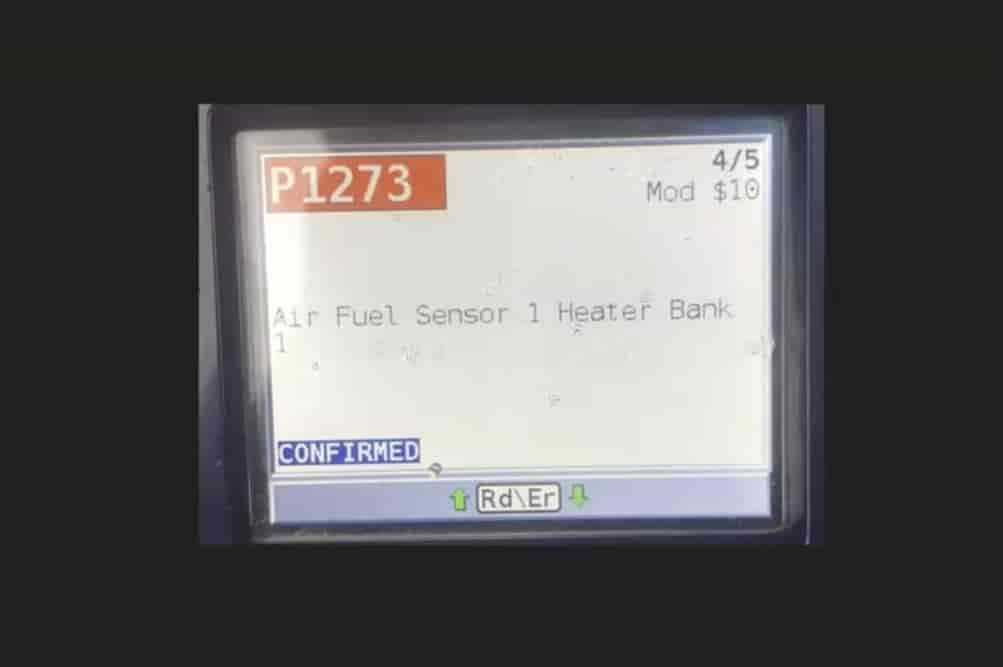
Nissan P1273 code indicates that the engine control system has detected an abnormal air-fuel ratio correction condition on Bank 1. In practical terms, the Engine Control Module (ECM) is attempting to compensate for a fuel mixture problem but has reached its adjustment limit. When this happens, the vehicle stores code P1273 and usually activates the Check Engine Light.
This fault commonly appears on Nissan models including the Nissan Altima, Sentra, Maxima, Murano, and X-Trail. Drivers often notice several changes in vehicle behavior at the same time. The most common symptoms include rough idle, poor acceleration, increased fuel consumption, engine hesitation, and occasional misfires. In more severe situations, the engine may lose noticeable power or emit a strong fuel smell from the exhaust.
There are 8 common causes behind Nissan P1273, including a faulty Air Fuel Ratio Sensor, vacuum leaks, contaminated Mass Air Flow sensors, injector problems, fuel pressure issues, damaged wiring, intake leaks, and ECM failures. Because multiple components affect fuel correction values, replacing parts without diagnosis frequently leads to unnecessary expenses.
This guide explains what Nissan P1273 means, what symptoms appear, what causes the code, how to diagnose it step by step, whether it is safe to continue driving, and how much repair may cost. The goal is to help identify the actual fault before replacing expensive components.
What does Nissan P1273 code mean?
Nissan P1273 means the Engine Control Module has detected that fuel mixture correction on Bank 1 has exceeded its normal adjustment range. The system continuously adjusts fuel delivery to maintain an ideal air-fuel ratio for combustion efficiency. When the ECM repeatedly compensates for a mixture problem and reaches its correction limit, it stores code P1273.
This happens because modern Nissan engines use an Air Fuel Ratio Sensor and fuel trim values to monitor combustion conditions in real time. The Air Fuel Ratio Sensor measures oxygen content in exhaust gases while the ECM adjusts injector operation based on those readings. If sensor feedback continuously indicates that the mixture is too lean or too rich, fuel trim values increase abnormally until the ECM can no longer compensate.
Bank 1 refers to the side of the engine containing cylinder number one. On four-cylinder Nissan vehicles such as Altima or Sentra, Bank 1 typically represents the entire engine. On V6 engines like the Maxima or Murano, identifying Bank 1 becomes important because diagnosis focuses on a specific cylinder bank rather than the entire fuel system.
Many owners confuse P1273 with oxygen sensor failures. The difference is that P1273 is a fuel correction limit code rather than a direct sensor malfunction code. The sensor may be faulty, but the code itself indicates that fuel adjustment values moved beyond normal operating parameters.
What symptoms appear when Nissan P1273 occurs?
There are 7 common symptoms associated with Nissan P1273 code. The most noticeable symptom is an illuminated Check Engine Light, but drivability problems usually appear before the warning light becomes obvious.
Rough idle is one of the earliest symptoms. The engine may shake, fluctuate between RPM levels, or feel unstable while stopped. This occurs because an incorrect air-fuel mixture creates uneven combustion events inside the cylinders. For example, drivers often describe the vehicle as feeling normal while driving but vibrating excessively at stoplights.
Poor acceleration and hesitation are also common. When fuel correction values move outside normal limits, combustion becomes inconsistent during throttle input. Drivers may press the accelerator and experience delayed engine response or sudden power loss during highway merging.
Fuel consumption often increases because the ECM may command extra fuel delivery while attempting to compensate for sensor readings. Some drivers report fuel economy drops of 10–20% after P1273 appears. In more advanced situations, engine misfires, exhaust fuel odors, and reduced engine power may also develop.
What causes Nissan P1273 code?
There are 8 primary causes responsible for most Nissan P1273 cases. The most common cause is a failing Air Fuel Ratio Sensor because it directly influences fuel correction calculations. Incorrect sensor readings create false feedback and force the ECM to make unnecessary adjustments.
Vacuum leaks are another major cause. Cracked hoses, leaking intake gaskets, or disconnected vacuum lines allow unmetered air into the engine. Additional air creates a lean mixture condition that pushes fuel trim values outside acceptable limits.
Dirty Mass Air Flow sensors also frequently trigger P1273. The MAF sensor measures incoming air volume before it enters the engine. Dust, oil residue, and contamination interfere with airflow readings and create inaccurate fuel calculations. Nissan vehicles are particularly sensitive to MAF contamination compared with many other manufacturers.
Fuel injector failures, abnormal fuel pressure, damaged wiring harnesses, intake leaks, and ECM faults complete the list of common causes. While ECM failure is rare, replacing sensors before checking wiring or intake leaks often creates unnecessary repair costs. Many technicians begin diagnosis with airflow measurements and vacuum testing because those failures occur more frequently than computer-related problems.
How do you diagnose Nissan P1273 step by step?
Diagnosing Nissan P1273 requires a structured process because multiple systems can create identical symptoms. Replacing parts immediately often leads to unnecessary costs because the code itself identifies a correction limit problem rather than a specific failed component.
The first step is to scan freeze frame data using an OBD2 scanner. Freeze frame information records operating conditions at the moment the code was triggered. Parameters such as engine RPM, coolant temperature, vehicle speed, and fuel trim percentages help identify patterns. For example, a code appearing during idle may suggest vacuum leaks, while a code occurring during acceleration may point toward fuel delivery problems.
The second step is evaluating Short-Term Fuel Trim and Long-Term Fuel Trim values. Healthy fuel trim values usually remain close to 0%, while numbers exceeding +10% or +15% often indicate a lean condition. Large negative values may indicate excessive fuel delivery. Fuel trim readings help narrow diagnosis before physical inspection begins.
Technicians then inspect the Air Fuel Ratio Sensor, vacuum hoses, intake components, and Mass Air Flow sensor. Smoke testing frequently identifies intake leaks because small leaks can remain invisible during visual inspection. Fuel pressure testing also verifies whether the fuel pump and injectors are operating within specification. Wiring inspections follow because damaged connectors, corrosion, or broken wires can create false sensor readings that imitate component failure.
How do you fix Nissan P1273 code?
Repairing Nissan P1273 depends entirely on identifying the root cause rather than replacing the first suspected component. Because several systems influence fuel correction values, the solution varies from one vehicle to another.
If the Air Fuel Ratio Sensor fails testing, replacement becomes necessary because inaccurate sensor output continuously forces the ECM into incorrect fuel adjustments. Sensor replacement is among the most common repairs for this code on Nissan vehicles including Altima, Sentra, and Maxima.
Vacuum leaks require immediate repair because unmetered air changes fuel calculations across the entire operating range. Replacing cracked vacuum hoses, damaged intake boots, or leaking intake manifold gaskets often restores fuel trim values quickly. Similarly, cleaning a contaminated Mass Air Flow sensor using MAF-safe cleaner can sometimes resolve the issue without replacing the sensor.
Injector problems and fuel pressure abnormalities may require additional repair procedures. Clogged injectors can sometimes be cleaned, while leaking injectors usually require replacement. Wiring damage should also be repaired before replacing electronic components. ECM replacement remains the least common solution because control module failures occur far less frequently than airflow or sensor-related issues.
Can you drive with Nissan P1273 code?
You can temporarily drive with Nissan P1273, but continuing for long periods increases the risk of expensive engine and exhaust damage. The severity depends on the underlying cause and the symptoms currently affecting vehicle operation.
Mild cases may involve only a Check Engine Light with minimal changes in drivability. However, if the engine begins misfiring, hesitating, or losing significant power, continued driving becomes risky. Misfires allow unburned fuel to enter the exhaust system where excessive heat can damage the catalytic converter.
Catalytic converter replacement frequently costs several times more than early diagnosis. A damaged converter on many Nissan vehicles can exceed $1,000–$2,500 including labor. Delaying repairs also increases fuel consumption and can create carbon buildup throughout the intake and exhaust systems.
Drivers should stop operating the vehicle immediately if severe shaking, flashing Check Engine Lights, stalling, or strong fuel odors appear. These symptoms indicate that the condition may be progressing beyond a simple fuel correction issue into a more serious engine performance problem.
Which Nissan models commonly show P1273?
Nissan P1273 appears more frequently on several models that use similar fuel management systems and Air Fuel Ratio Sensor designs. Although the code can occur on almost any Nissan vehicle, repair databases and technician reports commonly associate it with a smaller group of models.
Nissan Altima is one of the most frequently reported vehicles because of its high production volume and sensitivity to airflow measurement issues. Older Altima generations often develop Mass Air Flow contamination, intake leaks, and Air Fuel Ratio Sensor wear that gradually affect fuel trim calculations.
Nissan Sentra also commonly experiences P1273 due to sensor aging and intake-related issues. High-mileage Sentra models can develop vacuum leaks around intake components or exhibit injector performance problems after long-term use. Similar conditions appear on Nissan Maxima vehicles where V6 configurations introduce additional variables involving Bank 1 diagnostics.
Murano and X-Trail models occasionally display P1273 as mileage increases. Carbon buildup, airflow measurement issues, and fuel delivery irregularities become more common after extended operation. Vehicle age itself does not create P1273, but aging sensors, connectors, and rubber components increase the probability of fuel correction abnormalities.
How much does Nissan P1273 repair cost?
Nissan P1273 repair costs vary because the code identifies a fuel correction problem rather than a single failed component. Final pricing depends on diagnosis results, labor rates, and whether original or aftermarket parts are used.
Air Fuel Ratio Sensor replacement typically costs between $200 and $500 including parts and labor. This repair remains among the most common solutions because sensor performance gradually deteriorates with mileage. OEM sensors usually cost more but often provide more accurate calibration than lower-cost alternatives.
Vacuum leak repairs generally range from $100 to $400 depending on leak location and repair complexity. Simple hose replacements remain inexpensive, while intake manifold gasket repairs require additional labor. Cleaning a contaminated MAF sensor may cost less than $100, while replacing a damaged MAF sensor commonly ranges from $150 to $450.
Fuel injector repairs can vary significantly. Injector cleaning may cost $80 to $200, while replacement frequently ranges from $250 to $800 depending on the number of injectors involved. ECM replacement represents the highest potential expense and can exceed $1,000–$2,000 after programming and installation costs are included.
What codes commonly appear with Nissan P1273?
Nissan P1273 often appears alongside additional diagnostic codes because fuel correction problems rarely affect only one system. Multiple codes help narrow diagnosis and identify the source of abnormal fuel trim behavior.
P0171 commonly appears with P1273 and indicates that the system detected a lean condition on Bank 1. This combination frequently points toward vacuum leaks, intake leaks, or airflow measurement issues. P0174 can appear on engines with multiple banks and suggests similar fuel mixture problems on another cylinder bank.
P0130 and related oxygen sensor codes sometimes appear because sensor output directly influences fuel calculations. If sensor readings become inaccurate, the ECM may register both fuel correction limits and sensor circuit faults simultaneously.
P0300 random misfire codes can also accompany P1273. Misfires occur because incorrect air-fuel mixtures create unstable combustion events. When P0300 and P1273 appear together, technicians often inspect airflow systems, injectors, and ignition components before replacing expensive sensors.