
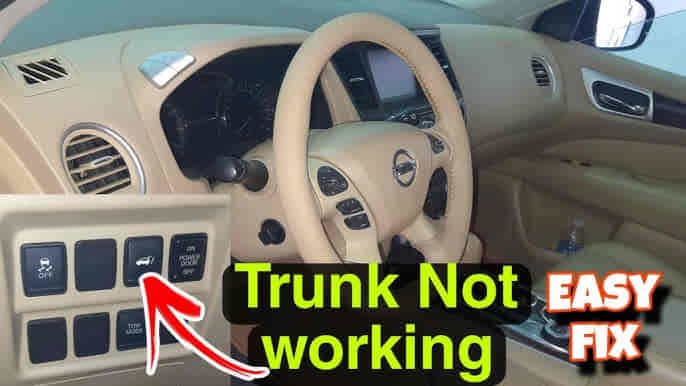
A Nissan Pathfinder trunk button can stop working without warning, leaving the liftgate stuck closed or preventing the power tailgate from opening normally. The problem may affect the exterior trunk release button, the dashboard liftgate switch, or the key fob release function. Although the symptoms often appear similar, the underlying causes can vary significantly depending on which component in the liftgate system has failed.
The Nissan Pathfinder liftgate system relies on several interconnected components, including the trunk release button, liftgate actuator, latch assembly, power liftgate motor, wiring harness, fuse, vehicle battery, and Body Control Module (BCM). When one of these components stops communicating properly, the liftgate may fail to open, operate intermittently, or stop responding altogether. In some cases, the issue is as simple as a weak key fob battery or a blown fuse. In other situations, the problem involves mechanical failures, damaged wiring, software calibration errors, or control module faults.
Diagnosing the exact cause is important because many liftgate problems produce nearly identical symptoms. Replacing parts without identifying the root cause often leads to unnecessary repair costs and wasted time. By understanding how the liftgate system operates and recognizing the warning signs associated with each failure point, Nissan Pathfinder owners can narrow down the source of the problem and apply the most effective repair strategy.
This guide explains the 10 most common reasons a Nissan Pathfinder trunk button is not working and how to fix each issue.
Why Is My Nissan Pathfinder Trunk Button Not Working?
A Nissan Pathfinder trunk button stops working when the liftgate release system can no longer complete the communication process required to unlock and open the rear hatch. The failure may originate from the trunk button itself, but it can also be caused by problems within the electrical, mechanical, or software-controlled components that support liftgate operation. Understanding how these components interact makes it easier to identify the true source of the problem.
When a driver presses the trunk button, the signal is sent to the vehicle’s Body Control Module (BCM), which acts as the central control unit for many electronic functions. The BCM verifies that the vehicle conditions allow the liftgate to open and then sends commands to the liftgate actuator, latch mechanism, and power liftgate motor. If any part of this communication chain fails, the trunk button may appear unresponsive even though the button itself is functioning correctly.
The most important distinction is whether the liftgate shows signs of life when the button is pressed. If nothing happens at all, the issue often involves power delivery, fuse failures, wiring damage, BCM communication faults, or a defective switch. If clicking sounds are heard but the liftgate remains closed, the problem is more likely related to the actuator, latch assembly, or liftgate motor. When the liftgate begins moving but stops midway, mechanical resistance, calibration errors, or motor performance issues become more probable causes.
Electrical faults account for a significant percentage of liftgate failures because the Nissan Pathfinder power liftgate system depends on multiple sensors, modules, and communication pathways. A weak vehicle battery can reduce available voltage below the level required for reliable liftgate operation. Corroded connectors can interrupt signal transmission between the BCM and liftgate components. Damaged wiring within the liftgate hinge area can create intermittent failures that appear randomly and become more frequent over time.
Mechanical failures can produce similar symptoms. The liftgate latch is exposed to moisture, dust, road debris, and temperature fluctuations throughout the vehicle’s lifespan. As components wear, the latch may stick or fail to release completely. In these situations, the trunk button may successfully send the command, but the liftgate remains closed because the locking mechanism cannot respond properly.
Software-related issues have become increasingly common in newer Pathfinder models equipped with advanced power liftgate systems. Battery replacement, module updates, interrupted software calibration procedures, and control module communication errors can all prevent the liftgate from responding correctly. These failures often occur suddenly, leading owners to believe a hardware component has failed when the actual problem involves system synchronization.
The symptom pattern often provides the strongest diagnostic clue. A completely unresponsive trunk button typically points toward electrical or communication failures. Intermittent operation often indicates wiring fatigue, battery weakness, or connector corrosion. Clicking noises without liftgate movement frequently suggest actuator or latch problems. A liftgate that opens partially before stopping usually indicates calibration issues, motor wear, or mechanical resistance within the liftgate assembly.
Because multiple components participate in every liftgate operation, accurate diagnosis requires evaluating the entire system rather than focusing only on the trunk button. The button is simply the starting point of a larger process involving electrical communication, mechanical release mechanisms, software logic, and power-assisted movement. Identifying which stage of this process has failed is the key to resolving the problem efficiently.
The Trunk Button Has Failed
A failed trunk button is one of the most direct reasons a Nissan Pathfinder liftgate will not open. The trunk release button functions as the first point of contact within the liftgate release system. When the button cannot transmit a signal to the Body Control Module (BCM), the remaining liftgate components never receive the command required to initiate opening.
Physical wear is the most common cause of trunk button failure. The exterior liftgate release button is exposed to thousands of operating cycles throughout the vehicle’s lifespan. Repeated pressing gradually wears internal contacts and switch membranes, reducing the button’s ability to create a complete electrical circuit. As wear progresses, the button may require excessive pressure to operate or stop responding altogether.
Moisture intrusion is another frequent source of failure. Because the button is mounted on the exterior of the vehicle, it is continuously exposed to rain, humidity, snow, road salt, and car washes. Over time, water can penetrate the switch housing and corrode electrical contacts. Corrosion increases electrical resistance and eventually prevents the signal from reaching the BCM. In colder climates, trapped moisture may freeze and temporarily disable button operation during winter months.
Internal electrical failure can also develop without visible signs of damage. Modern liftgate buttons contain small electronic components that can deteriorate due to age, temperature fluctuations, and electrical stress. When these components fail, the button may appear physically intact while remaining electrically inactive. In many cases, owners mistakenly suspect a liftgate motor or actuator problem when the actual fault exists within the switch itself.
The symptoms of a failed trunk button are often consistent. Pressing the button produces no sound, no movement, and no response from the liftgate. The key fob release function may continue working if the button alone has failed, creating an important diagnostic distinction. If the liftgate opens normally using the key fob but not the exterior button, the switch becomes the most likely point of failure.
A defective trunk button is generally easier and less expensive to repair than major liftgate components such as actuators, motors, or control modules. However, accurate diagnosis remains important because identical symptoms can also be produced by wiring damage, fuse failures, or BCM communication issues. Confirming signal output from the switch helps prevent unnecessary replacement of other liftgate components.
The Key Fob Battery Is Weak
A weak key fob battery can prevent the Nissan Pathfinder trunk release function from operating reliably. The Intelligent Key system depends on radio frequency communication between the key fob and the vehicle. When battery voltage decreases, signal strength weakens and the liftgate release command may fail to reach the vehicle consistently.
The key fob battery powers every wireless command transmitted to the Pathfinder, including door locking, unlocking, remote start functions, and liftgate release requests. As battery capacity declines, the trunk release feature often becomes unreliable before complete failure occurs. Drivers may notice that the liftgate responds intermittently, requires multiple button presses, or only works when standing very close to the vehicle.
Signal degradation typically develops gradually rather than suddenly. A healthy key fob transmits a strong radio frequency signal capable of reaching the vehicle from a considerable distance. As battery voltage drops, transmission range decreases and communication reliability deteriorates. This is why many owners initially believe the liftgate system is malfunctioning when the real issue is insufficient key fob power.
Environmental conditions can amplify the effects of a weak battery. Cold weather reduces battery efficiency and can accelerate voltage loss within aging key fob batteries. During winter months, a battery that functions adequately in warm conditions may struggle to generate a signal strong enough to activate the liftgate release system.
The relationship between the key fob and the Body Control Module is critical. When the liftgate button on the key fob is pressed, the BCM must receive, verify, and process the wireless signal before authorizing liftgate operation. If the transmitted signal is weak or incomplete, the BCM may reject the command entirely. As a result, the trunk button appears nonfunctional even though the liftgate hardware remains fully operational.
One of the clearest indicators of a weak key fob battery is inconsistent performance across multiple vehicle functions. Drivers often notice delayed door unlocking, reduced remote start range, or intermittent lock commands before liftgate problems become obvious. When several wireless functions begin behaving unpredictably at the same time, battery replacement should become a priority diagnostic step.
Because key fob batteries are inexpensive and simple to replace, they represent one of the fastest troubleshooting opportunities when a Nissan Pathfinder trunk button is not working. Restoring proper battery voltage immediately improves signal transmission quality and eliminates one of the most common causes of intermittent liftgate release failures.
A Blown Liftgate Fuse Is Preventing Operation
A blown liftgate fuse can completely disable the Nissan Pathfinder trunk release system by cutting electrical power to critical liftgate components. The fuse acts as a protective device that prevents excessive electrical current from damaging the liftgate circuit. When the fuse fails, communication between the trunk button, Body Control Module (BCM), actuator, and liftgate motor may stop immediately.
The liftgate system depends on a stable power supply to perform even the simplest functions. Every time the trunk button is pressed, electrical current must travel through multiple circuits before reaching the actuator and liftgate control components. If the fuse opens due to an overload or short circuit, this pathway is interrupted and the liftgate becomes unresponsive. In many cases, the trunk button appears defective even though the actual problem is the loss of electrical power.
Fuse failures rarely occur without a reason. A temporary voltage spike, wiring short, water intrusion, damaged electrical connectors, or a failing liftgate motor can create excessive current draw that exceeds the fuse’s designed capacity. The fuse sacrifices itself to protect more expensive components from damage. This protective function helps prevent costly repairs but can make troubleshooting more difficult because the liftgate simply stops working without providing obvious warning signs.
The symptoms of a blown fuse often resemble other electrical failures. Pressing the trunk button may produce no sound, no movement, and no response from the liftgate. The key fob release function may also stop working because the underlying power circuit is disabled. When multiple liftgate activation methods fail simultaneously, a fuse-related problem becomes significantly more likely.
Intermittent fuse failures can create confusing diagnostic situations. A fuse may develop internal damage that weakens its electrical connection without completely breaking the circuit. Under these conditions, the liftgate may function occasionally before becoming completely inoperative. Temperature changes, vibration, and electrical load fluctuations can worsen this behavior over time.
A fuse should never be viewed as an isolated component failure. If a replacement fuse blows again shortly after installation, the root cause likely exists elsewhere within the liftgate system. Wiring damage, actuator resistance, motor failure, or moisture-related electrical shorts frequently create recurring fuse failures. Identifying the source of the overload is therefore just as important as replacing the fuse itself.
Because fuse inspection requires minimal time and cost, it remains one of the most efficient diagnostic steps when a Nissan Pathfinder trunk button is not working. Verifying power delivery early in the troubleshooting process helps eliminate unnecessary parts replacement and narrows the focus toward the actual source of the malfunction.
The Liftgate Actuator Has Failed
A failed liftgate actuator can prevent the Nissan Pathfinder trunk from opening even when the trunk button, key fob, and electrical systems are functioning correctly. The actuator serves as the mechanical link between electronic commands and physical movement. When it receives a signal from the Body Control Module, it activates the release mechanism that unlocks the liftgate latch.
The actuator contains an electric motor and internal gear assembly designed to generate enough force to release the locking mechanism. Over time, these components experience wear from repeated operation. Thousands of opening and closing cycles gradually reduce performance, particularly in vehicles that rely heavily on the power liftgate system. As wear accumulates, the actuator may struggle to generate sufficient force to release the latch consistently.
Mechanical wear is one of the most common causes of actuator failure. Internal gears can wear down, electrical brushes can deteriorate, and moving components can develop excessive friction. When these issues occur, the actuator may respond more slowly than normal or fail entirely. Owners often notice that the liftgate becomes increasingly unreliable before complete failure develops.
Electrical faults inside the actuator can produce similar symptoms. Corroded internal contacts, weakened motor windings, and moisture-related damage may prevent the actuator from responding to commands. Unlike a failed trunk button, which typically produces no activity at all, actuator failures often generate audible clues. Clicking sounds, repeated attempts to unlock, or faint motor noises frequently indicate that the actuator is receiving commands but cannot complete the release process.
Environmental conditions accelerate actuator wear. The liftgate area is exposed to moisture, road salt, temperature extremes, and vibration throughout the vehicle’s lifespan. These factors contribute to corrosion, lubrication breakdown, and mechanical degradation. In regions with harsh winters, actuator failures often become more common because freezing temperatures increase resistance within the latch and release mechanism.
A failing actuator is frequently confused with a defective liftgate latch because both components influence the release process. The distinction lies in the source of the problem. The actuator creates movement, while the latch controls the locking mechanism. If the actuator cannot generate sufficient force, the latch never receives the mechanical action required to unlock. As a result, the liftgate remains closed even though the electrical system appears operational.
One of the strongest indicators of actuator failure is the presence of electrical activity without successful liftgate release. The vehicle may acknowledge the command, emit clicking noises, or activate liftgate sounds while the trunk remains locked. These symptoms suggest that communication between the trunk button and BCM is functioning correctly, shifting diagnostic attention toward the actuator itself.
Because the actuator occupies a central position within the liftgate release process, its failure effectively disconnects electronic commands from mechanical operation. Replacing a worn or damaged actuator often restores normal liftgate functionality and resolves trunk release issues that cannot be corrected through software resets or electrical troubleshooting.
The Liftgate Latch Is Stuck Or Damaged
A stuck or damaged liftgate latch can prevent the Nissan Pathfinder trunk from opening even when every electrical component in the system is functioning properly. The latch serves as the physical locking mechanism that secures the liftgate when closed. Regardless of how many commands the trunk button, key fob, or power liftgate system sends, the liftgate cannot open until the latch releases successfully.
Mechanical wear is the most common cause of latch-related failures. Every time the liftgate opens or closes, the latch assembly experiences friction, pressure, and movement. After thousands of operating cycles, internal components such as springs, locking hooks, and release levers begin to wear. As tolerances change, the latch may fail to disengage completely, causing the liftgate to remain locked even after receiving a valid release command.
Contamination can create similar symptoms. The liftgate latch is continuously exposed to dust, dirt, road debris, moisture, and environmental pollutants. Over time, these contaminants accumulate inside the latch assembly and restrict movement of internal components. The release mechanism may become sluggish, partially jammed, or completely seized. In many cases, owners notice that the liftgate requires multiple attempts to open before the latch finally disengages.
Corrosion is another major contributor to latch failure. Water intrusion combined with temperature fluctuations gradually promotes oxidation on metal components. Rust increases friction and reduces the ability of moving parts to operate smoothly. Vehicles driven in regions that experience heavy rain, snow, or road salt exposure are particularly vulnerable to corrosion-related latch problems.
A damaged latch often produces symptoms that closely resemble actuator failure. Clicking noises may be heard when the trunk button is pressed, indicating that the actuator is attempting to release the lock. However, the liftgate remains closed because the latch mechanism cannot physically disengage. This overlap in symptoms frequently leads to unnecessary actuator replacement when the true fault lies within the latch assembly.
Temperature can significantly influence latch behavior. During cold weather, moisture trapped within the latch mechanism may freeze and prevent normal operation. Owners often report liftgate failures that occur only during winter months and disappear once temperatures rise. This pattern typically indicates contamination, lubrication failure, or moisture accumulation rather than a major electrical problem.
The distinction between a latch failure and an electrical failure is important for accurate diagnosis. Electrical faults prevent release commands from reaching the liftgate. Latch failures occur after the command has already been delivered. Understanding where the process breaks down helps isolate the root cause and reduces unnecessary repairs.
Because the latch represents the final mechanical stage of the liftgate release sequence, even a minor defect can prevent the entire system from functioning. Inspecting the latch for wear, contamination, corrosion, and mechanical resistance should therefore be a priority whenever a Nissan Pathfinder trunk button is not working.
The Vehicle Battery Voltage Is Too Low
Low vehicle battery voltage can prevent a Nissan Pathfinder power liftgate from operating correctly even when every liftgate component remains mechanically sound. Modern power liftgate systems depend on stable electrical voltage to operate motors, actuators, sensors, control modules, and communication networks. When battery voltage drops below required operating thresholds, the liftgate system may disable itself or function unpredictably.
The power liftgate consumes significantly more electrical energy than a standard manual trunk release mechanism. Opening the liftgate requires the Body Control Module, liftgate motor, actuator, sensors, and safety systems to operate simultaneously. This coordinated process demands a consistent power supply. If battery voltage becomes unstable, the system may interpret the condition as a potential electrical risk and refuse to activate.
Battery degradation develops naturally over time. Most automotive batteries gradually lose capacity as they age, reducing their ability to maintain voltage under load. A battery that starts the engine successfully may still struggle to provide adequate power for high-demand accessories such as power liftgates. This explains why some Pathfinder owners experience liftgate problems even though no obvious battery warning signs are present.
Cold weather increases the likelihood of voltage-related liftgate failures. Battery efficiency decreases significantly as temperatures fall, reducing available electrical output. At the same time, mechanical resistance within the liftgate system increases due to colder lubricants and tighter component tolerances. This combination places additional stress on the electrical system and often exposes weaknesses that remain hidden during warmer months.
Voltage fluctuations can also interfere with communication between electronic modules. The Body Control Module relies on stable voltage to process commands and coordinate liftgate operation. When voltage drops unexpectedly, communication errors may occur between the BCM, actuator, liftgate motor, and safety sensors. These interruptions can produce symptoms ranging from intermittent operation to complete liftgate failure.
One common indicator of a battery-related problem is the appearance of multiple electrical symptoms throughout the vehicle. Slow engine cranking, dim interior lighting, inconsistent remote key operation, and infotainment system irregularities often accompany liftgate malfunctions when battery voltage is the root cause. The presence of several electrical issues simultaneously usually points toward a broader power supply problem rather than an isolated liftgate defect.
Low voltage conditions frequently create intermittent failures that are difficult to diagnose. The liftgate may operate normally one day and refuse to open the next. This inconsistency occurs because battery performance changes according to temperature, charging conditions, and overall electrical demand. Such behavior often leads owners to suspect software glitches or component failures when the underlying issue is insufficient electrical power.
Because modern Nissan Pathfinder liftgate systems rely heavily on electronic control and power-assisted operation, battery health should be evaluated early in the diagnostic process. Confirming adequate battery voltage helps eliminate one of the most common causes of seemingly random liftgate failures and provides a reliable foundation for further troubleshooting.
The Power Liftgate Needs To Be Reset
A power liftgate reset may be required when the Nissan Pathfinder liftgate system loses its calibration and can no longer determine the correct open and closed positions. Modern power liftgate systems rely on software-controlled movement rather than simple mechanical operation. When calibration data becomes corrupted or incomplete, the liftgate may stop responding to trunk button commands, reverse unexpectedly, or refuse to complete opening and closing cycles.
Calibration problems commonly occur after battery replacement. The liftgate control module stores position information that allows the system to manage movement, detect obstacles, and stop at predefined heights. When battery power is disconnected, some Pathfinder models may lose portions of this stored information. As a result, the system can become confused about the current liftgate position and disable normal operation as a safety precaution.
Software synchronization issues can create similar symptoms. The liftgate control module continuously communicates with the Body Control Module, position sensors, safety systems, and power liftgate motor. If these components become temporarily unsynchronized following a voltage interruption, software update, or electrical repair, the liftgate may fail to respond even though no hardware component is damaged.
The symptoms of a calibration problem differ from those associated with mechanical failures. A liftgate that begins moving and suddenly stops, reverses direction unexpectedly, or emits warning chimes without completing the operation often indicates a software-related issue rather than a broken actuator or latch. In many cases, owners report that the liftgate was functioning normally before battery replacement or electrical service and then stopped working immediately afterward.
Safety features play a major role in power liftgate behavior. Nissan engineers design the system to prevent accidental movement when position data cannot be verified. If the control module cannot accurately determine where the liftgate is located, it may intentionally disable operation to reduce the risk of injury or component damage. This protective behavior frequently causes owners to assume a major component has failed when the actual issue involves calibration data.
Intermittent operation is another common indicator of reset-related problems. The liftgate may work correctly for several cycles before becoming unresponsive again. This inconsistency occurs because the system is attempting to relearn position information while simultaneously detecting conflicting data from sensors and control modules.
A reset procedure restores communication and synchronization between the liftgate components. By rebuilding position references and re-establishing software alignment, the system can often return to normal operation without replacing any hardware. For this reason, recalibration should be considered whenever a Nissan Pathfinder trunk button stops working immediately after electrical maintenance or battery replacement.
Wiring Damage Is Interrupting Communication
Wiring damage can prevent the Nissan Pathfinder trunk button from working by interrupting communication between the switch, Body Control Module, liftgate actuator, and power liftgate motor. Every command issued through the trunk release system depends on electrical signals traveling through a network of wires and connectors. When these pathways become damaged, the signal may never reach its destination.
The liftgate wiring harness is particularly vulnerable because it moves every time the liftgate opens and closes. Unlike stationary wiring found elsewhere in the vehicle, liftgate wiring experiences continuous flexing and bending. Over thousands of operating cycles, individual wires can weaken, crack, or break internally. These failures often occur inside protective insulation, making them difficult to identify through visual inspection alone.
The hinge area is one of the most common locations for wiring damage. As the liftgate moves, wires repeatedly bend at the same points near the hinges. Over time, this constant stress creates fatigue within the conductors. Small fractures initially cause intermittent communication problems, but complete wire separation eventually results in total loss of function.
Corrosion can create equally disruptive failures. Moisture entering electrical connectors gradually oxidizes metal terminals and increases electrical resistance. As resistance rises, signal quality deteriorates and communication between liftgate components becomes unreliable. In severe cases, corrosion completely blocks electrical flow and prevents the system from operating.
Wiring-related failures often produce inconsistent symptoms. The liftgate may function perfectly one moment and become completely unresponsive the next. Changes in temperature, humidity, vehicle vibration, or liftgate position can temporarily alter the electrical connection and create unpredictable behavior. This inconsistency is one reason wiring faults are frequently misdiagnosed as software problems.
Partial wiring damage can be especially difficult to diagnose. A wire that remains partially connected may still transmit signals under certain conditions but fail under others. The result is a liftgate that opens intermittently, responds only after repeated button presses, or behaves differently depending on weather conditions and vehicle movement. These symptoms often persist for months before complete failure occurs.
Communication failures caused by damaged wiring affect more than the trunk button itself. Key fob release functions, liftgate sensors, position monitoring systems, and power liftgate controls may also become unreliable because they depend on the same communication network. When multiple liftgate-related functions begin exhibiting unusual behavior simultaneously, wiring damage becomes a strong diagnostic possibility.
Because wiring serves as the communication backbone of the entire liftgate system, even a single damaged conductor can disrupt operation. Identifying and repairing wiring faults restores signal integrity and often resolves liftgate problems that cannot be corrected through component replacement, software resets, or battery maintenance. For older Nissan Pathfinder models and vehicles with high mileage, wiring inspection should be considered a critical step in the troubleshooting process.
The Body Control Module Is Not Responding
A malfunctioning Body Control Module (BCM) can prevent the Nissan Pathfinder trunk button from working even when the switch, actuator, liftgate motor, and wiring remain fully operational. The BCM functions as the central communication hub for many electronic systems within the vehicle. Every liftgate release request passes through the BCM before reaching the components responsible for unlocking and opening the liftgate.
When the trunk button is pressed, the BCM receives the signal, validates operating conditions, and determines whether the liftgate should open. If the BCM fails to process the command correctly, the release sequence stops immediately. The actuator never receives an activation signal, the latch remains locked, and the liftgate appears completely unresponsive.
Software-related faults are among the most common BCM issues. Modern Nissan vehicles rely heavily on networked electronic modules that exchange data continuously. Voltage interruptions, battery failures, software updates, corrupted memory, and communication errors can disrupt BCM functionality. These disruptions may affect only one system initially, making the liftgate appear to be the sole component experiencing problems.
Communication failures between modules can produce confusing symptoms. The trunk button may work intermittently, the key fob release function may stop responding, or the liftgate may only operate under specific conditions. Because the BCM coordinates information from multiple vehicle systems, failures often appear inconsistent and difficult to reproduce.
Low battery voltage can contribute to BCM-related problems. Electronic control modules require stable operating voltage to process commands correctly. When voltage drops below acceptable thresholds, communication errors may occur between the BCM and liftgate components. This explains why some owners experience temporary liftgate failures that disappear after battery replacement or charging.
Internal BCM hardware failures are less common but can occur as vehicles age. Electrical surges, water intrusion, manufacturing defects, and long-term thermal stress can damage internal circuits. When this happens, the BCM may lose the ability to communicate with specific vehicle systems while continuing to operate others normally. The result is often a liftgate system that appears isolated from the rest of the vehicle’s electronics.
One of the strongest indicators of a BCM problem is the presence of multiple electronic abnormalities. Power door locks, keyless entry functions, interior lighting, warning messages, and liftgate controls may begin malfunctioning simultaneously because they share BCM oversight. When several seemingly unrelated electrical systems develop issues at the same time, the BCM becomes a primary diagnostic target.
Diagnosing BCM faults usually requires advanced scan tools capable of accessing manufacturer-specific control module data. Unlike simple component failures, BCM problems often involve stored fault codes, communication network errors, and software-level diagnostics. For this reason, BCM-related liftgate issues frequently require professional evaluation rather than basic DIY troubleshooting.
The Liftgate Motor Has Failed
A failed liftgate motor can prevent the Nissan Pathfinder power liftgate from opening even when the trunk button, actuator, latch, and control modules are functioning correctly. The liftgate motor provides the physical force required to raise and lower the liftgate automatically. Without sufficient motor output, the liftgate cannot complete its movement regardless of how many release commands are successfully processed.
The power liftgate motor operates under significant mechanical load throughout its service life. Every opening and closing cycle requires the motor to overcome the weight of the liftgate while maintaining controlled movement. Over time, internal components such as bearings, gears, brushes, and windings experience wear that gradually reduces performance.
Motor degradation rarely occurs instantly. Most failing liftgate motors exhibit warning signs long before complete failure develops. The liftgate may begin moving more slowly than normal, hesitate during operation, stop midway through the opening cycle, or require multiple attempts before responding. These symptoms often become progressively worse as internal wear increases.
Electrical failures within the motor can create similar problems. Worn brushes, damaged windings, overheating, and internal resistance increases can reduce motor efficiency. Although the motor may still receive commands from the BCM, it lacks the power necessary to generate adequate movement. In these situations, owners often hear mechanical sounds while observing little or no liftgate movement.
Mechanical resistance can accelerate motor wear. Liftgates that experience excessive friction due to misalignment, damaged hinges, worn struts, or latch problems place additional strain on the motor. The increased workload raises operating temperatures and shortens component lifespan. Over time, the motor reaches a point where it can no longer overcome the resistance within the system.
Environmental conditions also influence motor reliability. Exposure to moisture, temperature extremes, and vibration gradually affects internal components. Corrosion can develop within electrical connections, lubrication can deteriorate, and thermal cycling can weaken sensitive motor assemblies. Vehicles operating in harsh climates often experience accelerated motor wear compared to those driven under moderate conditions.
The distinction between actuator failure and motor failure is important because the two components perform different functions. The actuator releases the locking mechanism, while the motor physically moves the liftgate. A failed actuator prevents the liftgate from unlocking. A failed motor allows the liftgate to unlock but prevents it from opening automatically. Understanding this difference helps narrow the diagnostic process and reduces unnecessary parts replacement.
One common symptom of motor failure is partial operation. The liftgate may unlock successfully, initiate movement, and then stop unexpectedly. In some cases, manual assistance allows the liftgate to continue moving, indicating that the motor lacks sufficient power to complete the cycle independently. This behavior strongly suggests motor wear rather than communication or software issues.
Because the liftgate motor represents the final power-producing component in the system, its failure directly affects automatic liftgate operation. Replacing a worn or damaged motor restores lifting force and resolves many power liftgate issues that cannot be corrected through electrical repairs, software resets, or component recalibration.
Why Does The Nissan Pathfinder Liftgate Work Sometimes But Not Always?
An intermittently functioning liftgate usually indicates a developing problem rather than a complete component failure. When a Nissan Pathfinder liftgate works occasionally but fails at other times, the root cause is often related to unstable electrical connections, voltage fluctuations, wiring fatigue, sensor inconsistencies, or software communication errors. Unlike a permanently failed component, intermittent faults create inconsistent symptoms that make diagnosis more challenging.
Wiring fatigue is one of the most common causes of intermittent liftgate operation. The wiring harness passing through the liftgate hinge area bends every time the liftgate opens and closes. Over thousands of cycles, internal conductors begin to crack while remaining partially connected. Under certain conditions, electrical signals continue flowing normally. Under other conditions, slight movement, vibration, or temperature changes interrupt communication entirely. This explains why the liftgate may work perfectly one day and fail unexpectedly the next.
Battery condition can also create inconsistent behavior. Power liftgate systems require stable voltage to operate correctly. When battery voltage fluctuates due to age, temperature changes, or charging system irregularities, the liftgate control module may temporarily disable operation. Owners frequently notice that liftgate performance deteriorates during cold weather because battery output decreases while electrical demand increases.
Electrical connectors represent another common failure point. Moisture, corrosion, and oxidation gradually increase resistance within connector terminals. As resistance changes, communication quality between the Body Control Module, liftgate actuator, sensors, and motor becomes unpredictable. Small variations in temperature or humidity can temporarily improve or worsen the connection, creating seemingly random liftgate behavior.
Software synchronization issues can produce similar symptoms. The power liftgate system relies on continuous communication between multiple electronic modules. If position sensors provide inconsistent data or control modules temporarily lose synchronization, the system may permit operation during some cycles and reject commands during others. These failures often appear after battery replacement, software updates, or electrical repairs.
The most important diagnostic clue is identifying when the problem occurs. A liftgate that fails primarily during cold weather suggests battery, lubrication, or moisture-related issues. A liftgate that fails after driving over rough roads points toward wiring or connector problems. A liftgate that behaves unpredictably following battery replacement often indicates calibration or software synchronization issues. Understanding the operating conditions surrounding the failure provides valuable insight into the underlying cause.
Why Won’t The Nissan Pathfinder Trunk Open With The Key Fob?
A Nissan Pathfinder trunk may fail to open with the key fob when communication between the Intelligent Key system and the vehicle is interrupted. The key fob does not directly open the liftgate. Instead, it transmits a radio frequency signal to the Body Control Module, which then authorizes and initiates the liftgate release sequence. Any disruption within this process can prevent the trunk from responding.
A weak key fob battery remains the most common cause of key fob-related liftgate failures. As battery voltage declines, signal transmission strength decreases. The vehicle may receive lock and unlock commands intermittently while struggling to recognize liftgate release requests consistently. This often creates the impression that the liftgate system has failed when the actual problem originates from the key fob itself.
Radio frequency interference can also disrupt communication. Parking garages, commercial facilities, wireless communication equipment, and densely populated urban areas generate electromagnetic signals that occasionally interfere with key fob transmissions. Under these conditions, the liftgate may fail to respond even though the key fob is functioning normally.
Body Control Module communication problems can create similar symptoms. The BCM must receive, validate, and process every key fob command before activating the liftgate. If software glitches, low voltage conditions, or communication errors affect BCM operation, liftgate commands may be ignored while other vehicle functions continue operating normally.
Liftgate safety systems can also prevent operation. Nissan integrates multiple safety mechanisms designed to avoid accidental liftgate movement. If the vehicle detects an incomplete latch condition, sensor fault, calibration issue, or obstacle detection error, the BCM may intentionally reject key fob release requests. This protective behavior prevents potential damage or injury but can make the liftgate appear defective.
The distinction between a key fob problem and a liftgate problem is critical. If the liftgate opens using the exterior release button but not the key fob, the diagnostic focus should shift toward the Intelligent Key system, battery condition, radio frequency communication, and BCM processing. If neither activation method works, the underlying problem is more likely located within the liftgate system itself.
Why Did The Liftgate Stop Working After Replacing The Battery?
A Nissan Pathfinder liftgate may stop working after battery replacement because the power liftgate system loses calibration, stored memory settings, or communication synchronization during the power interruption. Modern liftgate systems depend on electronic control modules that store operating parameters used to manage movement, safety functions, and position tracking. Disconnecting battery power can temporarily disrupt these settings.
The most common post-battery replacement issue involves liftgate position calibration. The power liftgate control module continuously monitors open and closed positions to ensure safe operation. When battery power is removed, the module may lose portions of this reference data. Without accurate position information, the system may disable liftgate operation until calibration is restored.
Communication synchronization issues frequently occur as well. The Body Control Module, liftgate control module, position sensors, and power liftgate motor must exchange data continuously. Following battery replacement, these components may require time to re-establish communication and validate operating parameters. During this process, the liftgate may appear completely unresponsive despite having no mechanical defects.
Voltage irregularities during battery replacement can contribute to software instability. If battery terminals are connected improperly, voltage drops occur during installation, or the vehicle experiences interrupted power restoration, temporary software conflicts may develop. These conflicts often affect advanced convenience features such as power liftgate operation before impacting more basic vehicle functions.
Owners frequently assume a component failed coincidentally when the actual issue is software-related. This misunderstanding leads to unnecessary replacement of actuators, motors, switches, and other liftgate components. In reality, many post-battery replacement liftgate problems are resolved through recalibration procedures that restore system synchronization without replacing any hardware.
The timing of the failure provides a significant diagnostic advantage. When a liftgate functions normally before battery replacement and stops working immediately afterward, the probability of a calibration or communication issue increases substantially. The close relationship between the battery service event and the symptom onset helps narrow the list of potential causes and accelerates troubleshooting.
Because modern Nissan Pathfinder liftgate systems rely heavily on electronic control logic, battery replacement should always be considered a potential trigger for temporary liftgate malfunctions. Verifying calibration status and module synchronization often resolves these issues more efficiently than replacing components that may still be operating correctly.
How Can I Reset A Nissan Pathfinder Power Liftgate?
A power liftgate reset restores communication between the liftgate control module, Body Control Module, sensors, and power liftgate motor after a calibration or synchronization failure. Resetting the system is often effective when the liftgate stops working immediately after battery replacement, electrical repairs, software updates, or unexpected power loss.
The reset process works by forcing the liftgate system to relearn its operating positions and rebuild communication pathways between electronic components. During normal operation, the liftgate continuously tracks opening height, closing position, motor resistance, and obstacle detection parameters. When this information becomes corrupted or incomplete, the system may disable automatic operation to prevent damage or unsafe movement.
A calibration-related failure typically produces recognizable symptoms. The liftgate may stop halfway through an opening cycle, reverse direction unexpectedly, emit warning chimes without moving, or refuse to respond despite receiving commands from the trunk button or key fob. These behaviors indicate that the control module is uncertain about liftgate position rather than suffering from a major mechanical failure.
Resetting the liftgate can restore normal functionality when no physical component is damaged. The procedure re-establishes reference points used by the control module to determine where the liftgate should start, stop, and reverse. Once these references are restored, communication between the motor, sensors, and control modules becomes more reliable.
It is important to recognize that a reset cannot repair mechanical failures. A damaged actuator, failed liftgate motor, broken wiring harness, or defective latch will continue causing problems regardless of how many times the system is recalibrated. For this reason, reset procedures should be viewed as a diagnostic step rather than a universal solution.
When a Nissan Pathfinder liftgate stops working immediately after battery replacement or electrical service, recalibration should be performed before replacing hardware components. In many cases, restoring system synchronization resolves the problem completely and avoids unnecessary repair costs.
How Much Does It Cost To Fix A Nissan Pathfinder Trunk Button?
The cost of repairing a Nissan Pathfinder trunk button depends on the component responsible for the failure rather than the button itself. Many liftgate problems originate from related systems such as the actuator, latch assembly, liftgate motor, wiring harness, or Body Control Module. Accurate diagnosis is therefore the most important factor influencing repair expenses.
Trunk button replacement is generally among the least expensive repairs because the component is relatively simple and requires minimal labor. When the failure is limited to the switch itself, repair costs remain comparatively low and the problem can often be resolved without extensive disassembly.
Fuse-related repairs are typically inexpensive as well. However, recurring fuse failures often indicate a deeper electrical problem. In these situations, diagnostic costs become more significant than the replacement fuse because technicians must identify the source of the overload condition.
Liftgate actuator repairs occupy the middle range of repair expenses. The actuator performs a critical role within the release system and often requires access to internal liftgate components. Labor costs increase because trim panels and protective covers frequently need to be removed during the repair process.
Liftgate motor replacement is generally more expensive because the motor is one of the largest and most complex components within the power liftgate assembly. Additional costs may arise if worn hinges, damaged struts, or mechanical resistance contributed to the motor failure.
Wiring repairs vary significantly depending on the location and severity of the damage. A simple connector repair may require minimal labor, while damaged wiring within the liftgate hinge area can involve extensive diagnostic work and harness replacement. Intermittent electrical faults are often the most time-consuming problems to identify accurately.
Body Control Module diagnostics and programming typically represent the highest level of repair complexity. Control module issues often require manufacturer-specific scan tools, software updates, communication testing, and advanced electrical diagnostics. Although BCM failures are less common than switch, actuator, or motor failures, they usually involve higher labor costs and specialized equipment.
For this reason, replacing parts without diagnosis often increases total repair expenses. Identifying the root cause first allows vehicle owners to target the actual failure rather than replacing multiple components unnecessarily.
When Should A Nissan Dealer Diagnose A Liftgate Problem?
A Nissan dealer should diagnose a liftgate problem when basic troubleshooting no longer identifies the root cause or when symptoms suggest advanced electrical or software-related failures. While many liftgate issues can be traced to batteries, fuses, switches, actuators, or latches, certain failures require specialized diagnostic equipment that is not available through standard consumer tools.
Persistent liftgate failures following component replacement often indicate deeper communication issues within the vehicle’s electronic network. If the trunk button, key fob, battery, fuse, actuator, and wiring all appear functional yet the liftgate remains inoperative, dealer-level diagnostics become increasingly valuable.
Body Control Module problems are one of the strongest reasons to seek professional evaluation. Because the BCM coordinates communication between multiple vehicle systems, diagnosing module failures requires access to manufacturer-specific software and fault-code analysis. Many BCM-related issues cannot be confirmed through visual inspection alone.
Software synchronization problems also benefit from dealer diagnostics. Power liftgate systems rely on calibration data, module programming, and communication protocols that may require factory-level reset procedures. A dealership can verify software versions, perform module updates, and restore configuration settings that are inaccessible through standard troubleshooting methods.
Intermittent electrical faults represent another situation where professional diagnosis becomes worthwhile. Wiring damage, connector corrosion, and communication interruptions often produce symptoms that appear randomly. These issues may require advanced testing procedures to identify voltage drops, signal loss, and network communication failures.
Dealer intervention becomes particularly important when multiple electronic systems begin malfunctioning simultaneously. Problems affecting the liftgate, keyless entry system, interior electronics, warning messages, and body control functions often indicate a shared communication or control module issue rather than an isolated liftgate defect.
Escalating diagnosis at the appropriate time prevents unnecessary repairs and reduces overall troubleshooting costs. When repeated component replacements fail to resolve the problem, professional diagnostic analysis often identifies the underlying issue more efficiently than continued trial-and-error repairs.
Read more: Nissan Sentra Bluetooth Not Working
Which Nissan Pathfinder Liftgate Problems Can Be Fixed At Home And Which Require Professional Repair?
Most Nissan Pathfinder liftgate problems fall into two categories: owner-serviceable issues and advanced diagnostic issues. Understanding the difference helps prevent unnecessary repair expenses while ensuring that complex faults receive appropriate attention.
Owner-serviceable problems generally involve components that can be inspected, tested, or replaced without specialized equipment. Weak key fob batteries, blown fuses, dirty latch mechanisms, low vehicle battery voltage, calibration issues, and certain trunk button failures often belong to this category. These problems typically have predictable symptoms and can be addressed through systematic troubleshooting.
Professional repairs become more appropriate when the failure involves network communication, software programming, control modules, extensive wiring damage, or major power liftgate components. Body Control Module faults, advanced electrical diagnostics, liftgate motor replacement, and communication network errors frequently require specialized tools and manufacturer-specific procedures.
The most effective troubleshooting strategy begins with the simplest and most common causes before progressing toward complex diagnostics. A weak battery, damaged switch, blown fuse, or calibration issue is significantly more likely than a failed control module. Eliminating these common failures first reduces repair costs and improves diagnostic accuracy.
The Nissan Pathfinder liftgate system operates through a network of interconnected entities that include the trunk release button, Intelligent Key system, Body Control Module, wiring harness, actuator, latch assembly, liftgate motor, sensors, and vehicle battery. Every successful liftgate operation depends on communication between these components. When one component fails, the symptoms often resemble failures elsewhere in the system.
Accurate diagnosis therefore depends on understanding where the release sequence breaks down. Identifying the failed stage within the communication chain allows repairs to target the true cause rather than the visible symptom. This approach leads to faster repairs, lower costs, and more reliable long-term liftgate performance.